

Feeling secure in a relationship doesn’t mean never doubting or disagreeing. It develops through trust, consistent communication and respect, and the freedom to express your needs without fearing rejection or ridicule. Learning how to feel secure in a relationship also involves recognising whether your fear comes from personal insecurity or from a relationship that doesn’t feel emotionally safe.
If you brace for conflict, hold back your feelings or need constant reassurance, your experience deserves attention, not judgement. This article explores how trust, communication, conflict, personal insecurity and attachment triggers shape your sense of security. You’ll learn what emotional intimacy looks like in practice, how partners can repair tension and how to distinguish an inner fear from a pattern between you. The aim isn’t to silence your feelings or make yourself smaller. It’s to understand what they’re signalling and build connection through honesty, steadiness and self-respect.
Key Takeaways
- Notice whether your fear centres on sharing your feelings or on the relationship’s ability to withstand disagreement.
- Make conflict safer by listening for emotional cues, speaking with respect and pausing when tension rises.
- Build trust through consistent actions, honest conversations and time together that still leaves room for individuality.
- Recognise how attachment triggers shape your reactions, then practise responding rather than reacting automatically.
- Look for mutual respect, shared decision-making and support for each other’s growth as signs of a secure bond.
1. Conflict and emotional intimacy in secure relationships
Emotional security means being able to express your needs, limits and truth without expecting ridicule or rejection. For example, you can say, “I need time alone tonight,” and talk together about what that means. Disagreements still happen, but a difference of opinion doesn’t automatically feel like the relationship is about to collapse. Consistency, responsiveness and respect make space for honesty, repair and emotional intimacy.
Emotional abuse or an unsafe relationship may involve repeated humiliation, intimidation, threats, isolation or attempts to control your choices. If you recognise these patterns, speak with someone you trust, a GP or a UK domestic abuse support service. If you’re in immediate danger, seek emergency help.
Self-trust gives you steadier ground when emotions surge. Start by naming what happened, what you felt and what you need now. After a cancelled plan, for example, distinguish disappointment from the conclusion that you’re unwanted. Acknowledge your experience without dismissing it, then choose a response that respects your limits, such as asking to rearrange the plan or taking space to settle.
Understanding your partner’s inner world takes attention, not mind-reading. Notice their facial expressions, tone and body cues, then check your interpretation: “You’ve gone quiet; do you need time, or would listening help?” Their answer gives you better information than a guess. Learning what helps each of you during stress can also reveal how you reconnect, recover and share positive experiences.
Validation means recognising that a feeling is real, even when you see events differently. Reflect the experience before defending your position: “I can hear that my late message left you worried.” This doesn’t mean accepting blame for everything or agreeing with every conclusion. It shows you understand the impact. That small shift can reduce defensiveness and make a practical conversation possible.
Conflict is more constructive when both people maintain respect while addressing the issue. Avoid insults, blame and belittling, whether you’re alone or with others. If anger or hurt keeps rising, pause and agree when to return to the discussion. Then name the problem, explain its impact and suggest a solution that doesn’t make either person feel defeated. A repair might sound like, “I interrupted you. Let’s start again, and I’ll listen first.”
Feeling secure doesn’t require hiding difficult emotions or earning love through people-pleasing. It grows through repeated moments of self-validation, responsiveness and repair. If you’re working out how to feel secure in a relationship, notice what happens after you speak honestly: does your partner try to understand, and can you both agree on a respectful next step?
2. Building trust and security through communication
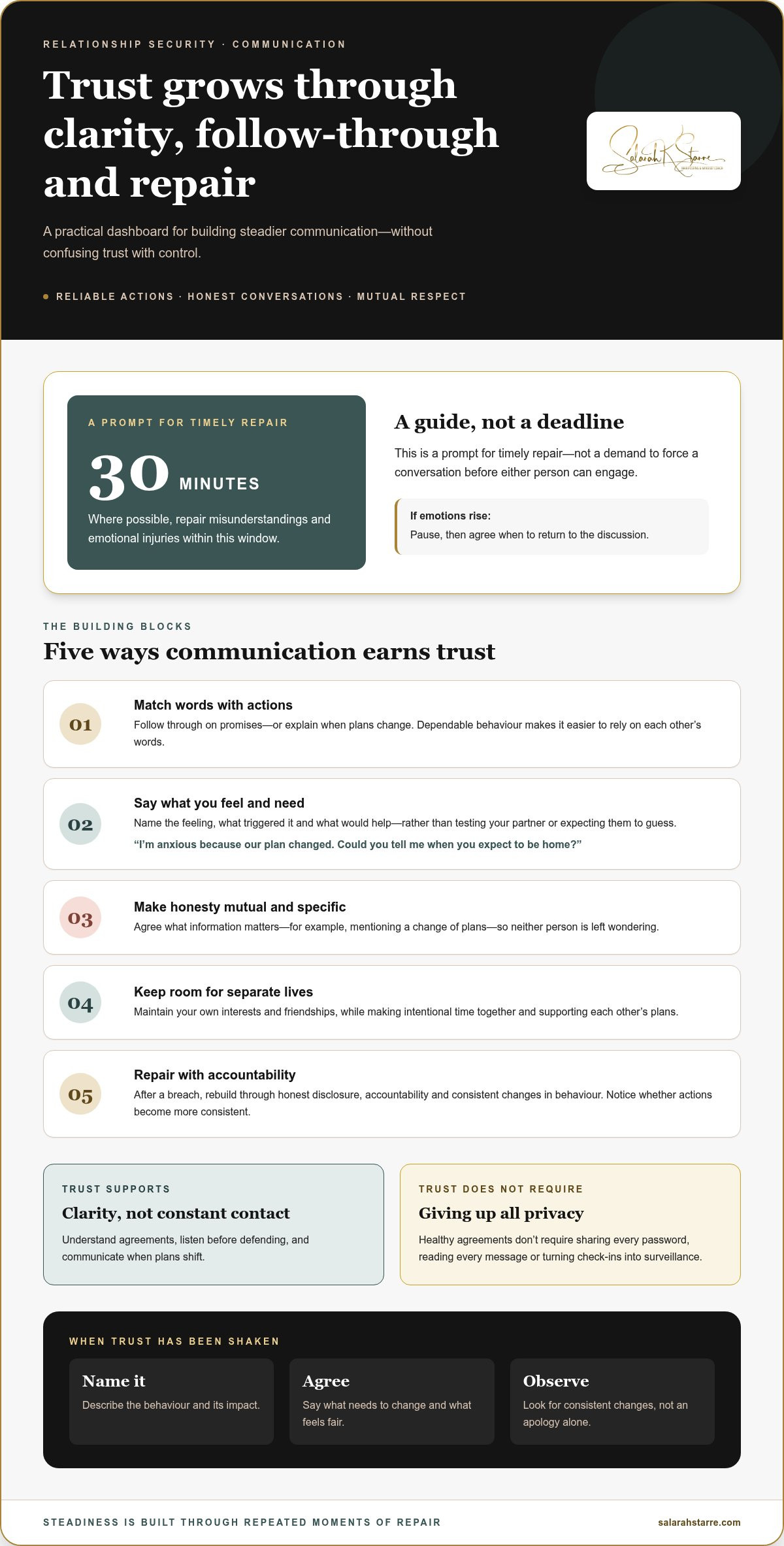
Trust grows through repeated actions that match your words. If you promise to call after work, follow through or explain when plans change. If your partner raises a concern, listen before defending yourself. Over time, these moments build a pattern in which each person can speak, respond and rely on the other’s words. Clear communication doesn’t mean constant contact. It means your agreements are understood and your behaviour is dependable.
Start with your own experience rather than asking your partner to settle every fear. Name what you feel, what triggered it and what would help. For example: “I’m anxious because our plan changed. Could you tell me when you expect to be home?” This is more direct than testing your partner or expecting them to guess. Validate your feelings, then consider whether the facts support the story your anxiety is telling.
Transparency supports trust, but it doesn’t mean giving up all privacy. A healthy agreement doesn’t require sharing every password, reading every message or voicing every thought. Both partners should be willing to share relevant information when asked. Discuss what honesty means to you. For example, agree to mention a change in plans rather than leave the other person wondering. Keep the agreement mutual, specific and respectful.
Trust also shows in how you handle time apart. You don’t need to spend every waking moment together to have a healthy relationship. Keep your own interests and friendships while making natural, intentional time for the relationship. Talk about personal dreams and plans, then decide how to support each other. If one person is out for the evening, agree on any practical update that would help, without turning check-ins into surveillance.
If your partner is inconsistent or breaks your trust, describe the behaviour and its impact, then say what needs to change. For example, ask for an honest update when plans shift and notice whether their actions become more consistent. Don’t dismiss a repeated pattern just because it was followed by an apology.
After betrayal, couples can rebuild trust through honest disclosure, accountability and consistent changes in behaviour. Agree together on what feels fair and sensitive, then make space to discuss the hurt without pressure to forgive quickly. Repair misunderstandings and emotional injuries within 30 minutes where possible, as recommended in the article’s relationship guidance. This is a prompt for timely repair, not a demand to force a conversation before either person can engage.
For a difficult conversation, agree on one topic. Let each person speak without interruption, then summarise what you heard. Clear up misunderstandings before deciding on a next step. If emotions rise, pause and agree when to return. Trust grows through clarity, follow-through and repair, not control.
3. Distinguishing personal insecurity from relationship insecurity
Separate the fear within you from the pattern between you. Personal insecurity can sound like, “If I share this, my partner will leave.” Relationship insecurity can sound like, “If we disagree, our relationship may fall apart.” The first fear is about expressing yourself; the second is about whether your bond can withstand tension. Both can feel intense, but they raise different questions.
Track a difficult moment in a note on your phone. Record what happened, what you felt, what you feared and what your partner actually did. For example, your partner may need quiet after work, while you interpret their silence as rejection. That fear may connect to your own insecurity. But if they repeatedly punish you for raising concerns, the relationship pattern also needs attention.
Look for evidence across different situations, not just one disagreement. Ask whether you can say, “I see this differently,” without being mocked, threatened or shut out. Consider whether your partner listens, explains their view and returns to the issue after cooling down. A respectful difference of opinion isn’t proof of danger. Repeated retaliation or refusal to discuss concerns may indicate that emotional safety is missing.
Personal insecurity can lead you to hide your needs, seek repeated reassurance or agree to things you don’t want. Notice when you start editing yourself. Pause and ask, “What would I say if I weren’t trying to prevent rejection?” Then express one clear preference, such as choosing where to spend the evening. Your partner’s response gives you useful information, but your worth doesn’t depend on their agreement.
Relationship insecurity requires looking at behaviour you share. Does one person control decisions, dismiss feelings or make connection conditional on compliance? Compare that with a partner who disagrees respectfully and works towards repair. Don’t use self-reflection to excuse harmful treatment. Your reactions are worth examining, but both people remain responsible for how they behave.
When personal fears and relationship tension occur together, address them separately. You might say, “I feel anxious when plans change, and I’d like to understand what happened.” Then make a practical request, such as agreeing how to communicate changes. If your partner responds openly, take note. If they repeatedly dismiss or distort your concerns, take the pattern seriously and seek support from someone you trust.
Moving towards a more secure relationship is possible, but it takes work, including examining your own insecure reactions. Start with one observable behaviour, one honest conversation and one boundary you can maintain. If you’re learning how to feel secure in a relationship, don’t make yourself solely responsible for creating safety. Your feelings deserve attention, and the relationship’s repeated actions deserve a clear-eyed assessment.
4. Understanding individual attachment triggers
An attachment trigger is a moment that activates fear, urgency or withdrawal. A delayed reply, changed plans or a difficult conversation can set it off. The reaction may feel immediate, but it isn’t the whole story. Notice the trigger, the sensation in your body and the action you feel driven to take. That pause makes room to choose a response instead of following your first impulse.
People leaning towards Blue may avoid or downplay emotions. They might go quiet, change the subject or leave a conversation when closeness feels intense. People leaning towards Red may experience hurt or fear of abandonment as a surge of emotion, then seek immediate reassurance or contact. These describe responses that can shift, not fixed diagnoses. The same person may react differently in different situations.
People high in attachment-related anxiety may worry about whether a partner is available, responsive and attentive, according to the University of Illinois Urbana-Champaign. For example, a message left unanswered might trigger repeated checking or thoughts of rejection. Separate the event from its meaning: the event is “there’s no reply yet”; “they’re leaving me” is an interpretation. Consider other evidence before acting on that fear.
To manage relationship anxiety and fear of abandonment, name the trigger and notice your physical sensations. Slow your breathing before sending another message. A minute of intentional breathing can interrupt a cascade of physiological defences. If you feel pulled towards an urgent action, use long, slow exhales; if you’re shutting down, focus on inhaling. Then make one clear request, such as asking when you can talk.
The SIFT tool offers a practical way to return to the present: notice physical sensations, images, feelings and thoughts. You might notice tight shoulders, picture your partner walking away, feel panic and think, “I’ve been abandoned.” Naming each part helps you distinguish what’s happening in your body from what you fear might happen next. Attachment styles can shift; they aren’t permanent labels.
When your partner seems overwhelmed, ask what would help rather than guessing. Someone in Red activation may need reassurance such as, “I’m here” or “I’m glad you’re telling me this.” Someone leaning towards Blue may need space to regroup. Agree on a pause and a time to return, so space doesn’t become unexplained silence. You can both practise new responses over time.
Consider individual therapy if attachment fears repeatedly disrupt your wellbeing or make everyday communication difficult. Couples counselling may help when both partners want support to change a recurring pattern, such as pursuing and withdrawing during conflict. If you feel unsafe or controlled, prioritise individual support rather than treating the issue as a shared communication problem.
5. What are signs of a healthy, secure relationship?
Secure functioning means both partners protect the health and security of their relationship. It doesn’t mean agreeing on every choice or spending every moment together. Notice what happens when your preferences differ: can each person speak honestly, stay connected and make room for individuality? For example, one partner may enjoy a quiet evening while the other meets friends. Both choices can fit within a committed relationship.
Respect shows in everyday decisions. Each partner’s views count, regardless of differences in income, age or gender. You might decide together how to handle a major move, then agree that one person chooses what to buy for the weekly food shop. Fair decision-making doesn’t require joint approval for every small detail. It means discussing who decides what and ensuring neither person is routinely overruled or excluded.
Partners in a secure relationship don’t need each other constantly or expect all of each other’s time. They can enjoy separate interests without treating independence as rejection. One person might attend a class while the other spends time with friends, then share what they enjoyed later. The key is connection without possession: personal space remains possible, and time together remains intentional.
Mutual encouragement is another marker of security. A secure partner can support your ambitions without treating your growth as a threat. If you’re considering a new course, for example, they can ask what matters to you and help you think through the change. You can offer the same support in return. The relationship becomes a base for growth, not a demand to shrink your plans.
Notice how you treat each other in company. Protecting the relationship means avoiding public embarrassment, mockery or joining others in shaming your partner. If a friend makes a cutting remark, you could redirect the conversation and discuss its impact privately later. Loyalty doesn’t mean pretending your partner is always right. It does mean handling disagreement without humiliation.
Check whether both of you take responsibility for the relationship. Each partner should take part in decisions, address recurring problems and make efforts to reconnect after tension. If one person always initiates plans, apologises or adapts, that imbalance deserves an honest conversation. A secure bond makes space for both people’s needs, rather than treating one person’s comfort as the permanent priority.
To assess how to feel secure in a relationship, review real interactions, not just promises. Think of a recent decision, a plan you made separately and a moment of disagreement. Did respect, choice and mutual support show up in each? These examples reveal patterns more clearly than a label. Look for repeated behaviour, then name what you value and what needs to change.
Salarah K Starre: The Magnetic Recalibration
The Magnetic Recalibration is a next step if you’re ready to explore the inner patterns shaping how you relate, respond and seek connection. After examining trust, attachment triggers and relationship dynamics, you can use this space to focus on your own growth and the changes you want to make. It may suit you if reflection alone hasn’t helped you shift a recurring response, or if you want to strengthen self-understanding alongside the practical steps in this article. For a more individual focus, Salarah K Starre also offers One to one Coaching. Choose the support that fits the work you want to do, at your own pace. Explore The Magnetic Recalibration.
Choose the next step that feels true to you
Security isn’t a performance you perfect. It’s a practice of staying connected to yourself while choosing relationships that make room for honesty, individuality and growth. If you’re still asking how to feel secure in a relationship, let your next step begin with curiosity, not self-criticism. What response would you like to practise the next time fear or uncertainty appears?
If you’d like support with personal growth, Salarah K Starre offers The Magnetic Recalibration, Speaking Engagements and Manifestation Workshops. Choose the format that best fits how you want to reflect, learn and move forward. You don’t need every answer before taking a meaningful step.
Contact Salarah K Starre to explore what could support your next step. Keep choosing clarity, self-respect and connection. You can build a steadier relationship with yourself, one honest choice at a time.
Frequently Asked Questions
What does feeling secure in a relationship mean?
It means being close to your partner without losing your sense of self. You can share a hope, preference or concern and still feel entitled to your own perspective. For example, you can want different weekend plans without treating that difference as proof the relationship is failing. Security isn’t constant certainty; it’s being able to face uncertainty without abandoning your needs.
How can I build trust and emotional security with my partner?
Build trust through small agreements that you can both keep. You might agree to tell each other when an important plan changes, or set aside time to discuss a decision that affects you both. Afterwards, notice whether each of you followed through. If an agreement doesn’t work, revise it together rather than quietly keeping score. Expectations that are clear and mutual make trust more grounded.
How can couples communicate needs and boundaries effectively?
Make a boundary specific, explain what you’ll do and keep your tone respectful. For example: “I want to talk about this, but I’m going to pause if we start shouting. I’ll come back when we’re both ready to speak calmly.” A request invites your partner’s cooperation; a boundary clarifies your own limit. Discuss practical details together, such as how you’ll signal a pause and resume the conversation.
How can I feel secure without relying on constant reassurance?
Offer yourself a clear response before seeking another from your partner. Write down what you know, what you’re assuming and one action that would support you now, such as finishing a task or contacting a friend. You can still ask directly for reassurance; the aim is to widen your sources of steadiness. If the same fear keeps returning, explore which situations intensify it and what support helps.


