

People-pleasing can look like kindness, but consistently putting others’ approval ahead of your own needs can leave you exhausted, anxious and disconnected from yourself. It may develop as a way to avoid conflict or disapproval, but it isn’t a personal failing. Healing people pleasing tendencies starts with noticing the pattern and choosing a more compassionate response.
If saying no brings guilt, or you agree to things you don’t want because someone might be disappointed, the pressure can feel real. You don’t have to harden yourself or stop caring about others. You can care for people without abandoning yourself.
This article explains what people-pleasing is, what may drive it and how it can affect your wellbeing and relationships. You’ll find practical ways to build self-compassion, recognise your needs, practise boundaries and seek support as you make manageable changes.
Key Takeaways
- People-pleasing may be a learned response to fear or uncertainty, not simply a personality trait.
- Notice what you give up when you say yes, then pause to consider whether a request fits your needs and values.
- Practise clear, respectful boundaries with family, friends and your wider community, starting with manageable situations.
- Meet guilt and discomfort with self-compassion instead of self-criticism; small changes can help build confidence over time.
- Support from trusted people can help you recognise patterns and practise new ways of relating.
1. Is being a people pleaser a trauma response?
Sometimes. The fawn response describes appeasing others, suppressing your needs and avoiding conflict to feel safer. Like fight, flight and freeze, it can be a response to perceived danger. For example, someone might agree with a family member’s criticism because disagreement feels risky. But people-pleasing doesn’t automatically mean trauma; learned habits, anxiety and a desire for approval can also shape behaviour.
An unsafe or unpredictable environment, including during childhood, can teach someone to monitor other people’s reactions. Saying yes may then feel like protection, even when the request is difficult or unwanted. A 2023 study suggests fawning occurs frequently among people who have experienced childhood sexual abuse. That finding can offer context, not a diagnosis of any individual. Chronic people-pleasing isn’t a specific disorder, though it can be linked to complex PTSD or dependent personality disorder.
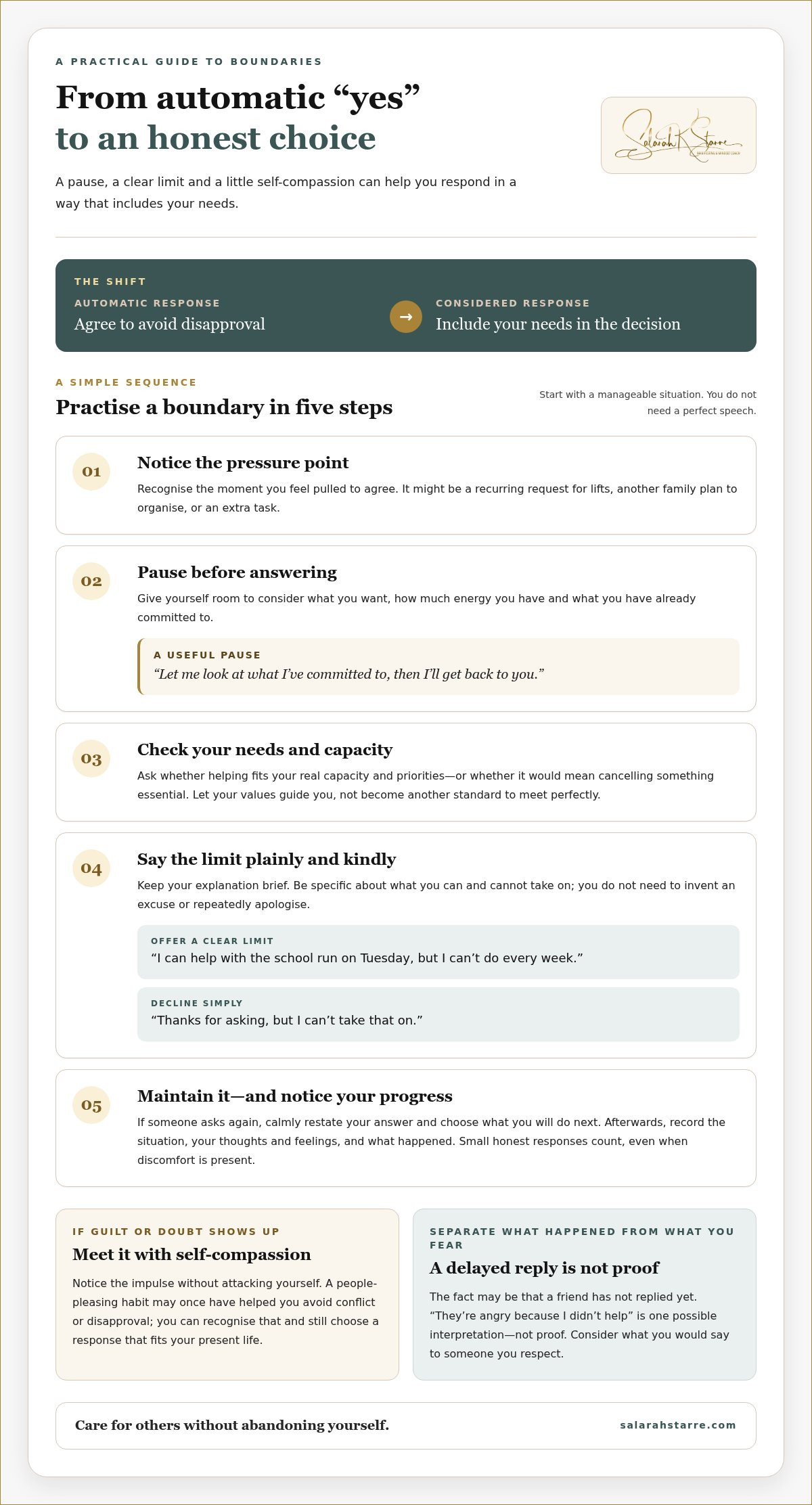
Start by noticing the moment before you agree. Ask yourself: “What do I want, and what am I afraid will happen if I say so?” If a friend asks you to take on another task, pause and consider your feelings, energy and existing commitments. That brief pause can help you distinguish a genuine choice from an automatic attempt to earn approval or prevent disapproval.
Next, name your values, needs and desires. Write down what matters to you in areas such as rest, family, work and friendship. Then compare a request with those priorities: does helping fit your capacity, or would it mean cancelling something essential? A short list of what you want to achieve over a chosen period can make personal aims more tangible. Let your values act as a compass, not another standard you must meet perfectly.
Prioritising yourself isn’t the same as disregarding others. It means including your wellbeing in the decision. If you need a quiet evening, you can say, “I can’t join tonight; I need time to rest.” You can also protect time for an activity you enjoy and treat it as a firm commitment. These choices support self-care and make your needs visible.
Track your progress by recording situations, thoughts and feelings in a journal. Note when you expressed a personal view, even if your voice shook, and what happened afterwards. For instance, write that you disagreed about weekend plans and stayed respectful. Reviewing your entries can reveal progress that anxiety might otherwise hide. Changing an old pattern takes practice: notice the impulse, choose one honest response, then acknowledge the step you took.
2. What causes a people-pleaser personality?
There isn’t one cause. A desire to avoid conflict, fear of judgement, low self-worth or worry about abandonment can all shape people-pleasing. A 2019 study indicates that people with emotional dependency may fear being alone, seek exclusivity in romantic relationships and engage in people-pleasing behaviours. These patterns can overlap, but they don’t explain every person’s choices. In a family, for example, someone may agree to host a gathering because they fear seeming unloving, even when they’re already stretched.
Boundaries offer a practical way to change the pattern. They clarify what you’re willing to give, what you can’t take on and how you expect others to treat you. Start with a recurring pressure point: perhaps a friend regularly asks for lifts, or a relative expects you to manage every family plan. Decide what feels manageable before the next request arrives. A limit works best when it reflects your real capacity, not a desire to punish or control someone else.
Communicate your boundary plainly and kindly. For example: “I can help with the school run on Tuesday, but I can’t do every week.” Or: “I’m happy to talk, but I can’t stay on the phone during work.” Keep the explanation brief. A long defence can turn a clear limit into an invitation to negotiate. In close relationships, be specific about the change you need and give the other person room to respond without immediately taking back your words.
Saying no can feel uncomfortable at first, especially if giving has become your way of securing closeness. You can pause instead of answering on the spot: “Let me look at what I’ve committed to, then I’ll get back to you.” That delay gives you room to assess your wishes and capacity. If you decline, try: “Thanks for asking, but I can’t take that on.” You don’t need to invent an excuse or repeatedly apologise for having a limit.
Maintaining boundaries means repeating them consistently, not delivering a perfect speech once. If a friend keeps asking after you’ve declined, calmly restate your answer and choose what you’ll do next, such as ending the call or leaving the conversation. With family or community commitments, offer an alternative only if you genuinely want to: “I can’t organise the event, but I can bring a dish.” Notice whether relationships make room for honest limits. If you want guided reflection on the patterns behind your choices, explore personal growth support.
3. Self-compassion and coping with discomfort
Changing a people-pleasing habit can stir guilt, anxiety and doubt, especially if approval once felt essential for safety. If your behaviour developed around trauma or fear of rejection, saying yes may have become an automatic way to avoid disapproval. Self-compassion doesn’t mean excusing every choice. It means recognising what the habit has done for you, then choosing a response that fits your present life. If you agree to an extra task, for example, notice the impulse without attacking yourself for having it.
Low self-worth can make another person’s response feel like a verdict on your value. A delayed reply from a friend might trigger the thought, “They’re angry because I didn’t help.” Separate the event from your conclusion: the fact is that the reply hasn’t arrived; anger is one possible interpretation, not proof. Ask what you’d say to someone you respect in the same situation. Try offering yourself the same words: “I made a reasonable choice with the energy I had.” This can help build self-esteem that depends less on external approval.
When your inner critic speaks, examine its claim instead of treating it as fact. Write down the thought, such as “I’m selfish for taking an evening off.” Then ask: “What evidence supports this, and what evidence challenges it?” Resting after a demanding day doesn’t mean you don’t care about your family. Replacing self-criticism with a balanced response can ease its emotional force: “I care about them, and I need rest tonight.” This is compassion with clear eyes, not forced positivity.
Discomfort may still arise after you decline a request. You might replay the conversation, feel tense or want to send an apology you don’t mean. Pause before acting. Breathe slowly, name the feeling as guilt or anxiety, and remind yourself that discomfort is a normal part of setting a boundary. Disappointing someone can feel difficult in the moment; agreeing beyond your capacity may create longer-lasting resentment. You can let the feeling pass without reversing a considered decision.
Make change gradual and specific. Choose a low-pressure situation, such as declining an invitation that clashes with a planned evening of rest. Use a brief response, then notice what happens in your thoughts and body. If your first attempt feels imperfect, record what you’d like to try next time instead of labelling yourself a failure. Small, achievable goals make a new response easier to practise, particularly when old patterns feel deeply ingrained.
Recognise each step you take, whether you express a preference, avoid an unnecessary apology or make time for an activity you enjoy. These actions show that your needs can sit alongside other people’s. Some days, you may return to familiar habits; notice the trigger and begin again without punishing yourself. Self-acceptance is ongoing. Patient, regular practice can help you respond to yourself with the same understanding you offer others.
4. Seeking professional and social support
When should you seek professional help for people-pleasing? Consider speaking with a therapist or counsellor when repeated patterns feel difficult to change, cause distress or strain relationships. For example, if fear of conflict repeatedly leads you to accept commitments you resent, tailored support can help you examine the pattern and practise alternatives.
Therapy can offer a space to explore how past experiences connect with present behaviour. You might discuss what happens before you agree, what you fear after saying no, and how those reactions affect your choices. If trauma is part of your experience, a mental health professional can help you explore its impact and develop healthier coping strategies. A counsellor or psychotherapist can also help you identify needs, set boundaries and express them clearly.
Useful support is practical, not just reassuring. For instance, you could bring a recent example to a session: a colleague asked you to take on extra work, and you agreed despite feeling overwhelmed. Together, you can identify the thought behind your yes, consider what you wanted and rehearse a response for next time. This can help you handle pressure without relying on approval or avoiding every conflict.
Support outside therapy matters, too. Choose people who respect your limits and encourage you to prioritise your wellbeing, rather than pressuring you to return to old roles. You might tell a trusted friend, “I’m practising being more honest about what I can manage. Please give me time to think before I answer.” Their response can help you see which relationships make room for honest communication and where you may need clearer limits.
Some people also find Co-Dependents Anonymous meetings useful for exploring patterns and sharing experiences. A meeting can provide a structured setting to listen, reflect and recognise that others are working on similar relationship habits. It isn’t a substitute for individual professional support when you need tailored help, but peer connection can complement it. Decide what feels useful and take part at a pace that suits you.
To prepare for a conversation with a professional or support group, write down a recurring situation, your usual response and what you’d like to do differently. For example, note that you agree to family plans before checking your schedule, then decide to pause before answering next time. This gives the discussion a clear focus. Support can help you understand the pattern, practise change and reduce the resentment that builds when your needs remain unspoken.
5. Common people-pleasing behaviours
People-pleasing often shows up in ordinary exchanges, not dramatic declarations. You might agree to cover a colleague’s shift, then cancel plans you wanted to keep. You may say “sorry” before asking a simple question, or soften every opinion to prevent disagreement. One behaviour alone doesn’t define you. Look for a repeated pattern: you change your response to manage someone else’s feelings while leaving your own preference unspoken. Noticing that sequence can reveal when an automatic habit takes over.
Watch for these signs in everyday situations:
- You say yes before checking your time, energy or genuine interest.
- You apologise for needs, such as asking a housemate to lower the music.
- You change your view when a friend disagrees, even if you felt sure beforehand.
- You take responsibility for other people’s tasks, then feel drained or resentful.
- You scan someone’s face or tone and immediately try to make them happier.
These examples matter most when they recur across work, family and friendships. A single favour can be freely chosen; repeatedly giving beyond your capacity may point to a learned pattern.
Some people hide their preferences to seem easy-going. At a restaurant, you might tell everyone “I’m happy with anything” despite wanting a quiet table, then feel overlooked. Others over-explain a refusal, offering several reasons for missing a community event. Notice the difference between kindness and self-erasure: kindness leaves room for your view, while self-erasure edits it out. Ask yourself, “What would I say if I didn’t need to manage their reaction?”
People-pleasing can also show up as over-functioning. You organise every family gathering, remind a friend about appointments or solve a colleague’s problem before they ask. This can leave others with less responsibility while you carry more. These behaviours may have been learned in childhood, especially if keeping adults calm felt necessary. That history can help explain the behaviour, but it doesn’t make every present-day yes inevitable.
Try a simple pattern check after a difficult interaction: write down what was asked, what you wanted, what you said and how you felt afterwards. For example, if you volunteered for another task and felt immediate dread, record that response without judging yourself. Then choose one small experiment next time, such as asking for time to think before answering. If you want structured guidance as you examine these patterns, explore support for personal growth.
Salarah K Starre: The Magnetic Recalibration
The Magnetic Recalibration offers a personal-growth next step when you’re ready to explore the patterns behind people-pleasing and reconnect with your own choices. After identifying where you override your needs, you can use that awareness as a starting point for deeper reflection and change. It may suit you if you want support alongside the practical work of expressing your views, honouring your limits and acting in closer alignment with what matters to you. Salarah K Starre also offers one-to-one coaching, Manifestation Workshops and Speaking Engagements. These offerings support personal development; they aren’t a substitute for therapy when you need mental health care. To explore The Magnetic Recalibration, visit salarahstarre.com.
Choose a more honest way forward
The next step isn’t proving you can handle everything. It’s making choices that leave room for your own voice, even when someone else may disagree. Healing people pleasing tendencies is less about becoming harder and more about building self-trust through honest, repeated decisions. Let your next step be manageable and meaningful.
If you’d like support with this personal-growth work, Salarah K Starre offers The Magnetic Recalibration, Speaking Engagements and Manifestation Workshops. Choose the form of support that feels relevant to where you are now, without expecting change to follow a fixed timetable.
Contact Salarah K Starre to discuss support, and take the next step at your own pace.
Frequently Asked Questions
What is a people pleaser (and what are the dangers)?
A people-pleaser habitually puts other people’s approval or comfort ahead of their own preferences. For example, they might laugh along with a hurtful joke to avoid tension, then feel uneasy afterwards. If the pattern persists, it can contribute to stress, anxiety, resentment, burnout and a weaker sense of identity. The concern isn’t being considerate; it’s feeling unable to choose differently, even when the behaviour harms your wellbeing.
Is being a people pleaser a trauma response?
It can be, but people-pleasing does not automatically indicate trauma. The fawn response describes appeasing others to reduce perceived threat or conflict, and may develop in unsafe or unpredictable environments. Someone might agree with an intimidating person to avoid escalation. Similar behaviour can also arise from learned expectations or fear of rejection. The pattern alone can’t establish its cause; consider its context and how it affects your life.
What causes a people-pleaser personality?
There’s no single cause or fixed “people-pleaser personality”. Fear of disapproval, low self-worth, emotional dependency and experiences of conflict can all contribute. For instance, someone who expects a friendship to end after disagreement may avoid sharing an honest opinion. These influences can combine differently for each person. Looking at the situations that trigger appeasing behaviour can help clarify what need or fear the response is trying to manage.
Is there a way to stop being a people pleaser?
Yes, you can change people-pleasing habits through deliberate practice. Healing people pleasing tendencies starts with noticing an automatic response and trying a different one in a manageable situation. For example, if someone asks you to recommend a film, share your genuine preference instead of saying you don’t mind. Notice any urge to retract your answer, and let the conversation continue. If the pattern causes ongoing distress or feels hard to change, consider professional support.
What is the root of being a people pleaser?
There isn’t one universal root; the behaviour may be driven by a belief that acceptance depends on being agreeable. For example, someone might assume that a friend’s disappointment means the friendship is at risk. That fear can turn accommodating into an attempt to preserve connection. To work on healing people pleasing tendencies, ask what you predict will happen if you express a different view. The answer may point to a belief worth examining.
Why do people become people pleasers?
People may learn to please others because it seems to reduce conflict, secure approval or protect important relationships. A child praised for being “no trouble” might carry that role into adulthood, even when it no longer fits. Others become accommodating after rejection or repeated criticism. Understanding what the behaviour does for someone matters: it can show what they’re trying to avoid or gain, without blaming them for adapting.
Why is people pleasing bad for your mental health?
People-pleasing can affect mental wellbeing when it repeatedly pushes personal needs aside. Someone who accepts every social invitation, for instance, may lose time for rest and feel increasingly overwhelmed. Ongoing self-neglect can be associated with stress, anxiety, depression, resentment and burnout. The impact depends on the pattern and its consequences. Notice whether accommodating others leaves you persistently depleted, fearful or disconnected from the choices you want to make.
What causes people-pleasing tendencies?
People-pleasing tendencies can grow from several influences, including fear of judgement, low self-esteem, past experiences and a strong need for reassurance. Someone might repeatedly seek agreement before making everyday choices because they doubt their own judgement. Notice when the urge appears: after criticism, during disagreement or around a particular relationship. Identifying the trigger can help distinguish a deliberate act of kindness from a response driven by fear.


