

The mother wound can develop when a child grows up without consistent emotional safety. In adulthood, it may show up as guilt, people-pleasing, difficulty receiving care or mistrust of women. Healing the mother wound in the UK starts with recognising how early adaptations still shape your feelings and relationships, then finding ways to respond with more self-compassion and choice.
You may know the past wasn’t perfect and still struggle to set boundaries, trust care or quieten your inner critic. These patterns aren’t proof that something is wrong with you; they can be responses learned in childhood, and they can be understood. This article explains what the mother wound means, how childhood experiences may influence adult behaviour, and how counselling, reparenting and reflective practices can support healing. Healing isn’t about assigning blame or forcing forgiveness. It’s about understanding what you needed, noticing what happens now and building a more grounded relationship with yourself.
Key Takeaways
- The mother wound describes how unmet needs for emotional safety in childhood may echo into adult life. Recognising a pattern can help you respond with self-compassion rather than self-blame.
- Explore how early survival responses may show up in relationships, such as over-functioning, emotional caretaking or difficulty receiving support.
- Mother and father wounds can be considered separately, but focus on the specific relationships and experiences that shaped your needs and expectations.
- Counselling and psychotherapeutic reparenting can offer space to understand unmet needs and develop a more supportive relationship with yourself.
- Journalling, noticing self-critical thoughts and practising boundaries can help you identify old patterns and choose responses that fit who you are now.
What Is The Mother Wound?
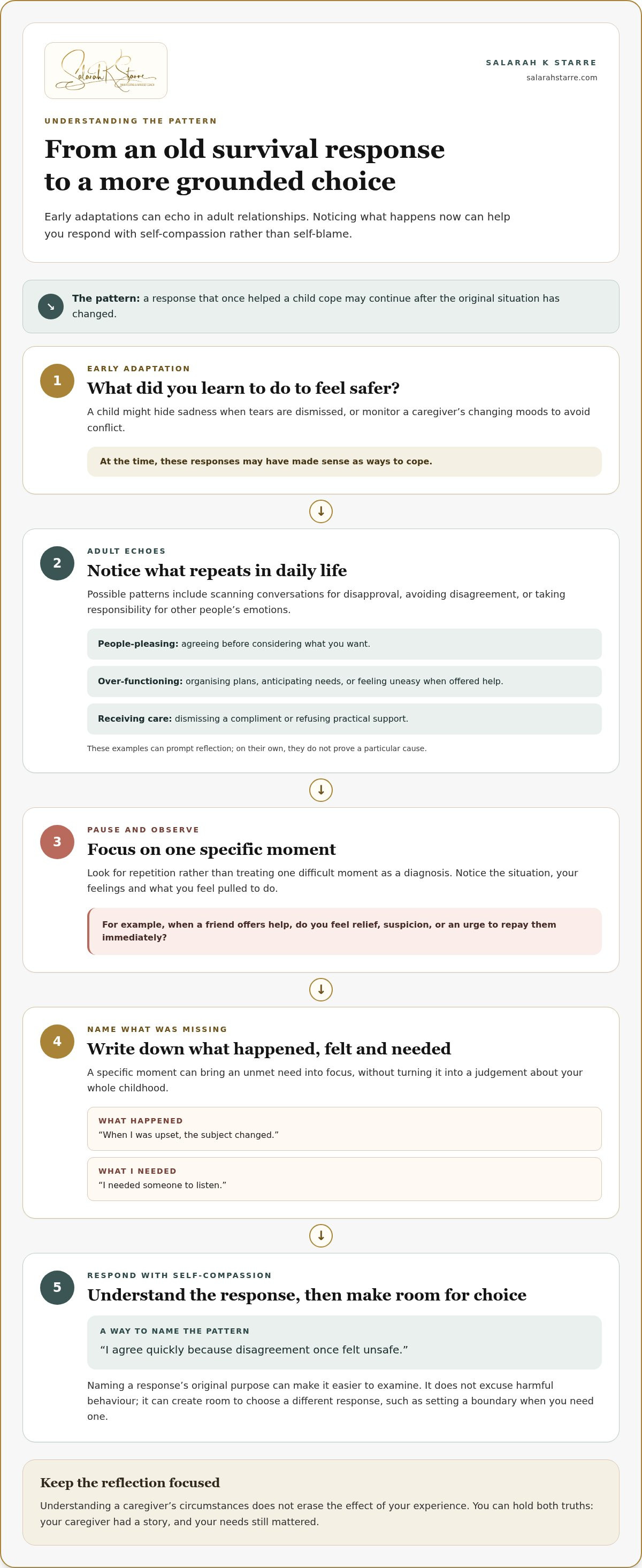
The mother wound describes emotional pain linked to growing up without consistent emotional safety from a mother or mother figure. A child might learn to hide sadness if a caregiver dismisses tears, or stay alert to changing moods to avoid conflict. These responses may make sense in childhood. Later, the same adaptations can affect how someone understands care, conflict and their own needs.
The phrase isn’t a verdict on every mother, and it doesn’t mean every difficult childhood has the same effect. A mother may have been loving at times and unavailable at others. For example, a daughter might receive practical help with schoolwork but feel unable to discuss fear or disappointment. The gap between visible care and emotional safety may be part of what she wants to understand.
“Mother wound” and “father wound” describe different relationships, not fixed categories of damage. The focus is on a person’s experience with each caregiver. For example, someone may associate their relationship with their mother with feeling unseen, and their relationship with their father with fear of criticism. Another person may experience the reverse, or find that one relationship mattered more. The useful question is what each bond taught them about safety, affection and belonging.
That distinction matters because labels can flatten a complicated family story. Rather than assume that mothers shape one aspect of life and fathers another, notice the specific pattern. Did you hide achievements around one parent? Did you seek approval from another? Naming the behaviour and the relationship it connects to can clarify what you learned, without attributing every present-day difficulty to one parent.
Self-worth can become entangled with a child’s attempts to maintain closeness. If praise came only after good marks, for instance, achievement might start to feel like the price of being valued. As an adult, someone may minimise success or feel guilty when resting. Recognising that link separates an old rule, “I must earn affection”, from a fuller sense of personal value.
Self-compassion offers a way to recognise the pattern without adding shame. Try naming the response and its original purpose: “I agree quickly because disagreement once felt unsafe.” This doesn’t excuse harmful behaviour; it makes the pattern easier to examine. A kinder inner response can support self-esteem by treating a learned survival strategy as something to understand, not proof of personal failure.
As you reflect, focus on a specific moment rather than judging your whole childhood. Write down what happened, what you felt and what you needed from the caregiver. For example: “When I was upset, the subject changed; I needed someone to listen.” This practice brings the mother wound into focus as unmet needs and learned meanings, not a permanent identity or an instruction to blame.
Childhood trauma responses and limiting patterns
Common adult signs include guilt, people-pleasing, difficulty receiving care and mistrust of women. These patterns can also affect relationships, for example by leading someone to over-function or take responsibility for others’ emotions.
Childhood Trauma Responses
A childhood trauma response is an adaptation a child develops to manage unmet emotional needs or a lack of safety. A strategy that once helped you cope can continue influencing your behaviour after the original situation has changed.
For example, a child who learned to monitor a parent’s mood may become an adult who scans every conversation for signs of disapproval. Someone who felt responsible for keeping peace at home might avoid disagreement, even when they need to set a boundary. These responses aren’t character flaws. They are patterns with a history, and recognising that history can create room to choose a different response.
The mother wound can also affect adult relationships through emotional caretaking or over-functioning. You might organise everyone’s plans, anticipate their needs and feel uneasy when others offer help. Or you might feel drawn to partners whose emotional distance resembles an early bond. These examples don’t prove a particular cause on their own; they can help you notice recurring patterns and the feelings that accompany them.
Healing means exploring unmet needs and survival patterns, not blaming mothers. A mother may have faced her own difficulties, but understanding her circumstances doesn’t erase the effect of your experience. You can hold both truths: your caregiver had a story, and your needs still mattered. That distinction keeps reflection focused on your life rather than a verdict about someone else.
Adult Signs and Effects
Adult signs are recurring feelings and behaviours that may reflect early relationship patterns. Identifying them matters because it shifts attention from self-criticism to understanding what a response is doing for you.
Guilt may arise when you rest, decline a request or prioritise your needs. People-pleasing can look like agreeing before you’ve considered what you want. Difficulty receiving care may show up when you dismiss a compliment or refuse practical support. Mistrust of women might make closeness feel risky, even when someone has behaved consistently. Notice the specific situation: the same behaviour can mean different things to different people.
Look for repetition rather than treating one difficult moment as a diagnosis. For instance, after a friend offers help, ask whether you feel relief, suspicion or an urge to repay them immediately. If you often become the emotional caretaker in relationships, note when you take responsibility for another person’s feelings. This gives you concrete information about the pattern without reducing your identity to it.
Inner-child work can help you explore how early adaptations continue to influence your behaviour. Noticing a trigger can help separate the present interaction from an older expectation. Instead of automatically smoothing over a disagreement, you might pause and name what you feel. That pause doesn’t erase the past; it helps you respond to the person in front of you rather than only to an old pattern.
Emotional stages experienced by daughters of unloving mothers
There’s no fixed sequence for processing a painful mother-daughter relationship. One daughter may move between longing, anger and grief; another may feel numb before naming any emotion. These are possible experiences, not a test or diagnosis. The practical value lies in noticing what happens in your life, such as feeling tense before a family visit or relieved after setting a limit.
Confusion and self-questioning. A daughter may struggle to reconcile warm family photographs with private experiences of rejection. For example, her mother might praise her in public but dismiss her worries at home. She may then wonder whether she is “too sensitive” or misremembering events. Recording a specific interaction, what was said and how she felt can make the contrast easier to examine.
Hope and renewed effort. Wanting maternal affection can continue into adulthood, especially when contact sometimes feels loving. A daughter might send frequent messages after a kind conversation, hoping to recreate that closeness. If replies become critical or distant, disappointment may follow. Noticing this cycle helps distinguish the hope for a different relationship from what is happening in each interaction.
Grief for what was missing. Recognising what was missing can bring sadness about care, protection or encouragement a daughter needed but didn’t receive. A birthday may sharpen that feeling if her mother forgets, or if celebrations have always centred on someone else. Grief can involve both specific memories and the imagined relationship she hoped to have. Naming the loss gives it shape without requiring a verdict on every family moment.
Anger and protest. Anger may emerge when a daughter stops excusing hurtful behaviour or sees how much she adapted to keep the peace. For instance, she may feel furious after another conversation turns into criticism of her choices. The feeling can point towards a boundary or an unmet need. It doesn’t require an immediate confrontation, a permanent break or a decision made in the heat of the moment.
Experimenting with boundaries. A daughter might start by ending a phone call when insults begin, or sharing less personal information. The first attempt can bring guilt, even when the limit protects her wellbeing. Notice what happens before and afterwards: the trigger, the boundary and the response. This record can reveal whether a chosen limit supports safety and steadiness in the relationship.
Building a more grounded view. Over time, a daughter may hold two truths: her mother had difficulties, and her own needs still mattered. For example, she can value practical help while acknowledging that emotional comfort was absent. This perspective doesn’t require forgiveness or closeness. It can help her make decisions based on present behaviour, rather than waiting for childhood needs to be met retroactively.
These emotional shifts can overlap, return or change with circumstances. A family gathering might bring back old hope, while a calm friendship offers a new experience of trust. Instead of asking whether you’ve reached a final stage, notice one concrete shift: did you name a feeling, ask for support or leave a hurtful exchange sooner? Such observations make your own process clearer.
Counselling and psychotherapeutic reparenting
A counsellor or psychotherapist can help you explore psychological difficulties connected with unmet mothering needs. Reparenting is one way to understand and respond to those needs with support.
Counselling and Reparenting
Counselling offers a space to examine how childhood experiences affect present feelings and relationships. Psychotherapeutic reparenting explores unmet needs within a therapeutic relationship, where the therapist may, within limits, stand in for a parent you didn’t truly have. This can help you examine old expectations with support rather than treating them as fixed truths about yourself.
For example, if you expect criticism after making a mistake, a counsellor can help you trace that response and consider what you need now. Reparenting doesn’t mean the therapist becomes your parent or replaces family relationships. It focuses on developing a more supportive inner response, such as recognising distress and responding with care instead of self-attack.
Some inner-child approaches combine reflection with body awareness. One described therapist-led inner-child healing session lasts 90 minutes and combines hypnotherapy with inner-child work. The approach matters because emotions may surface through bodily sensations as well as thoughts. You can explore what feels manageable, rather than forcing yourself to revisit every memory at once.
Therapy Costs and Lower-Cost Options
Private therapy fees depend on factors such as location, session format, practitioner experience and therapeutic approach. Lower-cost routes can include NHS talking therapies, charitable services and group support, where eligibility, waiting arrangements and the support offered affect what is accessible.
For example, someone seeking help with anxiety linked to family experiences might explore talking therapy, while another person may prefer individual sessions focused on relationship patterns. Compare the purpose of the support, not just its format. A clear goal, such as understanding a recurring trigger, can help you decide what kind of support fits.
Ask yourself what you need from support: space to process memories, help with present-day distress or guidance with boundaries. That distinction can make conversations about therapy more focused. If you’re already receiving support, bring a specific example, such as a recent interaction with your mother, to discuss how it affected you.
Books, Groups and UK Organisations
Books, support groups and UK mental health organisations can offer information, shared experience and routes to further support. They can help you feel less alone and find language for patterns that may have been difficult to name.
For reading, look for material on childhood emotional needs, attachment, family relationships and self-compassion. A practical book might include reflection prompts to use after a difficult conversation. In a support group, hearing someone describe people-pleasing or boundary struggles can help you recognise similar experiences without assuming your stories are identical.
Use UK organisations for clear information about emotional wellbeing and available support. Check whether the material focuses on education, peer connection or individual help, since each serves a different purpose. If a group discussion leaves you overwhelmed, pause and return to the topic with a trusted support person or professional.
Risks of Revisiting Trauma Alone
Revisiting childhood trauma alone means exploring painful memories without professional support to help manage your emotional response. A memory can bring distress into the present, affecting sleep, concentration or everyday routines.
For example, writing about a painful family event might bring intense sadness or agitation that feels hard to settle. Repeatedly searching for certainty about what happened can also deepen rumination. Professional support can help pace the work, notice signs of overwhelm and bring attention back to present-day safety and needs.
If you choose to reflect independently, keep the focus contained: note one event, your response and what would help you feel grounded now. Stop if the exercise sharply increases distress or makes daily tasks harder. You don’t need to uncover every memory to understand a pattern; support can help you decide what feels useful to explore.
Healing the mother wound
Healing involves understanding how early relationships shape present responses, then practising new ways to meet your needs. For readers exploring “healing the mother wound UK”, the work can begin with small, repeatable actions that make patterns visible.
The Healing Process
Healing the mother wound means recognising unmet needs and changing survival patterns that no longer serve you. Awareness gives you a chance to respond differently instead of automatically repeating an old reaction.
Start with a specific moment. Write down what happened, what you felt and what you needed. Journalling can help you develop a clearer sense of identity and explore your responses. Use “how” and “what” questions, such as “What did I need then?” or “How do I feel now?” Avoid “why” questions if they draw you into blame or circular explanations.
Mindfulness can help you notice present thoughts and feelings without immediately acting on them. You might pause after a tense call and name the emotion you feel. Check in with yourself throughout the day to notice self-critical thoughts, such as “I’m selfish for saying no”. Then consider a more compassionate response based on what happened, not an old judgement.
For a daily reflection, write down three things you’re grateful for and three things you’ve achieved. These could be ordinary details, such as enjoying a quiet cup of tea or asking for help. If you’re unsure where your time goes, record what you do every hour for two weeks. The pattern may show where your needs disappear beneath other people’s demands.
Boundaries with a Mother
A boundary is a clear limit on what you’ll accept or do in a relationship. Healing doesn’t require unlimited contact or agreement; a workable limit can protect your wellbeing while leaving room for connection.
Make the boundary specific and centred on your own action. For example, say, “If our conversation turns to insults, I’ll end the call.” Practise saying no to a request you don’t want to accept, without giving a long defence. If your mother dismisses the limit, repeat it calmly and follow through by ending the call or changing the subject.
Boundaries can shift as circumstances change. You might share less personal information before a family visit, then decide afterwards what felt manageable. Healing the relationship doesn’t mean controlling your mother’s response; it means choosing how you participate. Notice whether contact allows respectful conversation or repeatedly leaves you feeling pressured and depleted.
How Long Healing Takes
There’s no single timetable for healing a mother wound; the process varies with your experiences, present relationships and available support. Progress is better measured through changes in awareness and choices than against a deadline.
For example, you might first notice self-criticism after a family conversation, then later pause before agreeing to a request. Difficult anniversaries or renewed contact can bring old feelings back into focus. That doesn’t erase what you’ve learnt. Track concrete shifts, such as naming a need, setting a limit or accepting care without immediately feeling obliged to repay it.
A journal heading such as “healing the mother wound UK” can mark the start of your reflections. Choose a pace that helps you stay engaged with daily life. If reflection leaves you stuck in rumination, return to a grounding activity and consider support. For a more guided focus on personal change, explore deeper healing approaches.
Salarah K Starre: The Magnetic Recalibration
The Magnetic Recalibration is a personal-growth offering from Salarah K Starre. After exploring how early relationships may shape present patterns, you might choose it as a next step for broader self-reflection and change. It sits alongside One to one Coaching and Manifestation Workshops, which offer other ways to engage with personal growth.
This is a different kind of support from counselling or psychotherapeutic reparenting. Consider what you want from your next step: space to explore your direction, a focused coaching conversation or a workshop setting. Choose the approach that best fits your aims and needs.
If you’d like to explore The Magnetic Recalibration, visit salarahstarre.com.
Choose the next step that feels right for you
Healing the mother wound in the UK doesn’t require you to resolve every family question before moving forward. Start with one choice that reflects what you need now: more space to understand yourself, a clearer sense of direction or support as you practise new responses. Your next step can be personal and deliberate, without demanding reconciliation or forgiveness.
For personal growth beyond the reflection in this article, Salarah K Starre offers The Magnetic Recalibration, Manifestation Workshops and Speaking Engagements. Each offers a different way to engage with ideas around change and personal development. Choose what aligns with your aims, and keep your needs at the centre.
Contact Salarah K Starre to explore a next step. You’re allowed to move at your own pace, honour what you’ve lived through and build a future shaped by your choices.
Frequently Asked Questions
What Happens When A Mother Doesn’t Bond With Her Child?
When a mother doesn’t bond emotionally with her child, the child may receive less comfort, attention or responsive care. For example, a distressed child might repeatedly seek reassurance but receive little response. This experience can shape expectations of closeness, though it doesn’t determine how the child will relate to others later. Other supportive adults, such as a relative or trusted teacher, may also influence a child’s sense of safety and connection.
What Is The Unloved Daughter Syndrome?
“Unloved daughter syndrome” is a descriptive phrase for experiences some women associate with feeling emotionally rejected or unsupported by their mothers. It can refer to patterns such as seeking approval, struggling to trust affection or feeling responsible for keeping others happy. It isn’t a label that explains every person’s history. For example, two daughters may experience similar family behaviour but understand and respond to it differently.
What does “mother wound” mean in psychology and therapy?
“Mother wound” describes emotional pain and learned responses connected with unmet needs or a lack of emotional safety in a mother-child relationship. In therapy, discussing the phrase can help someone explore a specific experience, such as feeling unable to ask their mother for comfort. It frames reflection, rather than providing a complete account of someone’s mental health or family history. The person’s own experiences and meaning remain central.
How can someone begin healing a mother wound?
Begin by identifying one present-day situation that brings up a strong reaction, such as a difficult call or an urge to agree to a request. Write down what happened, what you felt and what you wanted to do next. This creates a clear starting point for reflection. Then consider what response would support your needs now, such as taking time before replying or choosing not to discuss a personal subject.
What types of therapy can help with mother wound issues in the UK?
Counselling and psychotherapy can help people explore emotional difficulties connected with childhood relationships. Approaches may include inner-child work, somatic awareness or hypnotherapy, depending on the practitioner’s method and the person’s aims. For example, someone might focus on how family experiences affect present relationships, while another explores bodily reactions to emotional triggers. These approaches differ, so consider what you want to work on and discuss that focus at the outset.
How do I find a therapist specialising in mother-daughter relationships in the UK?
Look for a therapist whose information discusses family relationships, childhood emotional experiences or mother-daughter dynamics. Before beginning, describe a specific concern, such as feeling anxious after contact with your mother, and ask how they would approach it. You can also ask how sessions are structured and how they respond if a conversation becomes emotionally difficult. These questions help you assess whether their approach feels clear and appropriate for your needs.


