

The part of you that clings, withdraws or seeks reassurance isn’t the whole story. Shadow work for anxious attachment means exploring the feelings, needs and traits you’ve pushed out of awareness to feel accepted, then meeting them with curiosity rather than shame.
If closeness feels both essential and frightening, you may recognise the pull: scanning for signs of rejection, seeking reassurance or losing sight of your own needs in a relationship. These responses don’t mean you’re broken. They can point to emotions and beliefs that deserve your attention.
This article explains shadow work and how it can support greater inner security. You’ll learn how reflection can help you recognise attachment triggers, practise self-validation, strengthen boundaries and stay connected to your autonomy. We’ll also explore emotional intimacy and practical ways to process feelings without making another person responsible for regulating them. This isn’t about judging yourself into change. It’s about seeing the pattern clearly, reclaiming what you’ve disowned and choosing your next step with intention.
Key Takeaways
- Use reflection to notice the needs and traits you’ve learned to hide, without turning self-awareness into self-criticism.
- Practise naming a boundary or need clearly, then pair each journalling session with one small relational action.
- Build self-validation by identifying qualities you admire in others and considering how you might express them yourself.
- When an attachment trigger arises, write down what happened, what you felt and what you need before choosing your response.
- Reclaim autonomy by exploring disowned traits and making room for parts of yourself you’ve been afraid to show.
1. Boundaries, vulnerability and emotional intimacy
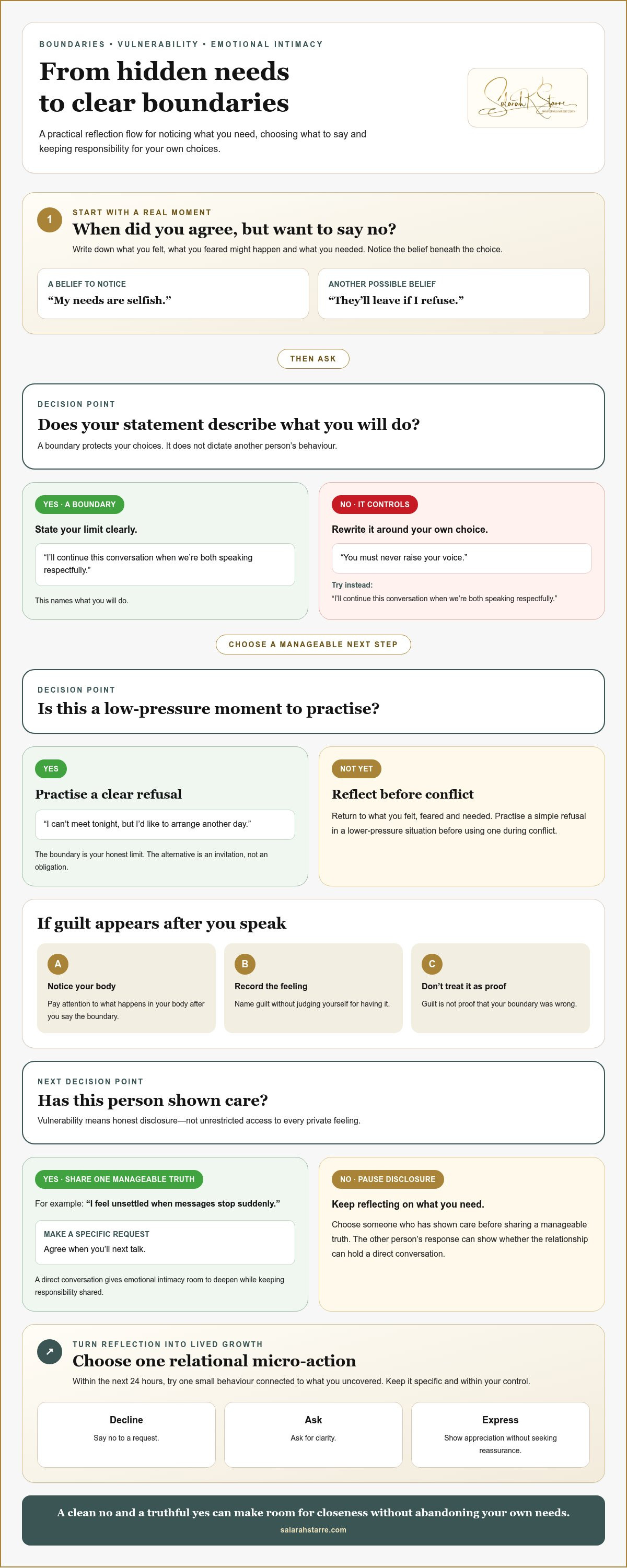
In relationships, a boundary protects your choices; it doesn’t dictate another person’s behaviour. For example, “I’ll continue this conversation when we’re both speaking respectfully” states what you’ll do. By contrast, “You must never raise your voice” tries to control someone else. Shadow work can reveal why setting limits feels dangerous, especially if earlier wounds taught you that disagreement risks rejection.
Start with a recent moment when you agreed but wanted to say no. Write down what you felt, what you feared might happen and what you needed. Perhaps you accepted a last-minute plan because you thought declining would disappoint your partner. Ask which belief drove your choice: “My needs are selfish” or “They’ll leave if I refuse.” Naming the belief makes it easier to choose a response instead of obeying an old alarm.
Practise a clear refusal in a low-pressure situation before using one during conflict. You might say, “I can’t meet tonight, but I’d like to arrange another day.” The boundary is your honest limit; the alternative is an invitation, not an obligation. Notice what happens in your body after you say it. If guilt appears, record the feeling without treating it as proof that your boundary was wrong.
- Choose one specific limit, such as needing notice before plans change.
- State it plainly: “Please tell me before changing our plans.”
- Decide what you’ll do if it isn’t respected, such as making separate plans.
Vulnerability grows through honest disclosure, not unrestricted access to every private feeling. Share one manageable truth with someone who has shown care, such as, “I feel unsettled when messages stop suddenly.” Then make a specific request, such as agreeing when you’ll next talk. This gives emotional intimacy room to deepen while keeping responsibility shared. Their response also tells you whether the relationship can hold a direct conversation.
End each shadow work journal session with one relational micro-action. Within the next 24 hours, try one small behaviour connected to what you uncovered: decline a request, ask for clarity, or express appreciation without seeking reassurance. Keep the action specific and within your control. This turns reflection into lived growth. Over time, practising a clean no and a truthful yes can help you approach closeness without abandoning your own needs.
2. Building inner security and self-validation
Inner security grows when your self-worth no longer depends on someone else’s immediate response. If a delayed reply triggers the thought “I’m not important”, pause and separate the event from its meaning. The event is silence; the meaning is a belief, not proof. This distinction brings clarity and gives you room to choose what to do next.
After a moment of insecurity, take a short time to reflect. Write down what happened, the emotion that followed and the need beneath it. For example: “They changed plans; I felt unwanted; I needed dependable time together.” Then ask what you can offer yourself now. You might plan an activity you enjoy instead of sending repeated messages to secure reassurance.
Your attachment style can describe familiar reactions, but it isn’t your whole identity. Notice the pattern without turning it into a verdict about yourself. Ask, “What do I do when I fear disconnection?” You might over-explain, cancel your own plans or interpret a quiet evening as rejection. Naming a behaviour gives you a point of choice. It doesn’t take away your capacity for change.
Shadow integration means allowing disowned needs and traits into your self-image instead of labelling them unacceptable. List people you admire, then identify the qualities that inspire you. If you admire someone’s directness, consider where you might be direct, too. Choose one small way to practise it, such as stating your preference for tonight’s plans. Admiration can become a mirror, not a measure of your shortcomings.
Self-soothing works best when it responds to the need beneath your reaction. If uncertainty leaves you restless, put your phone down, take a slower breath and write down the facts you know. If you feel lonely, contact someone you trust and ask for company directly. These actions don’t require you to pretend you need nobody. They help you respond to emotions without making another person solely responsible for calming them.
Build self-trust with promises small enough to keep. Choose one decision each day, such as taking a lunch break or declining a plan that doesn’t suit you. Record what you chose and how it felt. This gives you evidence that you can notice your needs, act on them and tolerate discomfort. Healing isn’t about becoming invulnerable; it’s about staying connected to yourself while relating to someone else.
Therapists across the UK may work with attachment-related concerns and relationship patterns. Look for profiles that specifically mention attachment, emotional regulation or relationship work, then consider whether the approach feels right for your needs.
If reflection brings up patterns that feel difficult to shift alone, explore guided support for inner work as a way to deepen your self-understanding.
3. First, what is shadow work?
Shadow work explores parts of yourself pushed out of awareness to fit family or societal expectations. These might include anger, neediness, ambition or the wish to be cared for. For example, someone praised for being “easy-going” may learn to hide disappointment. Later, that buried emotion can surface as resentment or indirect behaviour. The aim isn’t to label those parts bad. It’s to uncover what they protect and choose how to respond.
Early experiences can shape the patterns you bring into adult relationships. If affection once felt unpredictable, a partner’s quietness might now trigger fears of rejection. That reaction doesn’t prove the present relationship is unsafe; it signals an experience worth examining. Write down the current event, your first interpretation and an earlier memory it brings to mind. Keep the distinction clear: similar experiences aren’t necessarily identical.
Try a short dialogue with the part of you that fears disconnection. Ask, “What are you afraid will happen?” Then answer from your present-day perspective: “I’m worried they’ll leave, but I don’t know that.” This practice gives the fear a voice without letting it dictate your behaviour. In shadow work for anxious attachment, the aim isn’t to silence the anxious part. It’s to hear its need, check the facts and decide what might help now.
Overthinking can turn uncertainty into a chain of imagined conclusions. If someone sends a brief reply, you might reread it, assume they’re angry and draft several messages. Pause and record what you know, what you’re guessing and what you need. Then choose one grounded action, such as asking, “Are we all right?” Don’t use reflection to build a case against yourself or your partner. Curiosity uncovers patterns; accusation hardens them.
For a safer starting point, choose a manageable present-day trigger and journal for 10–15 minutes. Name the feeling, identify the belief beneath it, and finish by grounding yourself in the room. Stop if you feel overwhelmed; return to something steady, such as noticing your feet on the floor. Keep the focus on what you can process today, rather than forcing access to painful memories.
Can shadow work make anxiety or trauma symptoms worse, and what are the risks? Yes, exploring painful experiences can feel more distressing and bring difficult emotions closer to the surface. Pause if the exercise leaves you feeling overwhelmed or unable to settle.
Seek professional help rather than working alone when distress feels unmanageable, painful memories disrupt daily life or you feel unsafe. A qualified mental health professional can support you as you explore relationship patterns.
4. Reclaiming autonomy and regulating emotions
Autonomy means choosing your response instead of letting fear choose it. If a partner cancels plans, notice your first urge: perhaps sending repeated messages or cancelling your own evening. Pause, name the emotion, then choose an action that honours your needs. You could ask to rearrange plans, then carry on with a meal or activity you enjoy.
Shadow journalling gives emotions and thoughts somewhere to land. Set aside 10–15 minutes, write down an attachment trigger, and describe what happened without editing yourself. Then note the feeling, the thought attached to it, and what you need now. Writing down an attachment trigger reduces amygdala hijacking by 30%, according to the stated topic guidance.
Keep your reflection grounded in the present. If a delayed reply sparks panic, write, “I’m afraid they’re losing interest,” then add, “I don’t know that yet.” This separates the emotion from a fact. Next, choose a response within your control, such as putting your phone aside while you make tea. The aim is to create space, not force calm.
Expressive writing can also help process relationship wounds. The stated guidance describes 20-minute sessions over four days and says this reduces attachment-related intrusive thoughts by 47%. Use a private journal to explore what happened, how it affected you, and what you wish you’d received. Finish by writing one compassionate sentence to yourself, such as, “That hurt, and my feelings deserve care.”
Self-compassion supports emotional regulation by changing how you meet distress. Instead of “I’m too needy”, try “I’m feeling afraid, and I can respond with care.” This doesn’t excuse every behaviour. It means recognising the emotion before choosing what to do. For example, you can acknowledge jealousy, avoid accusing your partner and ask for a direct conversation later.
Use journalling to notice where you’ve handed over decisions in search of reassurance. Record one choice you made independently, such as choosing Saturday plans or stating a preference about dinner. Then note how you felt before and afterwards. This builds evidence that you can act without waiting for someone else’s approval. Emotional regulation isn’t about suppressing need; it’s about meeting feelings without letting them run your life.
End each journal entry with a practical next step. Write what you’ll do if the trigger returns, such as taking a walk, rereading the facts you know now or contacting a trusted friend. Keep the plan specific and realistic. Shadow work for anxious attachment can support autonomy when reflection leads to choices you control, rather than attempts to control another person’s response.
5. Shadow work and anxious attachment
Anxious attachment can make connection feel urgent and fragile. A quiet message, changed tone or cancelled plan may activate hidden fears of rejection. Shadow work for anxious attachment examines the beliefs and disowned traits beneath those reactions. The aim isn’t to blame your past or your partner. It’s to recognise what shapes your thoughts, then respond with more choice.
Start with a specific moment rather than a broad judgement about yourself. Write down what happened, what you assumed and what you felt tempted to do. For example: “They didn’t reply; I thought I’d upset them; I wanted to send several follow-up messages.” Now ask what the impulse is trying to prevent. Naming its protective purpose can reveal a need for reassurance, steadiness or honest communication.
Try these prompts in your journal: “What traits do I criticise in someone else, and where might I recognise them in myself?” “What do I fear would happen if I showed this part?” You could also complete, “I get to be…” with a disowned trait, such as “bold” or “selfish”. Explore what that word means to you, then choose a respectful way to express it.
That exercise isn’t permission to act without care. If “selfish” means taking needed rest, practise declining an optional plan. If “bold” means speaking plainly, state a preference without apologising for having it. Record what happened, including any discomfort. This helps you separate the feared consequence from what actually occurred and turn insight into a small experiment.
Don’t treat another person’s behaviour as proof of your worst belief. Instead, compare interpretations: “They’re quiet because they’re leaving” is one possibility, not an established fact. Ask what else could explain the silence, and consider whether a direct conversation would help. This keeps reflection grounded in reality while making room for the emotions beneath your reaction.
What shadow work prompts can help someone with anxious attachment? Ask, “What am I afraid this moment means?”, “What need am I hiding?” and “What response would honour both my needs and the other person’s boundaries?” Write freely, then choose one practical action.
Evidence-informed therapies that may address these concerns include cognitive behavioural therapy, schema therapy and attachment-focused psychotherapy. Each can explore different aspects of the pattern, including anxious thoughts, longstanding beliefs and relationship experiences.
Stop journalling if it becomes repetitive self-criticism. Return to the present by naming what you can see and feel, then write one balanced sentence about the situation. The strength is in meeting the hidden response without letting it control every choice. For structured support with deeper pattern work, explore support for subconscious patterns.
Salarah K Starre: The Magnetic Recalibration
The Magnetic Recalibration offers a way to explore subconscious patterns behind relationship reactions through one-to-one coaching focused on soul-deep recalibration. Salarah K Starre’s approach brings together shadow work, nervous system awareness and energetic alignment. It may suit you if journalling has helped you notice recurring fears and you want support exploring what drives them and how you respond. The focus is deeper self-understanding, not forcing yourself to stop needing connection or promising a particular outcome.
One-to-one Coaching can also offer a space to explore personal patterns and self-sabotage. Consider guided support if reflection is difficult to sustain alone or you want to work more closely with recurring responses. Explore The Magnetic Recalibration at salarahstarre.com.
Choose your next honest step
Inner security isn’t built by never feeling afraid. It grows each time you notice an old response and make a choice that reflects who you are now. Let shadow work for anxious attachment become a practice of listening, not self-interrogation. You don’t need to uncover everything at once. Choose one recurring pattern and meet it with curiosity, clear limits and a willingness to act differently.
Progress may look ordinary from the outside: expressing a need, allowing space before reacting or choosing an evening that belongs to you. These moments matter because they strengthen trust in your own judgement. If you’re ready to explore the subconscious patterns shaping your relationships, Salarah K Starre offers The Magnetic Recalibration, Manifestation Workshops and Speaking Engagements.
Contact Salarah K Starre to explore support and take the next step towards relationships that leave room for both connection and selfhood. Keep choosing yourself with honesty and courage.
Frequently Asked Questions
First, what is shadow work?
Shadow work is a reflective way to examine parts of yourself you’ve pushed aside to meet family or social expectations. For example, someone taught to keep the peace might hide anger, then struggle to recognise it before agreeing to something they resent. Rather than treating that response as a flaw, explore what it once helped you avoid and whether that protection still serves your present relationships.
What if the love you crave lies beyond the shadows you’ve been afraid to explore?
Exploring a hidden fear can show you what you need from connection, but it can’t guarantee a particular relationship or outcome. Suppose you fear being “too much” and hide your opinions. Ask what you would say if you didn’t need to earn acceptance. Your answer may reveal where you can practise honesty, choose relationships with room for it and stop confusing self-erasure with love.
Why does this matter?
Unexamined beliefs can shape how you interpret ordinary moments. A partner needing a quiet evening might feel like rejection if you believe closeness must be constant. Noticing that belief helps you distinguish a present event from the story attached to it. That distinction creates space to ask for what you need, consider other explanations and make choices based on the relationship as it is.
What is shadow work, and how might it relate to anxious attachment?
Shadow work examines feelings, needs and traits you’ve learned to conceal. With shadow work for anxious attachment, you might notice anger you hide to avoid conflict or independence you treat as a threat to closeness. Ask what the reaction is protecting, then consider whether to express the underlying need directly. This practice can help you respond to your present relationship rather than automatically follow an old belief.
What are common signs and triggers of anxious attachment?
Possible signs include strong worry about rejection, frequent reassurance seeking, difficulty tolerating uncertainty or neglecting personal plans to preserve closeness. Triggers can include a change in communication, postponed plans, conflict or a partner spending time independently. These reactions don’t establish a diagnosis. Notice the situation, your interpretation and what you do next; keeping a record can help you spot patterns without reducing yourself to a label.
How can shadow work help with fear of abandonment, reassurance seeking, or jealousy?
Shadow work for anxious attachment can help you examine the belief beneath a reaction and choose a more deliberate response. If jealousy appears when your partner makes plans, write down the fear, the facts you have and a request you could communicate respectfully. If reassurance seeking feels urgent, pause to identify what you hope the answer will prove. Reflection won’t control another person; it can clarify your needs and support a direct conversation.
What is the difference between shadow work and attachment-focused therapy?
Shadow work is a reflective practice for exploring disowned feelings, needs and traits. Attachment-focused therapy is professional support for attachment-related concerns and relationship patterns.


