
What if authenticity isn’t a hidden identity you need to uncover, but something you build through choices that feel more like your own? Can living authentically coaching help you make those choices? It can give you space to examine what matters to you and notice where approval-seeking or old patterns have been steering the wheel.
You may already sense the disconnect: saying yes when you mean no, shaping decisions around other people’s expectations, or wondering whether greater honesty could unsettle relationships and responsibilities. That tension doesn’t mean you need to blow up your life. It’s a reason to look closely at what feels aligned, what doesn’t, and what you want to choose next.
In this article, you’ll explore what authenticity looks like in everyday life, practical ways to recognise whether your choices reflect your values, and how coaching can help you strengthen self-trust. You’ll also get a grounded sense of whether one-to-one coaching with Salarah K Starre could support your next steps. No finished identity required. Just honest attention, clearer choices and steady movement forward.
Key Takeaways
- Authenticity isn’t constant confidence or saying whatever you think; it’s making choices that broadly reflect your values, needs and beliefs.
- Notice repeated everyday decisions to spot where your behaviour may have drifted from what matters to you.
- Living authentically coaching offers personalised support to explore your values, patterns and goals; it isn’t clinical diagnosis or treatment.
- Start with one real-life decision: name the value involved, identify the pressures at play and choose a manageable next step.
- Salarah K Starre’s warm, witty and straight-talking approach is grounded in nearly two decades of experience.
What Does Living Authentically Mean in Everyday Life?
Authenticity isn’t a perfect self you eventually uncover. It’s the ongoing practice of making choices and behaving in ways that broadly reflect your values, needs and beliefs, while staying responsive to the people and circumstances around you.
Authentic living means choosing from what matters to you, rather than performing an identity you think will earn approval. That doesn’t require constant confidence, blunt honesty or acting on every passing feeling. You can feel uncertain and still make a considered choice. You can keep a thought to yourself because the moment calls for care, not because you’re betraying who you are.
The pull between fitting in and wanting a life that feels more personally true can be uncomfortable. You might value connection and still need time alone. You might care about doing good work without wanting every waking hour organised around your job. These tensions don’t make you inconsistent. They’re invitations to understand what matters in a particular moment. The philosophical discussion of authenticity and the self offers broader context, but day-to-day authenticity is lived in ordinary decisions.
How can you recognise when you are living on autopilot?
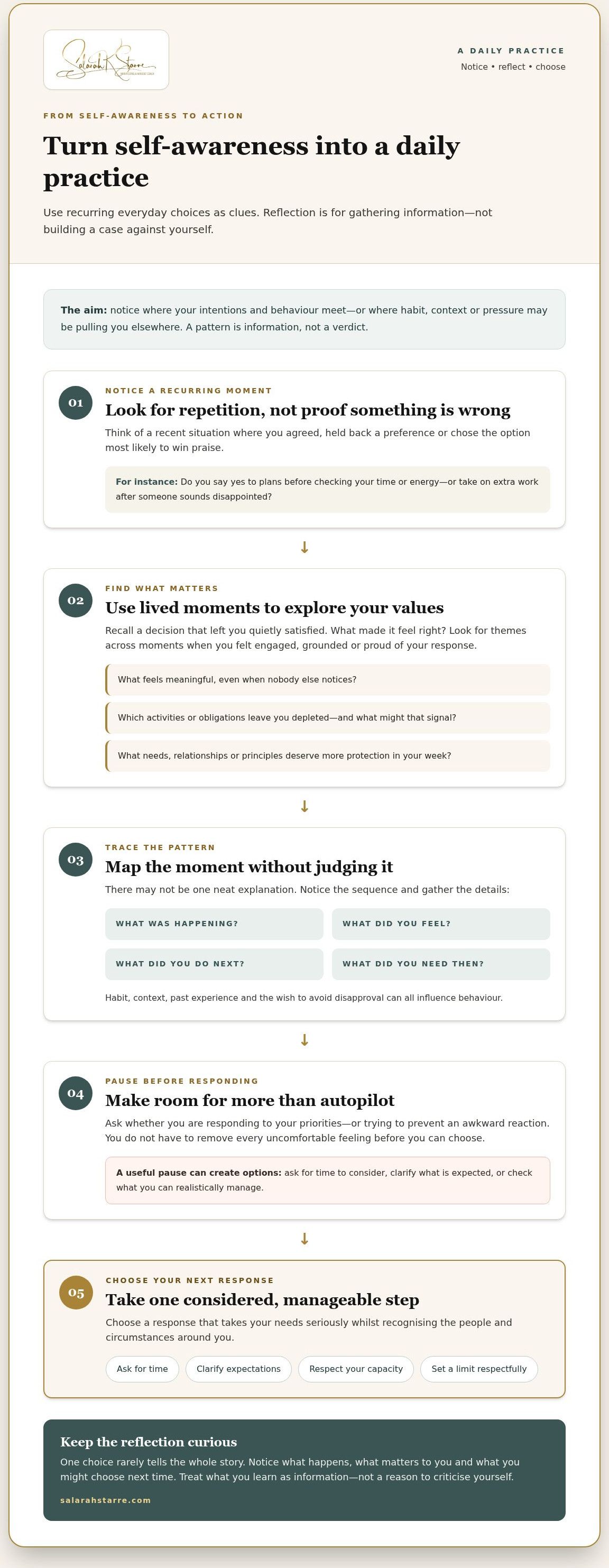
Look for repetition, not proof that something is wrong with you. Do you agree to plans before checking whether you have the time or energy? Edit a harmless preference because you expect someone to disagree? Choose the option most likely to win praise, then feel quietly resentful afterwards?
Notice what happens in recurring situations: what you say, what you leave unsaid and how you feel afterwards. Adapting is often useful. You may adjust your language at work or compromise on a shared plan because other people matter too. The question is whether adaptation has become a reflex that routinely pushes your needs out of view. A pattern is information, not a verdict.
What authenticity is, and what it is not
Authenticity isn’t a fixed identity or a rule to follow forever. People learn, change their minds and hold complexity. You can value stability and want change; care about someone and disagree with them. Living in alignment means taking those competing truths seriously, rather than forcing yourself into a simple story about who you are.
Nor does honest self-expression give you permission to disregard someone else’s boundaries. You can state a preference without demanding that everyone accommodate it. You can set a limit with respect. The aim isn’t to be unfiltered; it’s to stop confusing approval with self-trust. If you’re exploring living authentically coaching, this distinction matters: the work isn’t to construct a more impressive identity, but to understand the patterns shaping your choices and make room for more deliberate ones.
How Self-Awareness Turns Authenticity into a Daily Practice
Values can sound clear in theory, yet become harder to act on in the middle of a busy day. You might value rest but accept another task automatically, or say that creativity matters while leaving no space for it. Self-awareness helps you spot these small, repeated choices. It turns values into something you can see: the decisions you make, the limits you honour and the responses you practise.
This isn’t an invitation to scrutinise or diagnose yourself. Treat reflection as gathering information, not building a case against yourself. A single choice rarely tells the whole story; recurring patterns can show where your intentions and behaviour meet, or where a pressure or habit may be pulling you elsewhere. Ask what happened, what mattered to you and what you might choose next time. Stay curious. That’s how observation becomes useful rather than another reason to criticise yourself.
Which questions help uncover your own values?
Start with lived evidence, not a list of impressive-sounding ideals. Think of a recent decision that left you feeling quietly satisfied. What made it feel right? Perhaps you protected time for someone important, asked for clarity before committing, or gave focused attention to work you care about. Consider what that moment shares with other times you’ve felt engaged, grounded or proud of your response.
Use these prompts to explore further:
- What feels meaningful, even when nobody else notices?
- Which activities or obligations leave you depleted, and what might that signal?
- What needs, relationships or principles deserve more protection in your week?
Look for themes across your answers. “Being successful” may be an aspiration; examples from real life can help reveal whether you mean creativity, contribution, security, recognition or something else. Let your own experience sharpen the words.
How do patterns shape the choices you make?
Behaviour can be influenced by habit, context, past experience and the wish to avoid disapproval. There isn’t always one neat explanation. Notice the sequence instead: what was happening, what you felt, what you did next and what you needed at the time. If you take on extra work after a colleague sounds disappointed, pause to ask whether you’re responding to your priorities or trying to prevent an awkward reaction.
That pause creates options. You might ask for time to consider, clarify what’s expected, or choose a response that respects both your capacity and the situation. The aim isn’t to remove every uncomfortable feeling; it’s to notice it before it makes the decision for you. If body responses and manifestation are also on your mind, explore this related guide to the nervous system and manifestation as further reading.
Living authentically coaching can make this reflection more focused, with personalised support to explore values, self-trust and the patterns behind everyday choices. Learn about one-to-one coaching.
Living Authentically Coaching: Support, Self-Help or Therapy?
There’s no single right route to a more self-directed life. Independent reflection, coaching and therapy each offer a different kind of support, depending on what you want to explore and what you’re experiencing. The useful question isn’t which is best. It’s which kind of support fits your current needs.
| Type of support | Purpose and approach |
|---|---|
| Independent reflection | Journalling, pausing and reviewing your choices can help you notice themes at your own pace. You guide the process yourself. |
| Coaching | Collaborative reflection and goal-oriented personal development can help you explore values, decisions and possible next steps. |
| Clinical therapy | A therapeutic relationship can support assessment and treatment of mental-health concerns, according to the practitioner’s role and approach. |
These descriptions are broad, not a ranking or a substitute for understanding your own needs. Self-reflection may be enough for a question you can work through independently. Coaching can suit you if you want focused conversation, fresh questions and support translating insight into choices. Therapy has a different purpose when clinical assessment or treatment is needed.
What can authenticity-focused coaching help you explore?
Living authentically coaching creates space to examine what you value, where self-trust feels difficult and which recurring choices you’d like to understand more clearly. A coach might invite you to consider what you want from a situation, what assumptions are shaping your response, or what action feels both honest and realistic. These are possible tools, not a prescribed script or guaranteed result.
Coaching doesn’t have to mean being told how to live. Useful coaching is collaborative: you bring your perspective, the coach helps you examine it, and you decide what fits. For individuals looking for structured guidance across life and leadership decisions, practitioners such as charliewcoaching.com provide tailored support to help navigate these choices. You remain responsible for your choices and their pace. You can question a suggestion, change direction or take time before acting. The point is not to hand over your judgement, but to strengthen your capacity to use it.
When might another kind of support be more appropriate?
Coaching supports reflection and goal-oriented personal development. It is not clinical psychotherapy, a way to diagnose or treat mental-health conditions, or crisis support. If you need help with clinical concerns, seek appropriate support from a qualified health professional. If you’re in immediate danger or need urgent help, contact emergency services or an appropriate urgent-support service.
Choosing the right kind of help is an act of discernment, not failure. If your focus is personal growth and you want a collaborative space to explore your values and choices, explore one-to-one coaching.
How to Start Living More Authentically Without Upending Your Life
You don’t need to make a dramatic announcement or redesign your whole life to begin. Choose one real decision that’s in front of you: whether to accept an invitation, take on an extra task or share a preference. The aim is to make your next move more conscious, not perfect.
Use this short sequence: notice, name, choose and reflect.
- Notice the moment you’re facing and your first reaction. Are you about to agree automatically, stay quiet or act from genuine willingness?
- Name the value or need involved. It might be rest, connection, honesty, reliability or creativity. Be specific about what matters in this decision.
- Identify the pressures on both sides. Consider other people’s needs, practical responsibilities and your own capacity. A value-led choice doesn’t require pretending those pressures don’t exist.
- Choose one manageable next action. You could ask for time to think, suggest a different plan or express a preference clearly.
- Reflect afterwards. What felt congruent with your values? What felt difficult? Review the experience without judging yourself by the outcome.
How can you practise authenticity in one small decision?
Start with a low-stakes moment, such as choosing where to meet a friend or deciding whether you have room for an additional commitment. Pause before answering. You might say, “Let me check and get back to you,” or, “I’d prefer somewhere quieter.” Factor in your responsibilities as well as your needs; the goal isn’t to get your own way, but to respond deliberately.
Think of it as an experiment in awareness, not a test of courage or worth. If you choose to go along with someone else’s preference, that can still be an intentional decision. Notice the difference between a considered compromise and an automatic yes. Each gives you useful information for the next choice.
How can you hold boundaries without abandoning connection?
A boundary describes what you need or what you’re able to do. It doesn’t control another person’s response. Clear, respectful language can help you stay connected without quietly agreeing to something you can’t sustain. Try preparing a phrase that feels natural: “I care about this, and I can’t take it on today,” or, “I’d like to talk, but I need some time first.”
You don’t need to over-explain or make the other person wrong. State your limit, allow them their response and stay open to a practical conversation where appropriate. If you’re noticing repeated dynamics in relationships, this guide to breaking toxic relationship patterns offers related context.
Small, repeated choices can make self-trust more tangible. For personalised support exploring the patterns behind your decisions, explore one-to-one coaching through The Magnetic Recalibration.
How Salarah K Starre’s Coaching Supports a More Authentic Life
Recognising a pattern is a meaningful start. Changing how you respond to it can take more than insight alone. Salarah K Starre brings nearly two decades of experience in mindset coaching, manifestation and subconscious reprogramming to her work helping people examine hidden patterns and build self-trust.
Her style is warm, witty and straight-talking, with a practical, no-fluff edge. Rather than handing you a ready-made identity or telling you what to choose, coaching gives you space to look beneath familiar reactions, question assumptions and consider what feels aligned with your own values. You remain the person making the decisions. The work is about creating room to make them with greater awareness.
What makes Salarah’s approach distinct?
Salarah brings mindset coaching and subconscious reprogramming together with practical reflection. That can mean exploring what sits behind a repeated choice, noticing where an old belief may be shaping your response, and considering what action you want to take now. The focus is not on forcing a dramatic reinvention. It’s on examining the pattern and choosing your next step with intention.
The mission is to empower you to create a better life, on your terms. That emphasis on personal agency matters: coaching can help you ask clearer questions, but your needs, values and decisions remain yours to define. Testimonials from Lucy Sheridan of Proof Coaching, Karen Drucker and Anji McGrandles of The Mind Tribe reflect their experiences of Salarah’s work.
The Magnetic Recalibration is Salarah’s one-to-one coaching, focused on soul-deep recalibration. It offers personalised space to explore your values, self-trust and the patterns behind everyday choices. The process is an exploration, not a promise of a particular result.
Which next step could suit your journey?
One-to-one coaching offers a personalised coaching relationship. The Activation Suite - Pathways to Your Expansion is a programme. Workshops and boutique retreats are other ways to engage with Salarah’s work. Each offers a different route into reflection and personal development; choose based on the kind of support or setting you’re looking for, without pressure to have every answer first.
You could begin by identifying one area where you’d like more clarity: a recurring decision, a belief you’re questioning or a value you want to honour more consistently. Then consider which form of support fits. Explore coaching and programmes at your own pace. Your next step doesn’t need to be dramatic. It only needs to be considered, honest and yours.
Choose the Next Step That Feels Like Yours
You don’t need absolute certainty before you act. Let your next choice be a way to practise listening to yourself, then notice what you learn. A more authentic life isn’t built in one dramatic gesture. It takes shape through decisions you can stand behind, even when they’re small or imperfect.
If you’re considering living authentically coaching, start by asking what kind of support would help you reflect and move forward. You might want space to explore a recurring pattern, or simply be ready to look more closely at what you want. There’s no need to force a decision before you’re ready.
Salarah’s work is grounded in the mission to empower you to create a better life, on your terms. She has been featured in mainstream media and invited to speak on big stages with hundreds. Explore Salarah’s coaching and programmes to decide whether one feels right for you. Your pace is yours to set. One considered step is enough to begin.
Frequently Asked Questions
How do I know whether I am living authentically or people-pleasing?
Look at what tends to drive your response and how you feel afterwards. Agreeing because you genuinely want to help is different from saying yes mainly to avoid someone’s disappointment. For example, after accepting a social invitation, ask whether you feel glad, neutral or resentful. One reaction doesn’t define you, but repeated choices made from fear of disapproval may be worth examining with curiosity.
Can you live authentically without changing your job or relationships?
Yes. Authenticity doesn’t automatically call for a major change to your work or relationships. You might begin by being clearer about the kind of work you can take on, asking for a different division of a shared task, or making time for an interest outside work. Small adjustments can help you test what feels more aligned while still honouring commitments and the people who matter to you.
Is living authentically the same as being completely honest about everything?
No. Being authentic doesn’t mean sharing every thought, feeling or personal detail. You can choose privacy, tact and timing without being false. If a colleague asks for your opinion, for instance, you can offer a considerate, honest response rather than saying everything that crosses your mind. A useful check is whether you’re choosing discretion deliberately or silencing yourself because you feel unable to express a reasonable view.
How long does it take to feel more authentic?
There isn’t a set timeline. Some decisions may feel clearer quickly, whilst building trust in your own judgement can take continued practice, especially if you’re used to prioritising other people’s expectations. Progress may be uneven: you might speak up in one situation and fall back into an old habit in another. Instead of setting a deadline, notice whether you’re recognising your preferences sooner and responding with more intention.
Can authenticity change as your values and circumstances change?
Yes. What feels important can shift as responsibilities, relationships, health or priorities change. A value such as independence might once have meant doing everything alone; later, it could mean choosing support on your own terms. Revisiting your decisions can help you see whether an old rule still fits. Changing your mind after learning more isn’t necessarily inconsistency. It can be a considered response to new circumstances.
Is coaching the same as therapy?
No. Coaching is generally centred on personal development, reflection and goals, whilst clinical therapy can involve assessment and treatment of mental-health concerns. They serve different purposes, and neither is automatically right for every situation. Coaching isn’t clinical psychotherapy or crisis support. If you’re dealing with concerns that call for clinical care, seek support from an appropriate health professional; coaching should not be presented as a substitute.
Can living authentically coaching help if I do not know what I want?
Yes, uncertainty can be a useful starting point for living authentically coaching. You don’t need a polished goal before exploring what matters. A coach can help you consider what you want more or less of, which choices feel draining, and what you’re curious to try. The role isn’t to decide for you. You retain responsibility for your direction, including the option to pause, revise or take a small next step.


