
What if a strong reaction to distance isn’t proof that you’re “too much”, but a pattern asking to be understood? When conflict, silence or perceived rejection sets off alarm bells, it can be hard to see why the same pursue, withdraw or mistrust dynamic keeps returning. If you’re wondering how to heal attachment wounds, “just think positively” rarely reaches the heart of it.
Healing attachment wounds isn’t about blaming yourself, forcing calm or expecting an instant fix. It begins with noticing what gets activated, meeting that response with curiosity and practising steadier choices, one moment at a time. Repeated experiences of awareness, regulation and safer connection can help you build self-trust without treating an attachment style as a diagnosis or a life sentence.
This guide explores common attachment patterns and how they may show up in relationships, then offers grounded ways to respond when you feel triggered. You’ll also learn how personal-development coaching, including The Magnetic Recalibration, differs from clinical mental health care, so you can better understand what kind of support fits your needs. The aim isn’t to become someone else. It’s to create more room for security, choice and connection.
Key Takeaways
- Relational patterns can offer clues about expectations of closeness, trust and safety; they aren’t proof that you’re broken.
- Notice how a present-day cue affects you, while staying curious about the story your mind attaches to it.
- Explore how to heal attachment wounds through small, flexible steps: pause, name the feeling and choose your next response.
- Progress can mean more awareness, greater choice and repair after hard moments, not never feeling triggered.
- Understand the difference between clinical mental health care and coaching focused on mindset, subconscious patterns and personal development.
What are attachment wounds, and how might they show up in adult relationships?
A painful relational pattern is information, not proof that you’re broken. If closeness brings up fear, mistrust or a powerful urge to pull away, meet that response with curiosity rather than shame. It may reflect what you’ve learnt to expect in relationships, but it doesn’t define your character or determine what you’re capable of building.
An attachment wound is relational hurt that may shape your expectations of closeness, safety and trust. It can influence how you interpret someone’s silence, respond to disagreement or feel when you need support. An attachment wound is an experience that may shape how you relate, not a fixed identity or label for who you are.
Attachment Theory offers a way to reflect on how early bonds and later relationships may influence expectations of connection. It’s a lens, not a diagnostic test. One argument, unanswered message or moment of needing reassurance can’t establish someone’s attachment style. Context matters: what happened, how often it happens and how it affects you over time.
What experiences can contribute to attachment wounds?
Repeated inconsistency, emotional unavailability or ruptures in important relationships may affect a person’s sense of whether closeness is dependable. A child who often couldn’t predict whether comfort would be available, for example, might grow alert to signs of disconnection. But difficult childhood experiences don’t lead to one inevitable outcome, and no single story explains everyone’s relationship patterns.
Adult experiences can also unsettle felt safety and trust. Betrayal, a painful break-up or a relationship marked by unpredictable closeness may influence what you anticipate from future connections. This doesn’t mean every hard relationship creates an attachment wound. It means your responses have a history worth exploring, without forcing them into a neat explanation before you’re ready.
What patterns might signal an attachment wound?
Look for patterns that recur, especially around moments of closeness, conflict or uncertainty. You might fear abandonment when someone needs space, struggle to trust reassurance, withdraw when a relationship feels emotionally intense, or seek repeated confirmation that everything is all right. Another person might respond to a similar situation differently. The same need for connection or protection can show up as reaching out, shutting down or watching carefully for signs of rejection.
- Notice what tends to happen just before a strong reaction.
- Ask what you felt and needed, without judging the answer.
- Consider whether this response repeats across situations, or makes sense in this particular one.
These observations aren’t a way to diagnose yourself or label someone else. A partner’s quietness might reflect many things, and your wish for reassurance isn’t automatically evidence of a wound. Keep the inquiry grounded: what do you know, what are you assuming, and what would help you feel clearer? That kind of honest noticing is a useful first step in understanding how to heal attachment wounds, without turning self-reflection into self-criticism.
How can attachment wounds shape your reactions, trust and sense of safety?
A present-day cue can sometimes feel connected to earlier expectations about closeness or trust. A partner’s quietness, a change of plans or a tense exchange might stir a fear that connection is slipping away. That reaction can be meaningful without proving what the other person intends. The past may influence the meaning you give a moment, but it doesn’t decide what you do next.
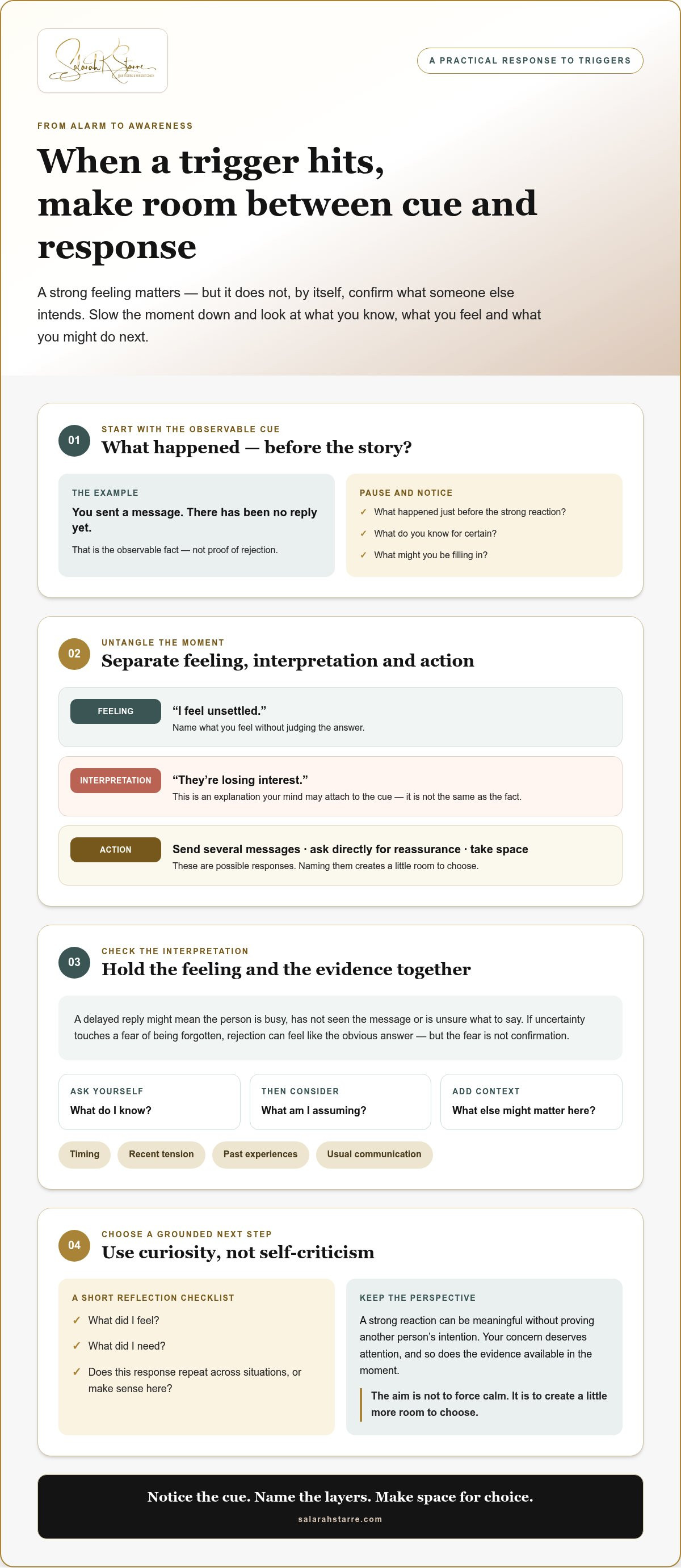
Try separating three things: the feeling, the interpretation and the action. For example, “I feel unsettled” is a feeling. “They’re losing interest” is an interpretation. Sending several messages, asking directly for reassurance or taking space are actions. When these become tangled, an assumption can feel like a fact, and a strong feeling can seem to demand an immediate response. Naming each part creates a little room to choose.
Why can a small moment feel so emotionally charged?
Imagine sending a message and not receiving a reply for several hours. The observable fact is that there’s no reply yet. The explanation might be that the person is busy, hasn’t seen it or is unsure what to say. If uncertainty touches an expectation of being forgotten, rejection may feel like the obvious answer. Pause before treating that fear as confirmed: what do you know, what are you filling in, and is there context you haven’t considered?
Timing, recent tension, past experiences and the usual communication between you can all shape how a moment lands. A delayed reply isn’t proof of rejection, just as feeling anxious doesn’t mean you’re being irrational. Both the emotion and the available evidence deserve attention. Holding those two truths together is more useful than dismissing your concern or accepting the first frightening interpretation as fact.
How might protective responses affect connection?
When uncertainty feels hard to tolerate, someone might pursue reassurance, ask the same question repeatedly or push for an immediate conversation. Another person might go quiet, shut down or create distance to feel more protected. These are possible responses to discomfort, not character flaws, and a brief checklist can’t sort you into an attachment category. The key is noticing what happens for you, in context.
A protective response may bring short-term relief: reassurance can quiet doubt, while withdrawing can reduce the pressure of an intense exchange. Over time, though, the other person may feel pressed, shut out or unsure what’s happening. That can make clear communication harder. You don’t have to condemn the response or obey it automatically. Ask what it’s trying to protect, then consider whether there’s a way to communicate the underlying need more directly.
This separation of feeling, interpretation and action is a practical starting point for how to heal attachment wounds. In the moment, you might tell yourself: “I feel worried; I’m interpreting the silence as rejection; I’ll check what’s happening before deciding how to respond.” It isn’t a demand to think positively. It’s a way to slow the leap from alarm to conclusion, so your next step can reflect the present situation as well as the feeling it has stirred.
If you want support exploring recurring beliefs and responses as personal-development work, one-to-one mindset coaching may offer a space for that reflection.
Can attachment wounds heal, and what does meaningful progress look like?
Yes, change is possible. That doesn’t mean erasing the past, never feeling activated or securing a particular relationship outcome. Progress is a growing ability to recognise what’s happening, find more than one possible response and return to connection or self-care after a difficult moment. It can be quiet. It still counts.
Supportive relationships can offer chances to practise trust, boundaries and honest communication, but a partner isn’t a treatment plan. Nor does this work have to happen only within romance. A friend who listens consistently, a group where you feel respected or a trusted colleague who responds reliably can all give you experiences of connection beyond the couple dynamic. No one person is responsible for healing you; the work is yours, and safe support can help you practise it.
What can progress look like in real life?
Progress might mean noticing you’re upset and pausing before sending a message you may regret. It could look like saying, “I’m feeling unsettled and would appreciate clarity,” rather than expecting someone to guess what you need. Or it might mean returning to a conversation after tension, acknowledging your part and listening to theirs. These aren’t perfect performances. They’re moments of increased choice.
Setbacks belong in the learning process. You may still react sharply, go quiet or find it hard to trust, especially under stress. That doesn’t cancel out previous effort or prove you’ve failed. Instead of tracking every mood, occasionally reflect on a specific situation: what set it off, what helped, and whether you repaired or responded differently afterwards. Keep the review compassionate and brief. Self-awareness should support you, not become another standard you have to meet.
When might professional mental health support be helpful?
If distress is persistent, affects daily life or connects with trauma-related concerns, consider speaking with a suitably qualified mental health professional. They can help assess what’s going on and discuss appropriate care. Self-guided reflection may feel manageable for some people; others may want structured support or find that personal reflection brings up more than they can hold alone. Neither route is universally right. Your needs and level of distress matter.
Coaching is different. It can support mindset, self-inquiry and personal development, but it isn’t psychotherapy, diagnosis or crisis care. One-to-one coaching such as support for personal development may suit someone exploring beliefs and recurring patterns, while clinical concerns call for mental health care. These forms of support have different purposes; coaching shouldn’t replace clinical treatment when that’s what you need.
If you’re in immediate danger in the UK, call 999 or go to A&E. For urgent mental health help in England, contact NHS 111; elsewhere in the UK, use the local urgent mental health service. Reaching out isn’t a failure of self-trust. It’s a practical response to what’s happening now.
Healing Attachment Wounds: Practical Response to Triggers
A trigger can make an old fear feel urgent. You don’t have to solve the whole relationship in that instant. Try this flexible sequence to create a little space between what you notice and what you do. It’s an invitation, not a test. If reflection feels overwhelming, stop and turn your attention to something grounding in the present.
- Notice the cue. What happened just before the reaction? Name the observable event, such as a change of plans or a tense comment.
- Pause. If it feels safe, wait before replying or making a decision. Look around and notice a few things you can see or hear.
- Name the feeling. Is it fear, anger, hurt, confusion or something else? You don’t need to justify the emotion to acknowledge it.
- Check the story. Ask, “What do I know, and what am I assuming?” Keep the facts separate from the conclusion you fear.
- Choose a response. Decide what would help now, whether that’s asking a question, taking space or returning to the conversation later.
This pause isn’t meant to erase painful experiences or make you calm on demand. It can help you notice your response with greater care. Body awareness may also provide useful context: you might notice a clenched jaw, a racing heart or an urge to leave. If focusing on bodily sensations doesn’t feel helpful, you can skip it and orient to your surroundings instead. A related discussion of nervous system awareness and manifestation can offer further context for noticing what’s happening in the body.
How can you pause before reacting to a relationship trigger?
Keep the pause small. Put both feet on the floor, take in the room and give yourself a moment before sending a message. Then name the emotion and ask what you need: clarity, comfort, time or a boundary. You may not have an answer straight away. That’s fine. The aim is to make room for a choice, not to force a perfect response.
How can you practise a different relational response?
Try expressing a need without presenting a fear as fact. For example: “I felt worried when our plans changed. Could you let me know what to expect?” This is clearer than “You don’t care about me,” and leaves space for an honest reply. You can also state a boundary, such as needing to pause a heated conversation and agree when to return to it.
Communication and repair matter, but they don’t require you to stay in a relationship that feels unsafe. If there’s a pattern of harm or control, prioritise your safety and seek appropriate support. For broader reflection on repeated dynamics, explore breaking toxic relationship patterns. If you want guided personal-development support to examine recurring beliefs and responses, explore one-to-one coaching with Salarah K Starre. This work can support self-inquiry; it isn’t a substitute for clinical mental health care.
Learning how to heal attachment wounds doesn’t mean getting every moment right. It means practising awareness, honesty and choice, then beginning again when old reactions return.
What support can help you keep healing attachment wounds?
The next step depends on what you’re facing, what feels manageable and how much distress you’re carrying. You might begin with personal reflection, speak with someone you trust or seek professional mental health care. There’s no prize for doing everything alone, and support should fit the concern rather than force it into a particular approach.
What is the difference between therapy and personal-development coaching?
Therapy is clinical mental health care. A suitably qualified mental health professional can assess concerns, support treatment and work with issues such as trauma or mental health conditions. Coaching serves a different purpose: it supports personal-development goals, such as examining beliefs, clarifying what matters to you and exploring how you want to respond in relationships. Coaching doesn’t treat attachment disorders, trauma or mental health conditions, and it isn’t a substitute for psychotherapy.
If distress is persistent, overwhelming or affecting your ability to manage everyday life, clinical support may be the more appropriate next step. If you’re looking to reflect on mindset and personal goals, coaching may be relevant. Some people use different forms of support for different needs. Be honest with yourself about the concern you want help with, rather than expecting one kind of support to do every job.
How can coaching support deeper self-inquiry?
Guided reflection can help you slow down and examine a recurring belief or response with more compassion. For instance, you might explore what you tell yourself when someone disagrees with you, or what makes it difficult to ask directly for what you need. The aim is not to diagnose the pattern or promise a particular relationship outcome. It’s to build awareness and practise making choices that feel more aligned with your values.
Salarah K Starre brings nearly two decades of experience in mindset coaching and subconscious reprogramming. Her practical, no-fluff approach combines real-life insight with shadow work and nervous system awareness. The Magnetic Recalibration is one-to-one coaching focused on soul-deep recalibration, offered as personal-development support rather than clinical treatment.
If that kind of guided self-inquiry feels like a fit for your goals, you can explore Salarah’s coaching work. There’s no need to force a decision. Consider what you want support with, what feels within your capacity now and whether the support you’re exploring matches that need.
A clear next step could be writing down one relationship pattern you want to understand, then deciding whether personal reflection, coaching or clinical care best fits the question. Start where you are. The purpose is to empower you to create a better life, on your terms.
Choose one grounded step towards safer connection
You don’t need a perfect plan before you begin. Choose one small act of self-trust: write down a question you want to explore, practise expressing a need, or decide what kind of support feels right for you now. The path to how to heal attachment wounds can start with a single honest choice, made without demanding that you have everything figured out.
Salarah K Starre brings nearly two decades of experience in manifestation, mindset coaching and subconscious reprogramming. Her practical, no-fluff approach pairs warmth and wit with soul-deep wisdom. Her work has also received testimonials from Lucy Sheridan, Karen Drucker and Anji McGrandles.
If you’re ready to explore personal-development support for deeper self-inquiry, explore how Salarah supports deeper personal change. Take the next step at your own pace, with the intention to empower you to create a better life, on your terms. Change can begin with choosing to meet yourself differently, one moment at a time.
Frequently Asked Questions
Can you heal attachment wounds on your own?
Yes, you can begin on your own by keeping a brief note of situations that unsettle you and what you wish you’d been able to say or do. Practising a clear request with a trusted friend can also help you find words before a difficult conversation. But self-guided reflection won’t suit every experience. If distress feels intense, persistent or trauma-related, a suitably qualified mental health professional can help you consider appropriate care. You don’t have to do it all alone.
How long does it take to heal attachment wounds?
There’s no universal timetable for how to heal attachment wounds, and a promised deadline would be misleading. Your circumstances, support and the patterns you’re exploring can all affect how change unfolds. Rather than counting days, notice whether you’re becoming more able to spot a familiar reaction, make a choice that fits your values or reconnect after a misunderstanding. A difficult week doesn’t erase earlier learning. Progress can be uneven and still be real.
Can you heal attachment wounds while single?
Yes. You don’t need a romantic partner to learn about your relationship patterns or practise self-trust. You might notice how you respond when a friend cancels, practise saying no to a social plan, or let someone supportive know what would help. Friendship and other caring connections can offer meaningful opportunities to practise openness and boundaries. Being single isn’t automatically easier, and it doesn’t measure your readiness for a relationship.
Can a relationship cause attachment wounds in adulthood?
Painful adult relationships can affect how safe or trusting you feel in later connections. For example, repeated dishonesty may leave you more guarded, though it doesn’t mean every future partner will behave the same way. Consider what happened, whether it was part of a wider pattern and how it affects you now. If you feel unsafe in a relationship, focus on practical safety and appropriate support, not on fixing yourself to tolerate harm.
Does having an attachment wound mean you have an attachment disorder?
No. “Attachment wound” is a phrase for relational hurt or patterns, not a clinical diagnosis on its own. Recognising yourself in a description of reassurance-seeking or distance doesn’t establish a disorder. If you’re concerned about symptoms or your mental health, speak with a suitably qualified mental health professional who can assess your situation. Use attachment concepts as prompts for reflection, not as a label to apply to yourself or someone close to you.
Can a secure relationship help heal attachment wounds?
A caring relationship can give you opportunities to experience reliability, mutual respect and repair, but a partner can’t do the work for you or act as your therapist. Look for everyday signs of mutual care: you can raise a concern, hear each other’s perspective and respect a boundary, even if you don’t agree on everything. No relationship is flawless. Your own reflection and choices matter too, and safety should never be traded for the hope of healing.


