
What if success doesn’t require you to feel positive all the time? If your ambitions feel disconnected from your daily choices, it makes sense to wonder how to align your energy for success. Difficult emotions don’t mean you’re blocking what you want. They’re part of being human, not proof that you’ve failed at mindset work.
Alignment begins when your intentions, inner patterns and behaviour start pulling in the same direction. That takes honesty, not forced optimism. You’ll learn how to spot conflicts between your stated goals and everyday decisions, and how to respond to uncomfortable feelings without letting them dictate your next move.
This guide turns energy alignment into practical reflection. You’ll explore how beliefs and habits can shape your choices, then identify small, values-led steps that bring your actions closer to the future you want. No pretending and no vague advice to simply let go. Just a clearer way to move with purpose, even when the path feels messy.
Key Takeaways
- Define success in a way that reflects what genuinely matters to you, rather than relying on someone else’s measures.
- Use the article’s three-part reflection to spot tension between your intention, inner response and observable behaviour.
- Recognise that difficult emotions don’t mean you’re out of alignment, and releasing control of outcomes doesn’t mean giving up responsibility for your choices.
- Explore how to align your energy for success with a four-step reflection that turns your desired direction into one grounded action.
- Consider how deeper support can help you understand recurring patterns without treating them as proof that something is wrong with you.
What does it mean to align your energy for success?
You can want a different kind of success and still feel hesitant about moving towards it. Perhaps the goal matters, but the next step feels exposing, unfamiliar or at odds with what you’ve learnt to expect of yourself. That gap doesn’t make you fake or incapable. It gives you something useful to examine: what you want, what feels true inside you, and what your choices currently show.
Here, energy is reflective personal-growth language, not a measurable force or a guarantee that thinking or feeling a certain way will cause an external result. Your circumstances, opportunities and other people’s decisions matter too. Alignment is about the part you can explore: the relationship between your values, your internal responses and your behaviour.
Energetic alignment is greater consistency between what matters to you, what feels true and the choices you make. It doesn’t mean every part of you agrees, or that you must feel confident before acting. It means noticing when your actions are out of step with your priorities, then deciding whether you want to choose differently.
How is energetic alignment different from simply wanting something?
A desired outcome is a destination; alignment also asks what you’re willing to value and choose along the way. Imagine wanting meaningful work but avoiding every conversation that could help you explore a change. That tension doesn’t prove your desire is wrong, or that your thoughts are causing events around you. It may point to competing needs: purpose on one side, security or fear of judgement on the other.
Instead of scolding yourself for being inconsistent, get specific. What does the goal ask of you in practice? What feels uncomfortable about that? Is there a smaller, more honest way to engage with it, such as asking someone about their role or setting aside time to explore your options? The point isn’t to force a dramatic leap. It’s to find a choice that better reflects what you say matters.
What does success mean when it is genuinely yours?
Success can mean recognition, meaningful work, deeper relationships, creative contribution, more space in your life or something else entirely. There’s no universal answer to borrow. A goal can look impressive from the outside and still feel empty if it doesn’t reflect your values. Equally, a quieter ambition can be deeply significant to you.
Pause before measuring your progress against family expectations, workplace culture or someone else’s carefully edited milestones. Ask yourself: What do I want this success to make possible? What would I still care about if nobody applauded? Which relationships, values or forms of contribution do I want to protect as I grow? Your answers can change as life changes. That’s not a flaw in the vision; it’s a reason to keep checking whether it still belongs to you.
Alignment isn’t a demand to maintain an upbeat mood. If you’re curious about the wider idea and its criticisms, the overview of Positive Thinking offers context. The grounded question here is simpler: can your next choice honour what matters, even if your feelings are complicated?
How intention, inner patterns and behaviour shape alignment
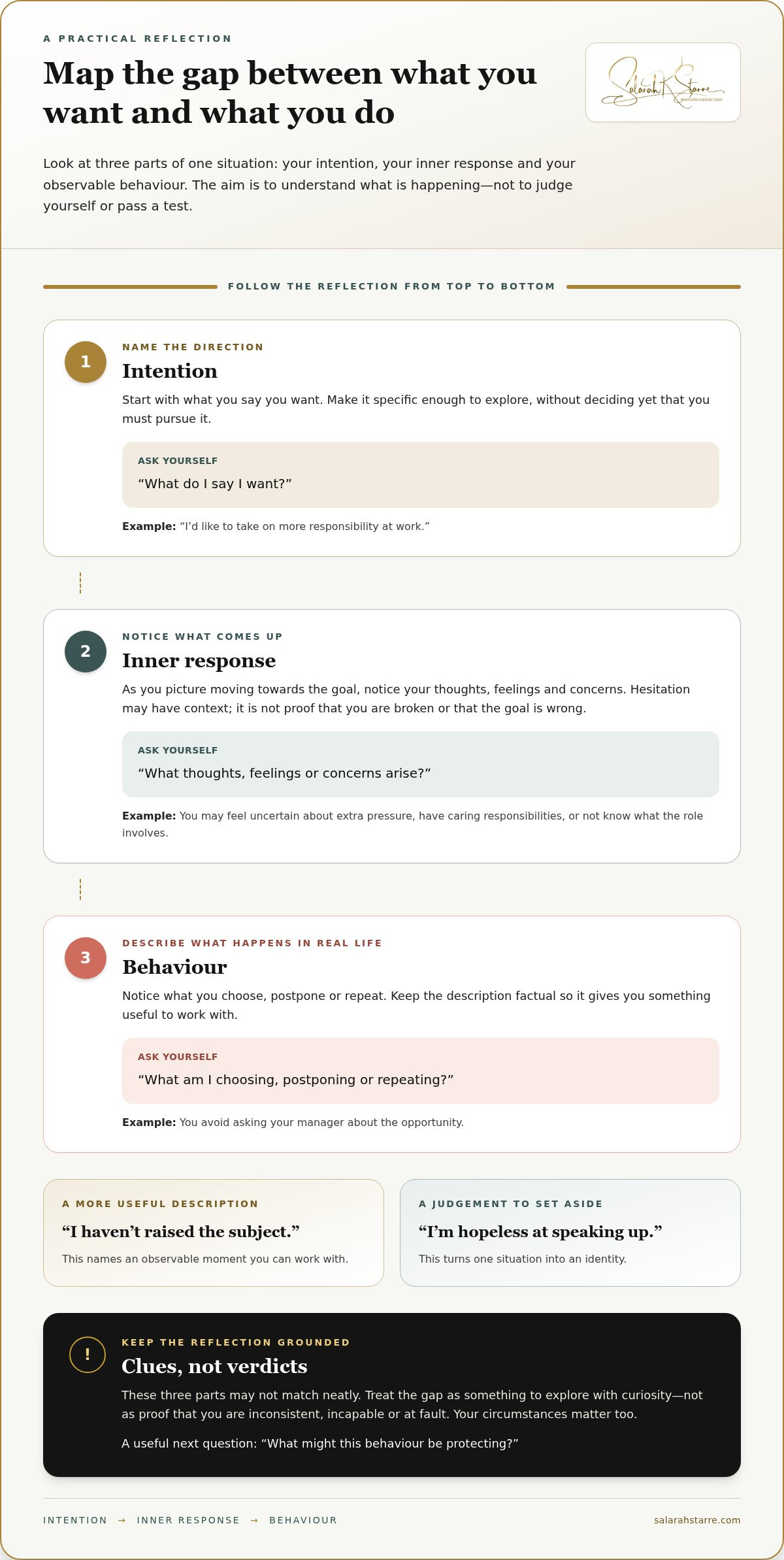
A useful way to examine alignment is to look at three things side by side: what you say you want, what happens inside you as you consider it, and what you actually do. This is a reflection tool, not a clinical model or a test you can pass. It helps turn a vague sense of being “stuck” into something more specific and workable.
Your intention names the direction, your inner response reveals what the direction brings up, and your behaviour shows the choices you’re making in real life. These parts may not match neatly. That doesn’t make you inconsistent or broken. It means you’re responding to needs, feelings and circumstances that can pull in different directions.
Imagine you’d like to take on more responsibility at work, but the possibility leaves you uncertain. You might worry about the extra pressure, have caring responsibilities, or simply not know what the role involves. You then avoid asking your manager about it. The intention is there; the hesitation has context; the behaviour gives you something to notice. None of this proves that your thoughts create external events or that you must pursue the goal. It gives you a fuller picture before you choose what comes next.
What might misalignment look like in everyday life?
It can be subtle. You might repeatedly postpone a conversation about sharing responsibilities, even though fairness matters to you. Or you may pursue a goal because peers seem to value it, whilst your own interest feels thin. These patterns are clues, not verdicts. Ask, “What might this behaviour be protecting?” Perhaps you need more information, time, safety or simply permission to want something different. Stay curious; you don’t have to settle on an explanation straight away.
Try mapping a current situation in a few plain lines:
- Intention: What do I say I want?
- Inner response: What thoughts, feelings or concerns arise when I picture moving towards it?
- Behaviour: What am I choosing, postponing or repeating?
Keep the language descriptive. “I haven’t raised the subject” is more useful than “I’m hopeless at speaking up”. The first gives you a fact to work with. The second turns a moment into an identity.
How can you listen to inner resistance without letting it decide everything?
Pause before you label resistance as self-sabotage or try to silence it. Ask what the hesitation might need you to understand: Is there a practical constraint? A concern worth addressing? A value you don’t want to compromise? Reflection can inform a choice, but it can’t guarantee a particular result. You remain the decision-maker.
If recurring patterns feel hard to untangle alone, one-to-one coaching can offer space to explore them with support. Start with honest observation, not self-judgement. That’s where a more deliberate choice becomes possible.
Does aligning your energy mean staying positive or giving up control?
No. Alignment isn’t a demand to smile through disappointment, uncertainty or fear. Difficult feelings don’t prove you’ve failed, attracted hardship or chosen the wrong direction. Life includes events beyond your control, and telling yourself that every setback reflects your “energy” can turn a tough moment into misplaced blame.
What you can influence is how you respond to what’s in front of you. You can acknowledge a feeling, consider what it might be signalling and choose a next step that reflects your values. That isn’t the same as controlling the outcome. You may prepare carefully for a conversation, for example, but you can’t dictate how another person will respond. Your responsibility is to make a considered choice, not to guarantee the result.
This is the grounded heart of how to align your energy for success: take your intentions seriously without pretending you have power over every circumstance. Releasing the demand for certainty doesn’t mean becoming passive. It means putting your effort where it can have a bearing, while staying open to information you can’t yet see.
Can difficult feelings coexist with a meaningful goal?
Absolutely. You might feel excited about a new opportunity and anxious about what it could change. Both feelings can be present without cancelling each other out. Try naming what’s there plainly: “I’m disappointed”, “I’m unsure” or “I’m afraid of getting this wrong”. Naming a feeling can create a little space between your response and your next choice. It won’t necessarily resolve distress, and it doesn’t have to.
Then ask what would help you respond with care and clarity. Perhaps you need more information, time to think, or a conversation with someone involved. The feeling deserves to be heard; it doesn’t automatically have to make the decision.
What is the difference between aligned action and forcing?
Aligned action is purposeful effort that stays responsive to your values and circumstances. Forcing is treating one outcome, method or deadline as the only acceptable proof of progress. Imagine you want to move into work that feels more meaningful. You might arrange an exploratory conversation, then use what you learn to decide whether to take another step. That’s active, but flexible.
Forcing would mean insisting that this particular role must work out, regardless of new information, competing responsibilities or the cost to what matters to you. Flexibility isn’t a lack of commitment. It lets you adjust your approach without abandoning the deeper intention.
If a step feels difficult, don’t rush to label it either a sign to stop or a challenge you must overpower. Pause. Name the concern, consider the real-world constraints and choose a response you can stand behind. That’s not forced positivity or surrender. It’s honest participation in your own direction.
How to align your energy for success: a practical reflection
Turn the idea of how to align your energy for success into a reflection you can use, not another routine to get “right”. Take a goal that matters to you and move through these four steps at your own pace. You can write your answers down or simply think them through.
- Name the desired direction. Describe what you want in clear, personal terms. Focus on the change or experience you’re seeking, rather than a label that could mean anything. For example, “I want work that gives me more room to create” is more revealing than “I want to be successful”.
- Identify what matters. Ask which values sit beneath that desire. Is it creativity, security, contribution, connection or something else? Consider how this goal fits your present responsibilities and priorities. You don’t need to dismiss those responsibilities to take your ambition seriously.
- Notice the friction. What feels difficult, uncertain or out of step? Separate what you can influence from what you can’t control. You might be able to prepare for a conversation, but you can’t decide how another person will respond. Both facts belong in the picture.
- Choose one action. Pick a specific, manageable step that reflects what matters and sits within your influence. It could be making a note of questions, researching an option or asking for a conversation. Decide when you’ll review what happened, without demanding a particular result.
This reflection clarifies your choices; it doesn’t guarantee success. Its value is in helping you act with more awareness, while leaving room for real circumstances and new information.
How do you choose a goal that reflects your values?
Look beneath approval, status and comparison. Ask what makes this goal meaningful to you, even if nobody else sees it. Then consider what pursuing it would ask of your time, energy and existing commitments. For example, someone balancing physical exhaustion and demanding shifts might turn to resources like bluecollarfit.com to build health habits that fit real-world limits rather than unrealistic ideals. A goal can matter and still need reshaping to fit your life. If circumstances change or your priorities shift, revisit it. You’re allowed to revise a direction that no longer feels like yours.
How do you turn alignment into one grounded next step?
Make the action concrete enough to recognise: “I’ll draft three questions for a conversation” gives you a clearer starting point than “I’ll be more confident”. Keep it within your control, then choose a realistic point to reflect on what you learned. If the first attempt doesn’t work, look for useful information: Was the step too broad, poorly timed or dependent on someone else? Adjust the approach without turning the outcome into a judgement of your worth.
If you’d like support exploring the patterns beneath your choices, consider The Magnetic Recalibration one-to-one coaching. It focuses on soul-deep recalibration as you examine what matters and decide how you want to move forward.
Deepen your alignment with support that goes beneath surface-level thinking
You’ve explored what success means to you, noticed where intention and behaviour may be pulling apart, and considered how to respond honestly rather than force a particular outcome. The next move can be simple: choose one grounded action that reflects what matters. You don’t need every answer before you begin.
Sometimes, though, the same hesitation or pattern keeps resurfacing. You might find yourself changing direction whenever a goal feels exposing, or striving towards an ambition that no longer feels like your own. That isn’t proof that you need fixing. It may be a sign that there’s more to understand beneath the surface.
When might a deeper conversation help?
Reflective support may be useful if you feel stuck in a recurring pattern, or find it hard to separate your own priorities from old expectations. A conversation can help you examine what you’re noticing and consider possible next steps. Coaching is personal-development support, not clinical psychotherapy, and it can’t promise a particular transformation. You’re still the one choosing what feels right for you.
You can make progress through your own reflection and actions, too. Support isn’t a requirement or a shortcut; it’s an option when having space to explore your thoughts with someone feels valuable. The aim isn’t to hand over your decisions. It’s to meet them with more awareness.
What kind of support does Salarah K Starre offer?
The Magnetic Recalibration is one-to-one coaching focused on soul-deep recalibration. It offers space to examine recurring patterns and the beliefs or priorities you bring to your choices, without reducing your experience to a demand to “think positive”. The Activation Suite - Pathways to Your Expansion is another programme in Salarah K Starre’s work.
Support can deepen the questions you’re already asking: What do I want? What feels true? What choice reflects that now? It isn’t a declaration that you can’t move forward alone. You can explore whether The Magnetic Recalibration one-to-one coaching feels like a useful next step, at your own pace.
Alignment isn’t a finish line where doubt disappears and every choice becomes obvious. It’s the ongoing practice of defining success for yourself, noticing tension without judgement, responding honestly and choosing actions that honour your values. Some days that may mean moving forward; other days, it may mean pausing, adjusting or asking a better question.
Keep it real. Keep it yours. Aligned. Unapologetic. Unstoppable.
Let your next choice reflect the life you want
You don’t need a perfect plan before you move. Choose one decision that feels more honest, more grounded or more aligned with what you value, then let it inform your next step. Learning how to align your energy for success isn’t about controlling every outcome. It’s about meeting yourself with enough clarity to choose your direction, again and again.
If you’d like support with that work, Salarah K Starre brings nearly two decades of experience in mindset and manifestation coaching. Her work has received testimonials from Lucy Sheridan, Karen Drucker and Anji McGrandles, and she has been featured in mainstream media and invited to speak on big stages with hundreds.
Explore The Magnetic Recalibration, one-to-one coaching focused on soul-deep recalibration. Take the next step that feels right for you, with honesty, intention and room to grow.
Frequently Asked Questions
Can you align your energy for success whilst feeling anxious or uncertain?
Yes. Alignment doesn’t require you to feel calm or confident before taking a meaningful step. You might be keen to apply for a role and still feel uneasy about being judged. Notice the unease without treating it as an instruction or a verdict: what does it bring to your attention, and what information or preparation might help? Then choose a considered next step, even if the feeling remains.
Is energetic alignment the same as manifestation?
Not exactly. Energetic alignment is often used to describe reflecting on whether your intentions, inner responses and choices fit together. Manifestation is a broader spiritual or personal-growth practice, and its meaning varies between people and traditions. You might use both ideas, or explore alignment without a manifestation framework. Neither should be treated as a scientifically measured force or a promise that external events will unfold in a particular way.
How long does it take to feel more aligned with your goals?
There’s no universal timeline or guaranteed moment when alignment suddenly clicks. Writing down a goal may bring clarity in one sitting, whilst changing a familiar response, such as avoiding feedback, may take ongoing attention and support. Review what you chose and what you learned rather than demanding instant certainty. Progress isn’t a race against someone else’s schedule, and a slower pace doesn’t prove you’re doing it wrong.
What happens if your goals change after you start working towards them?
Changing a goal doesn’t automatically mean you’ve failed, or that the new direction is necessarily more aligned. New information, changed responsibilities or a clearer sense of what matters can all affect what you want. Return to the reason you chose the goal: does that value still matter, and does this route still serve it? You might continue, reshape the goal or stop. Make the choice deliberately, not from shame or comparison.
Can practical planning and energetic alignment work together?
Yes. Reflection can help you decide what deserves attention; planning can turn that decision into a practical step. For example, if learning a skill matters to you, identify a manageable way to practise and choose when to review how it fits alongside existing commitments—just as golfers in communities like GolfFromtheHeart.golf integrate athletic practice with spiritual growth. Treat the plan as a guide, not a guarantee. Feedback, time and circumstances can change what’s workable, and no plan gives you control over every outcome.
What is one first step to align your energy with success?
Write one sentence about what success means to you, then compare it with a recent choice. If you value creativity but have made no room for it, ask what small action could create space, such as setting aside time to sketch an idea. This is a practical first move in how to align your energy for success. Stay curious about the gap; one exercise can clarify, not erase, deeper patterns.


