

Saying yes when you mean no doesn’t keep a relationship healthy. It trades your wellbeing for temporary peace. Learning how to set healthy boundaries in relationships starts with a clear distinction: a boundary isn’t a demand that someone else change. It’s a commitment to what you’ll do to protect your needs and values.
If you feel resentful after agreeing to things you didn’t want, or worry that speaking up will make you seem selfish, you’re not alone. When someone pushes back, it can be tempting to apologise, explain yourself in circles or abandon the limit altogether. Discomfort, though, isn’t proof that you’re doing something wrong.
This guide will help you identify your limits, express them clearly and follow through without trying to control another person. You’ll find practical ways to say no, respond when a boundary is ignored and notice patterns that make self-trust harder to access. The aim isn’t distance or conflict. It’s more honesty, mutual respect and room for both people to be themselves.
Key Takeaways
- Learn how to set healthy boundaries in relationships by focusing on what you will do to protect your needs, rather than trying to control someone else.
- Notice people-pleasing habits, guilt or fear of rejection that may make it harder to name a limit, without treating those patterns as a diagnosis.
- Use one recurring situation to clarify what feels unmet, what your limit is and which action is within your control.
- Practise a clear four-step approach to communicating a boundary, with wording for interruptions, last-minute requests and private information.
- Distinguish ordinary disappointment from behaviour that feels coercive or threatening, then choose how to respond with care for your wellbeing.
How to Set Healthy Boundaries in Relationships: What They Are, and What They Aren’t
Speaking up can feel risky. You might worry that naming a limit will make you seem difficult, selfish or demanding, especially if you’re used to keeping the peace by saying yes. But having a need doesn’t make you unreasonable. It tells you something about what helps you feel respected and well in a relationship.
A boundary is a limit that guides what you will do to protect that need. It isn’t a rule that gives you authority over another person’s choices. The difference is straightforward: a demand tries to dictate their behaviour; a boundary clarifies your response if a situation doesn’t work for you.
A clear boundary protects your wellbeing while making respectful connection possible, because it shows where your responsibility ends and your choices begin. This distinction is central to how to set healthy boundaries in relationships. You can ask someone to speak respectfully, for example, but you can’t make them agree with you. You can choose to pause or leave a conversation when it becomes insulting. That action belongs to you.
What does a healthy boundary look like in a relationship?
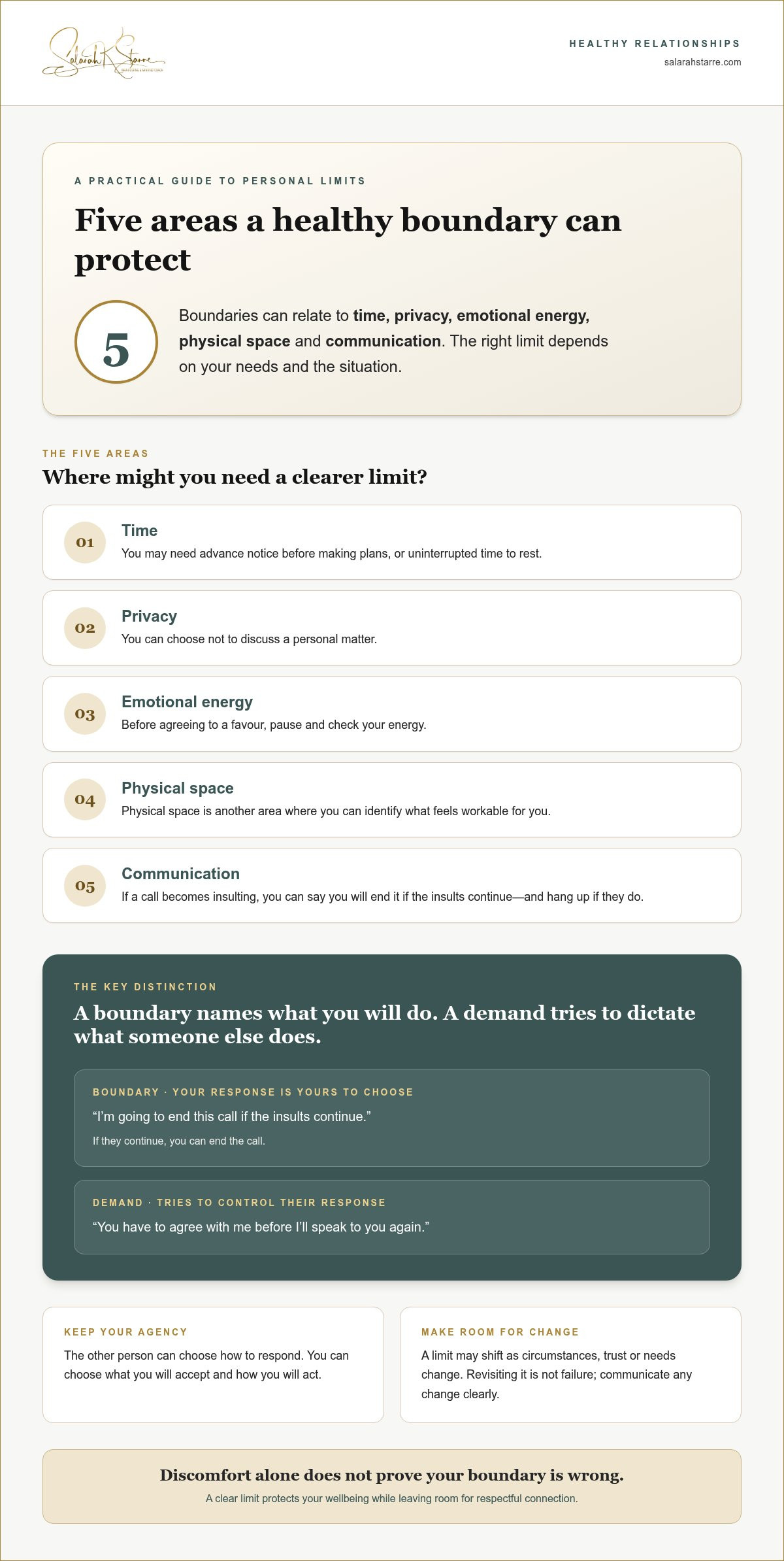
Boundaries can relate to time, privacy, emotional energy, physical space or communication. You might choose not to discuss a personal matter, need advance notice before making plans, or protect uninterrupted time to rest. The right limit depends on your needs and the relationship’s context. A boundary that feels supportive in one situation may not fit another, so consider what is workable for you.
For example, if a call turns insulting, you could say, “I’m going to end this call if the insults continue,” then hang up if they do. That’s a limit paired with an action you control. “You have to agree with me before I’ll speak to you again” tries to force a particular response. For a broader overview of how personal boundaries can cover different aspects of life, see this reference.
Are boundaries walls, punishments or ultimatums?
A boundary isn’t the silent treatment, retaliation or a tactic to make someone comply. Those responses aim to punish or pressure. A clear limit names what you need and what you’ll do. You might say, “I’m not ready to talk about this. I’ll let you know when I am.” You’re communicating your position, not making the other person guess or chase you.
Healthy limits can protect connection because they let each person retain agency. The other person can choose how to respond; you can choose what you’ll accept and how you’ll act. A boundary may also shift as circumstances, trust or needs change. Revisiting it isn’t failure or inconsistency. Check whether the limit still serves you and the relationship, then communicate any change clearly.
Why Setting Boundaries Feels Difficult, and What Your Relationship Patterns Reveal
Knowing you need a limit doesn’t always make it easy to express one. You might feel guilty about disappointing someone, fear they’ll reject you, or wonder whether you’re being unfair. Those feelings deserve attention, but they don’t automatically mean your need is unreasonable. The difficulty may come from what you expect will happen if you speak honestly.
People-pleasing can make approval feel like a reflex. You agree to a favour before checking your energy, accept plans you don’t want, or stay quiet to prevent a difficult conversation. The relief may be immediate, while resentment or exhaustion arrives later. Those feelings don’t prove what another person intends. They can be a cue to pause and ask whether your choices leave enough room for your needs. Discussions shared by Courtney Recovered frequently highlight how stepping away from chronic people-pleasing requires learning to tolerate that initial discomfort instead of immediately giving in.
How can people-pleasing and fear of rejection blur your limits?
Think about one conversation you’ve avoided. What consequence are you imagining: an argument, being called selfish, losing closeness or being left out? Name the fear without criticising yourself for having it. Then separate what you know from what you predict. This won’t guarantee the other person’s response, but it can help you decide whether silence is protecting the relationship or postponing your own discomfort.
Guilt can also arise because a limit breaks an old expectation. Perhaps you learnt that being helpful meant never refusing, or that keeping the peace mattered more than expressing frustration. That history may influence your present behaviour, but it doesn’t dictate what you must do next. HelpGuide.org on Setting Healthy Boundaries also explores how personal limits relate to wellbeing and communication.
What can repeated relationship patterns teach you?
Look for repetition, not blame. Is there a need you routinely leave unspoken with friends, family or partners? Do you agree quickly, then withdraw or feel drained? Write down what happened, your first reaction and what you wished you could have said. A few honest notes may show where self-trust gets interrupted, without proving that every relationship has the same cause.
Subconscious patterns can shape what feels familiar or safe, but there isn’t one explanation for every boundary struggle. Curiosity is more useful than a label. Ask yourself, “What do I expect will happen if I say what I need?” and “Is that expectation based on this moment, or an older pattern?” If you’re exploring recurring unhealthy dynamics, breaking toxic relationship patterns offers a related perspective. One-to-one coaching can also give you space to examine recurring patterns and strengthen self-trust.
Feeling uncomfortable after naming a need is understandable; discomfort alone doesn’t prove the boundary is wrong. Give yourself time to notice the feeling, identify what it may be pointing to and choose a response deliberately. That’s a practical first step in how to set healthy boundaries in relationships.
Which Relationship Boundary Do You Need? A Practical Way
Trying to reset every relationship at once can feel overwhelming. Start with one recurring situation that leaves you uncomfortable, depleted or unheard. Your need doesn’t have to be extreme, and you don’t need to prove that it would bother everyone. If it matters to you, it’s worth examining.
Make the situation specific and observable. “They don’t respect me” is an interpretation; “I’m interrupted several times when I’m explaining something” describes what happened. Then ask: What feels uncomfortable? What do I need instead? What can I personally choose to do? This keeps the exercise grounded in your experience without assuming you know the other person’s motives.
How do you identify the need beneath a boundary?
Use the comparison below to turn a broad frustration into a clearer limit. Treat the examples as starting points, not universal rules. Adapt them to your circumstances and what feels respectful to you.
| Situation | Unmet need | Personal limit | Action within your control |
|---|---|---|---|
| Plans regularly run into your rest time | Time to recharge | You need to keep some evenings free | Decline plans on those evenings |
| Someone asks questions about a private matter | Privacy | You don’t want to discuss that subject | Change the subject or end the conversation |
| You’re repeatedly expected to manage another person’s feelings | Emotional space | You can listen, but can’t take responsibility for solving it | Offer a listening ear without taking on the task |
| Messages arrive when you’re unavailable | Time away from communication | You’ll reply when you have capacity | Mute notifications or respond later |
Notice the difference between naming what you need and judging someone else. “I need more time to respond” gives you a clear next step. “You’re needy” assigns a motive and is unlikely to clarify what should happen next. This distinction can help you decide how to set healthy boundaries in relationships without turning the conversation into a verdict on the other person.
How can you tell whether a boundary is flexible or firm?
Some preferences leave room for discussion. You may be open to changing a plan with enough notice, or finding another time to talk. Other limits may need consistent follow-through because bending them would leave you feeling unsafe, overwhelmed or at odds with your values. There’s no single rule that defines which limits must be firm for everyone.
Before raising the issue, decide what flexibility you can genuinely offer. Ask yourself what adjustment would feel workable and where you’d be saying yes only to avoid discomfort. You don’t need to settle every detail in advance, but knowing your own line makes it easier to speak clearly and avoid agreeing to something you’ll resent.
If you want a focused space to explore what makes a particular limit difficult to hold, one-to-one coaching can support reflection on recurring patterns and self-trust.
How to Communicate a Boundary Clearly, Calmly and Without Over-Explaining
A boundary can be clear without being harsh, and respectful without a long apology. The aim isn’t to deliver a perfect speech or secure agreement. It’s to make your limit understandable and state what you’ll do. Keep the focus on the situation, your need and your next step.
Use this four-step sequence to organise your words:
- Describe the situation: Name what’s happening in specific, neutral terms.
- State your limit: Say what you can or can’t accept.
- Name your action: Explain what you’ll do if the situation continues.
- Pause: Give the other person room to respond without rushing to fill the silence.
For example: “I’m being interrupted while I’m speaking. I want to finish my thought. If I’m interrupted again, I’ll pause this conversation and come back to it later.” You don’t need to prove that your limit is reasonable or persuade the other person to agree. Calm, direct words are enough. For individuals navigating social anxiety or neurodivergence, structured programmes such as those from socialskillsaustralia.com.au can offer supportive frameworks for practising this kind of direct communication.
What words can you use to state a boundary?
Adapt the wording to sound like you. Keep it short, concrete and centred on your choices. A request asks another person to do something; a boundary states what you will do. Both can belong in the same conversation, but they aren’t interchangeable.
- Interruptions: “Please let me finish. If I can’t, I’ll stop here and we can talk later.”
- Last-minute requests: “I can’t make plans at short notice. I’ll let you know if I’m free.”
- Private information: “I’m not discussing that. If the questions continue, I’ll change the subject.”
You could make a request by adding, “Could you ask me before sharing that?” Then decide what you’ll do if your privacy isn’t respected. That second part keeps the boundary in your hands.
What should you do when a boundary is crossed?
Name the specific behaviour and restate your limit once, without turning the moment into a debate. For example: “You’ve asked about that again. I’m not discussing it, so I’m going to change the subject.” Repeated warnings can muddy the message; consistent follow-through makes your next step clearer. If emotions are running high, pause and return to the conversation when it feels appropriate.
Following through isn’t punishment. You’re not withdrawing affection to force compliance or trying to control the other person. You’re doing what you said you’d do to look after your needs. That steady practice is central to how to set healthy boundaries in relationships: clear words, considered choices and action you can own.
If you want support exploring what makes it difficult to communicate and hold a limit, explore one-to-one coaching.
How to Handle Pushback and Build Relationships That Respect Boundaries
A boundary may change a familiar dynamic, so someone might need time to adjust. They may feel disappointed, ask questions or disagree. Their first reaction doesn’t decide whether your limit is legitimate. Notice what happens next: can you discuss the impact and make room for each other’s needs, even if you see things differently?
There’s a difference between discomfort and intimidation. Disappointment, disagreement or a request to talk later can be part of an ordinary conversation. Coercion, threats or behaviour that makes you fear for your safety are different. You don’t have to manage that alone or keep explaining your boundary in an unsafe situation. Prioritise your safety and seek appropriate specialist support; if you’re in immediate danger, contact emergency services.
What if someone says you are selfish or overreacting?
Listen for useful information without giving up your right to decide what you’ll accept. You might acknowledge their feelings, then calmly repeat your limit: “I understand you’re disappointed. I’m still not able to do that.” You don’t need to defend your character or debate whether you deserve a need. Mutual respect means making space for both people’s needs and choices, not requiring one person to abandon theirs.
Pushback can stir guilt, especially if you’re used to smoothing things over. Pause before changing your mind. Ask yourself whether you genuinely want to revise the limit or are trying to make the other person’s reaction stop. You can care about their feelings and still hold your decision. Compassion doesn’t require self-erasure.
When can deeper reflection help you keep a boundary?
If guilt or fear repeatedly pulls you away from limits you’ve chosen, notice the pattern without judging yourself. What do you expect will happen if you follow through? What do you feel responsible for? Reflecting on these questions can help you consider how self-trust and learned subconscious patterns may shape your responses, without assuming there’s one cause or one simple fix.
After the conversation, review the situation proportionately. What changed? What remains difficult? Was your limit clear, and does it still fit your needs? You might clarify how you’ll respond, adjust a flexible preference or keep a firm limit steady. A review isn’t a reason to blame yourself or automatically give way. It’s a chance to respond with intention rather than react from guilt or frustration.
Where the same dynamic keeps resurfacing, shadow work for self-sabotage may offer a useful lens for exploring the patterns beneath your response. One-to-one coaching can also provide reflective space to examine recurring behaviour and strengthen self-trust. Learning how to set healthy boundaries in relationships isn’t about preventing every difficult reaction. It’s about staying connected to your needs, noticing how others respond over time and choosing your next step with care.
Make Your Next Boundary a Practice in Self-Trust
You don’t have to transform every relationship overnight. Choose one moment this week to pause before answering. Notice what you want, then give yourself permission to respond honestly. Each time you act in line with your needs, you build a steadier relationship with yourself and make more room for honest connection with others.
Learning how to set healthy boundaries in relationships is ongoing practice, not a test you pass by getting every conversation right. If you keep finding yourself pulled back into familiar patterns, a reflective space can help you explore what’s beneath them. Salarah K Starre brings nearly two decades of experience in manifestation, mindset coaching and subconscious reprogramming, with a practical, no-fluff approach focused on the patterns beneath behaviour.
Explore one-to-one coaching with Salarah if you’d like support strengthening self-trust and making choices that honour your needs. Start with one clear step. You’re allowed to build relationships without losing yourself.
Frequently Asked Questions
Can setting boundaries improve a relationship?
Yes, clearer limits can help people understand each other’s expectations and make everyday decisions less fraught. For example, agreeing how to share household tasks may reduce repeated misunderstandings. But learning how to set healthy boundaries in relationships can’t guarantee agreement or a warm response. The aim is to make choices that reflect your needs while leaving the other person free to make theirs. Trust develops through how both people respond over time.
Is it selfish to set boundaries with someone you love?
No, protecting your time, privacy or emotional energy isn’t automatically selfish. You can be considerate in how you communicate without taking responsibility for preventing every disappointment. For instance, you might decline a family commitment because you need rest, while saying you care about seeing them another time. Focus on the particular need and what you can choose, rather than judging your character for having a limit.
What happens if someone ignores a boundary you have stated?
If it feels safe, identify what happened and state what you’ll do next. For example: “I asked you not to share that. I’m going to leave this conversation now.” Then follow through without escalating into threats or repeated warnings. If the behaviour involves coercion, intimidation or threats, prioritise your safety rather than trying to resolve it through another conversation. Seek appropriate specialist support for guidance suited to your circumstances.
Can boundaries change over time in a relationship?
Yes. A new responsibility, a change in trust or a shift in your capacity may mean you want to revisit a limit. Explain what has changed and what the adjustment means in practice, such as needing more notice before making plans. You don’t need permission to change what you’ll accept. At the same time, be clear about which parts you’re open to discussing and which remain important to you.
How do you set boundaries when you feel guilty?
Start by identifying the need you’re trying to protect, then choose one manageable action that reflects it. You could say, “I can’t take that on this week,” without listing every reason. Guilt may arise because speaking up feels unfamiliar, not because your choice is wrong. Give yourself time to reflect after the conversation. If the same fear keeps overriding your decisions, suitable support may help you explore the pattern.
Should you set a boundary during an argument?
If there’s no immediate safety concern, you may find it easier to talk once the intensity has eased and you can both listen. You could say, “I want to discuss this, but not while we’re shouting. I’ll come back to it when we’re calmer.” Keep the focus on what needs to change for you to continue. If you feel threatened or unsafe, don’t wait for a calmer moment to protect yourself.


