
What if the coach making the boldest promises isn’t the one offering the deepest support? If you’re working out how to find a manifestation coach, look beyond magnetic claims and ask what their process can help you understand.
It makes sense to feel cautious. Coaches use different methods, and manifestation coaching is an unregulated industry with no official standards for training or certification. Unlike accredited wellness disciplines where organisations like Active Health Group deliver formal qualifications, personal development fields often lack structured benchmarks. A confident promise isn’t proof of a grounded approach, and no coach can guarantee what you’ll manifest. What matters is whether their work respects your agency, boundaries and real-life circumstances.
This guide will help you assess what you need, recognise coaching that looks beyond positive thinking, and distinguish mindset support from challenges that may call for a different kind of care. Salarah K Starre’s approach explores subconscious patterns, shadow work, nervous system awareness and energetic alignment. She has nearly two decades of experience in mindset and manifestation coaching. You’ll also learn how one-to-one coaching and group experiences can serve different needs, so you can choose a considered next step without relying on a promise.
Key Takeaways
- Clarify whether you want help defining a goal or exploring a pattern that keeps resurfacing.
- Use a simple self-assessment to identify the depth and format of support that may suit you.
- Learn how to find a manifestation coach by looking for a clear approach that respects your agency.
- See how mindset coaching, shadow work and nervous system awareness address different areas of personal growth.
- Discover how Salarah K Starre’s work explores subconscious patterns alongside your goals.
How to Find a Manifestation Coach When You Feel Stuck or Sceptical
You can be curious about manifestation and still question the idea that thoughts alone shape everything that happens. That tension isn’t a problem to overcome. It can help you approach coaching with discernment: stay open to reflection, but don’t suspend your judgement or personal agency.
Manifestation coaching supports you to clarify intentions, examine your mindset and choose actions aligned with your goals. It can offer a structure for noticing what you want, what you believe about it and how your choices may be helping or hindering you. It cannot promise that a particular person, opportunity or outcome will appear. For background on how the concept is framed in popular culture, see What is Manifestation in popular psychology?
So, how to find a manifestation coach who offers more than positive slogans? Start with the issue you want to explore. Perhaps you have a clear goal but keep postponing the steps towards it. Or perhaps you notice the same relationship dynamic, fear or self-doubt resurfacing in different situations. Naming the pattern gives you a more useful starting point than asking a coach to make something happen for you.
What a manifestation coach can help you explore
Coaching can help you clarify what you want, question beliefs that shape your decisions and identify recurring choices. For example, if you want a new direction but repeatedly avoid taking visible steps, coaching may help you examine the gap between intention and behaviour. The focus is on reflection and practical personal work, not a guarantee of external results.
Salarah K Starre’s work explores subconscious patterns and self-sabotage, looking beyond surface-level positive thinking. This can mean paying attention to what keeps repeating, rather than treating every setback as proof that you have failed to think positively enough. The aim is greater awareness and choice.
When coaching is not the right kind of support
Manifestation coaching isn’t clinical psychotherapy, mental health care or crisis support. These forms of support have different purposes, and choosing one doesn’t invalidate the other. Coaching may suit someone seeking to reflect on goals, mindset and personal patterns. It isn’t a substitute for clinical care when distress, symptoms or safety concerns require it.
If you’re struggling to manage day-to-day life, experiencing significant emotional distress or facing an immediate safety concern, prioritise appropriate professional or urgent support. You don’t need to force a coaching framework onto a situation that calls for something else. A grounded coach should respect that boundary and your right to decide what support fits.
Keep the first question simple: what do you want to understand or change? A focused goal may call for clarity around intention and action. A recurring pattern may invite deeper exploration. Either way, start with your lived experience, not a promise about what you’ll manifest.
What to Look for in a Manifestation Coach: Depth, Clarity and Boundaries
A compelling story or confident presence can catch your attention. Neither, on its own, tells you how coaching works or whether it respects your needs. A stronger signal is clarity: can the coach explain what they focus on, how you’ll take part and where their role ends?
Use this practical checklist to assess a coaching approach:
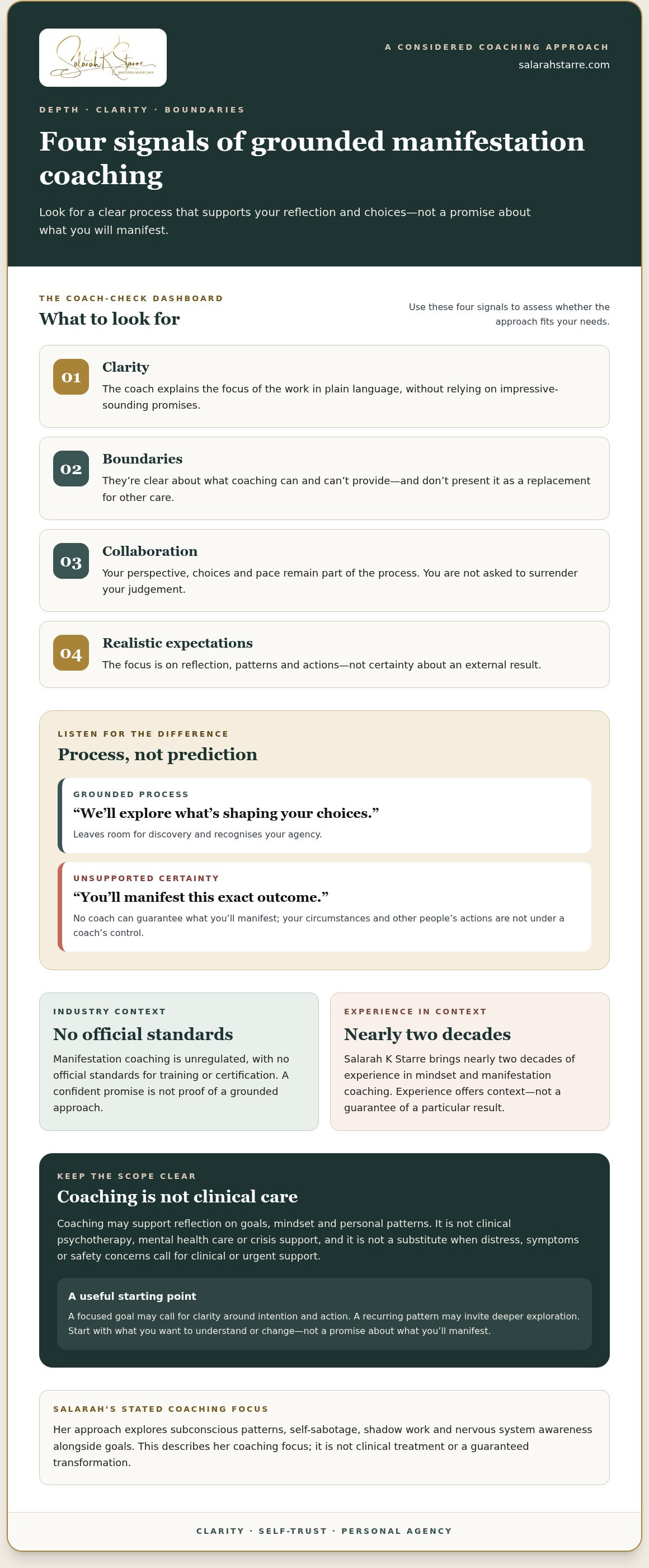
- Clarity: The coach can describe the focus of the work in plain language, without relying on impressive-sounding promises.
- Boundaries: They’re clear about what coaching can and can’t provide, and don’t present it as a replacement for other forms of care.
- Collaboration: Your perspective, choices and pace remain part of the process. You’re not asked to surrender your judgement.
- Realistic expectations: The focus is on reflection, patterns and actions, not certainty about an external result.
How to recognise grounded coaching language
Listen for the difference between process and prediction. “We’ll explore what’s shaping your choices” leaves room for discovery; “you’ll manifest this exact outcome” claims certainty no coach can guarantee. Grounded language can still be ambitious. It recognises that your decisions, circumstances and other people’s actions aren’t under a coach’s control.
Salarah’s work centres on self-trust and personal power. It helps you notice what may be influencing your choices and build a more conscious relationship with your goals, rather than handing responsibility for your future to someone else. Experience can show that a coach has worked in their field, but it can’t guarantee a particular result. Salarah brings nearly two decades of experience, which provides context for her work, not a promise about what you’ll achieve.
Why a clear scope and method matter
Before choosing, make sure you understand the focus of the work. Does it centre on goal-setting and mindset, or does it also explore recurring patterns and emotional responses? A clear scope helps you judge whether the approach matches what you want to examine and whether the coach recognises when something falls outside that scope.
Salarah’s approach brings together subconscious patterns, shadow work and nervous system awareness. These areas look beneath the surface of a goal: what might be driving a repeated response, and what do you notice in yourself as you move towards change? This describes her coaching focus, not clinical treatment or a guaranteed transformation.
As you consider how to find a manifestation coach, notice whether the language leaves you feeling informed and able to choose, rather than pressured to believe. To understand Salarah’s perspective on this deeper approach, explore her manifestation coaching work and consider how its focus aligns with what you’re ready to explore.
Manifestation Coaching Approaches: Match the Work to What You Need
“Manifestation coaching” can describe different kinds of work. One coach may focus on clarifying goals and strengthening mindset; another may explore the beliefs and emotional patterns that shape how you pursue them. Rather than ranking these approaches, match the focus to the question you’re bringing. This map is a useful starting point:
- Goal clarification: Mindset coaching can help you define what you want, identify assumptions around it and connect intention with practical choices.
- Recurring patterns: Shadow work explores less visible beliefs, reactions and behaviours that may keep appearing across different situations.
- Embodied awareness: Nervous system awareness can help you notice how stress or overwhelm shows up in your body and affects your responses.
These areas can overlap, but they aren’t interchangeable. A clear goal doesn’t automatically explain why taking action feels difficult. And noticing a bodily stress response doesn’t, on its own, tell you what decision to make. The right focus depends on what you’re trying to understand, not on which method sounds most impressive.
When the goal is clear but progress keeps stalling
If you know what you want but repeatedly avoid the next step, another goal-setting exercise may not address the block. It may be more useful to examine what happens just before you pull back: a belief about failure, discomfort with visibility or a familiar form of self-sabotage. These are prompts for reflection, not diagnoses. Salarah’s subconscious reprogramming focus brings attention to the beliefs and patterns that may sit beneath repeated choices.
The Magnetic Recalibration is Salarah’s signature transformational programme. It focuses on aligning energetic states, clearing emotional blocks and recalibrating the subconscious mind. Consider whether this emphasis aligns with the questions you want to explore.
When the deeper need is emotional or relational
Do you keep finding yourself in a similar relationship dynamic, even with different people? Shadow work can offer a way to examine your own hidden expectations, protective responses and recurring choices. It isn’t a guaranteed cure, and it doesn’t mean you’re responsible for another person’s behaviour. If relationship cycles are your focus, learning about breaking toxic relationship patterns may help you name what you’re noticing.
Nervous system awareness offers another lens. You might notice that a difficult conversation leaves you tense, or that uncertainty prompts an urge to withdraw. Observing these responses can help you recognise what’s happening before choosing how to act. It isn’t a promise to eliminate distress or a substitute for clinical care.
Salarah’s work brings subconscious patterns, shadow work and nervous system awareness together, alongside energetic alignment. An integrated approach can make room for different parts of your experience, but it doesn’t mean every client receives identical work or that every approach is relevant to every goal. Explore a guide to nervous system and manifestation if that lens speaks to your situation, or a guide to shadow work for self-sabotage if repeating patterns are more central. The best fit is work that meets your actual need and supports your choices.
How to Decide Whether a Manifestation Coach Fits Your Situation
You don’t need a perfect goal or a polished explanation before seeking support. You do need a starting point: what feels stuck, what you hope could shift, and what kind of space would help you examine it honestly. Use this four-step check to clarify your needs before choosing a format.
- Name the pattern. Describe the situation or response you keep noticing. Is it a clear goal you’re hesitating to pursue, or a familiar reaction that appears in different parts of life?
- Describe the desired change. Think beyond a specific outcome. What might change in your everyday choices, boundaries or self-trust if you felt more aligned?
- Choose your preferred depth. Do you want focused help with intention and mindset, or are you ready to explore the beliefs and responses beneath a recurring pattern?
- Consider the support format. Would you prefer personalised one-to-one coaching, or would a group or more immersive experience feel like a better fit?
Clarify the change you want before beginning
Make the shift tangible. For instance, “I want a new career” names a goal; “I want to understand why I keep dismissing opportunities that interest me” points towards a pattern. Neither is a better starting point. If your aim is still taking shape, begin with what you want to understand. Clarity can develop through reflection, rather than needing to be complete before coaching begins.
Ask yourself what meaningful progress could look like in ordinary moments. Perhaps you’d speak up sooner, make a decision with less second-guessing or notice a familiar reaction before acting on it. These measures keep the focus on your choices and awareness, not on a result nobody can promise.
Choose a format that fits your preferred support
One-to-one coaching offers personalised support. Workshops provide a group setting, while retreats are more immersive. Salarah’s work also includes The Magnetic Recalibration, focused on energetic and subconscious alignment. Think about the kind of support you’re drawn to, without assuming that every format has the same purpose or that every person’s experience will be identical.
This simple decision guide connects common needs with a possible direction. Use it as a prompt, not a rigid prescription:
Your need: A specific goal feels unclear. Consider: Mindset-focused coaching or a workshop to explore intention and choices.
Your need: A familiar pattern keeps resurfacing. Consider: One-to-one coaching to explore what may be beneath it.
Your need: You want a group or immersive setting. Consider: A workshop or retreat, depending on the kind of experience you prefer.
Your need: You’re drawn to energetic and subconscious alignment. Consider: Exploring The Magnetic Recalibration.
Knowing how to find a manifestation coach means choosing support that fits your current question, not forcing yourself into a format because it sounds more powerful. If you’re ready to explore personalised coaching, explore Salarah’s coaching options and take your next step with intention.
Taking the Next Step with Manifestation Coach Salarah K Starre
You now have a clearer way to assess your needs, recognise grounded coaching and consider which kind of support may suit you. The next step doesn’t need to be a leap of faith. It can be a considered choice about whether the work on offer speaks to the pattern or goal you want to explore.
What Salarah’s approach brings together
Salarah K Starre has nearly two decades of experience in mindset and manifestation coaching. Her work looks beyond positive thinking to subconscious patterns and self-sabotage, bringing together shadow work, nervous system awareness and energetic alignment. This creates space to consider not only what you want, but what may be shaping your responses and choices as you move towards it.
Her offerings include personalised one-to-one coaching, programmes, workshops and retreats. The Magnetic Recalibration focuses on energetic alignment, emotional blocks and the subconscious mind. These are different ways to engage with her work, rather than a promise that every person will follow the same path or explore the same themes. Consider whether you’d value individual attention, a workshop experience or a more immersive programme or retreat.
Experience can help you understand a coach’s background, but it can’t predict your results. Coaching supports your reflection and personal work; it doesn’t control external circumstances or guarantee a specific manifestation. Your choices, circumstances and the actions of others remain part of the picture.
Move forward with clarity, not pressure
Before taking a next step, write down one pattern or question you’d like support to explore. Keep it simple: “I want to understand why I hold back when an opportunity appears” is enough to begin. You don’t need to arrive with a perfect goal, a complete explanation or certainty that coaching is right for you. Use what you’ve learned here to notice whether the approach feels relevant and whether its emphasis matches the depth of work you’re seeking.
Meaningful change is personal. It may involve shifts in awareness, self-trust or everyday decisions, but no coach can promise in advance exactly what will change or what external outcome will follow. Keep your agency at the centre: choose based on the clarity of the approach, the support format and your sense of fit, not pressure or a guarantee.
If Salarah’s focus feels aligned with what you want to explore, explore coaching and programmes with Salarah. Take a look with curiosity, then decide whether it feels like the right next step for you.
Choose Support That Keeps You in Your Power
The clearest next step may not be a dramatic leap. Start by naming what you want to explore, then choose support that gives you room to think, question and decide for yourself. That’s the heart of how to find a manifestation coach: seek a process that helps you engage with your goals without asking you to treat any outcome as guaranteed.
Salarah K Starre brings nearly two decades of experience in mindset and manifestation coaching, alongside her work as a bestselling author and podcast host. Her approach integrates shadow work, nervous system awareness and energetic alignment, with attention to the subconscious patterns that can influence how you move towards change.
If that depth feels relevant to the questions you’re carrying, take a considered look at exploring coaching and programmes with Salarah. You’re allowed to move at your own pace, trust your judgement and choose the support that feels right for you.
Frequently Asked Questions
Can manifestation coaching help if I do not know exactly what I want?
Yes. You can begin with a sense that something feels off, even if you can’t yet name a clear goal. For example, you might be weighing two possible directions or noticing that your current priorities no longer feel like yours. Coaching can help you explore those questions without forcing a dramatic vision. If you’re learning how to find a manifestation coach, look for an approach that makes space for uncertainty and keeps decisions in your hands.
How long does manifestation coaching take?
There’s no universal timetable for coaching or personal change. The time involved may depend on what you want to explore, how complex the pattern feels and which support format you choose. Rather than relying on a promised deadline, consider what you’d like to understand or do differently, then review whether the process is helping you move towards that. A fixed-date guarantee doesn’t account for individual circumstances or choices.
Can I work with a manifestation coach while seeing a therapist?
Yes, coaching and therapy can sit alongside one another, but they have different purposes. Manifestation coaching may focus on intentions, mindset and personal patterns; it isn’t clinical psychotherapy. If you’re already in therapy, keep clear about which support is addressing your mental health needs and which is focused on personal goals. Don’t use coaching as a substitute for clinical care, and prioritise qualified clinical support when you need it.
Is manifestation coaching spiritual or practical?
It can be either, or a blend, depending on the coach’s approach. Some use spiritual or energetic concepts; others place more emphasis on reflection, mindset and the actions you take. Salarah’s work combines energetic alignment with attention to subconscious patterns, shadow work and nervous system awareness. To assess the balance, consider whether the coach can explain their ideas clearly and connect them to choices you can make in everyday life.
What should I do if coaching brings up difficult emotions?
Tell your coach what you’re experiencing and pause or adjust the work if you need to. You’re allowed to set limits on what you explore and when. Difficult emotions shouldn’t be dismissed as proof that you need to push harder. Coaching isn’t crisis support or clinical treatment. If distress feels intense, persists or affects your safety, prioritise appropriate professional support rather than relying on manifestation coaching alone.
Can a manifestation coach guarantee that I will attract a specific outcome?
No. A coach can’t responsibly guarantee that a particular person, event or external circumstance will respond in a certain way. Coaching may support you to reflect on what you want and how you choose to act, but it can’t control factors outside your influence. Be cautious of promises tied to a fixed result. Salarah’s approach centres on authenticity and personal power, not certainty about what will happen.


