
What if transformation begins not by forcing yourself into a new identity, but by noticing the pattern that keeps pulling you back? If you’ve searched “what is energetic alchemy”, you may have found a phrase that means different things to different people. That matters: spiritual language can help describe an experience, but it shouldn’t be mistaken for a clinical explanation or a scientifically measured force.
At its most grounded, energetic alchemy is a personal-growth lens for noticing emotional patterns, beliefs and habitual responses, then choosing actions that better reflect who you want to become. The shift isn’t instant, and it isn’t about pretending difficult feelings away. It’s about seeing what’s happening, exploring it honestly and choosing your next move with more intention.
This guide explores common meanings of energetic alchemy without presenting one framework as universal. You’ll see how it differs from practices such as Reiki and meditation, how inner awareness can connect with everyday behaviour, and how to approach the idea with discernment rather than expecting a quick fix.
Key Takeaways
- Explore what is energetic alchemy and why it’s better understood as a personal-growth metaphor than one universal method.
- Trace how an inner response can influence behaviour, then consider a more intentional next step.
- Compare energetic alchemy with Reiki, manifestation and positive thinking to understand where the ideas overlap and differ.
- Try a simple reflection practice: notice, name, question and choose one small response, without demanding instant change.
- See how coaching can connect shadow work, subconscious awareness and energetic alignment with everyday personal growth.
What Is Energetic Alchemy? A Clear Definition of the Concept
At its simplest, energetic alchemy is a spiritual or personal-growth metaphor for transforming how you relate to inner experience. You might use it to describe recognising a difficult emotion, exploring what it reveals and responding with greater intention. The focus is on changing your relationship with what you feel, not erasing the feeling itself.
Energetic alchemy is a personal-growth or spiritual metaphor for changing how you relate to inner experience. Its meaning varies between practitioners, and it isn’t one universally defined method or a scientific measure of energy.
That distinction matters. Some practitioners combine ideas from different spiritual traditions; others use the phrase more broadly to describe reflection and personal change. There’s no shared sequence, set of techniques or agreed definition that applies to everyone. So, if you’re asking what is energetic alchemy, treat it as a flexible framework and look closely at what a particular practitioner means by it.
The word “energy” can bring to mind a force measured in physics. In this context, however, it often refers to a person’s felt experience, emotional state or quality of attention. Those experiences are real to the person having them, but describing them as “energy” doesn’t make them a measurable physical force. The language can be meaningful without being literal.
Why Does the Word Alchemy Appear in Personal Growth?
Alchemy offers a vivid image of change: something difficult or raw becoming a source of insight. Historically, alchemy involved varied attempts to transform physical substances, alongside philosophical and symbolic ideas. Personal-growth writing borrows the image of refinement, not a literal chemical process for changing emotions. For context, Alchemy has a long and varied history; its modern metaphorical use is only one way the word is understood.
In practice, the metaphor might describe turning regret into clearer understanding, or using a setback to reconsider a habitual response. The experience itself isn’t magically converted into something pleasant. Reflection may instead change what you take from it and how you choose to act next.
What Can “Energy” Mean in This Context?
Here, “energy” may be shorthand for emotional tone, attention or a felt sense of ease and strain. Before a difficult conversation, for example, you might notice a tight jaw, racing thoughts or an urge to avoid it. Calling that “heavy energy” is one interpretation of the experience, not a scientific reading. A more practical question is what you notice and what response would serve you.
This keeps the concept grounded. You don’t need to decide whether energy is spiritual, symbolic or simply a convenient word before reflecting on a reaction. You can recognise what’s happening, stay curious about its meaning and avoid treating one person’s explanation as universal truth. The metaphor is useful when it helps clarify experience, not when it replaces evidence or promises instant transformation.
How Energetic Alchemy Describes Inner Change
Rather than promising a dramatic overnight shift, energetic alchemy can describe a cycle of noticing, understanding and choosing. It isn’t necessarily tidy or linear. You may recognise a response, lose sight of it under pressure, then notice it again with more space to decide what happens next. The shift isn’t that difficult feelings vanish. It’s that they don’t have to make every decision for you.
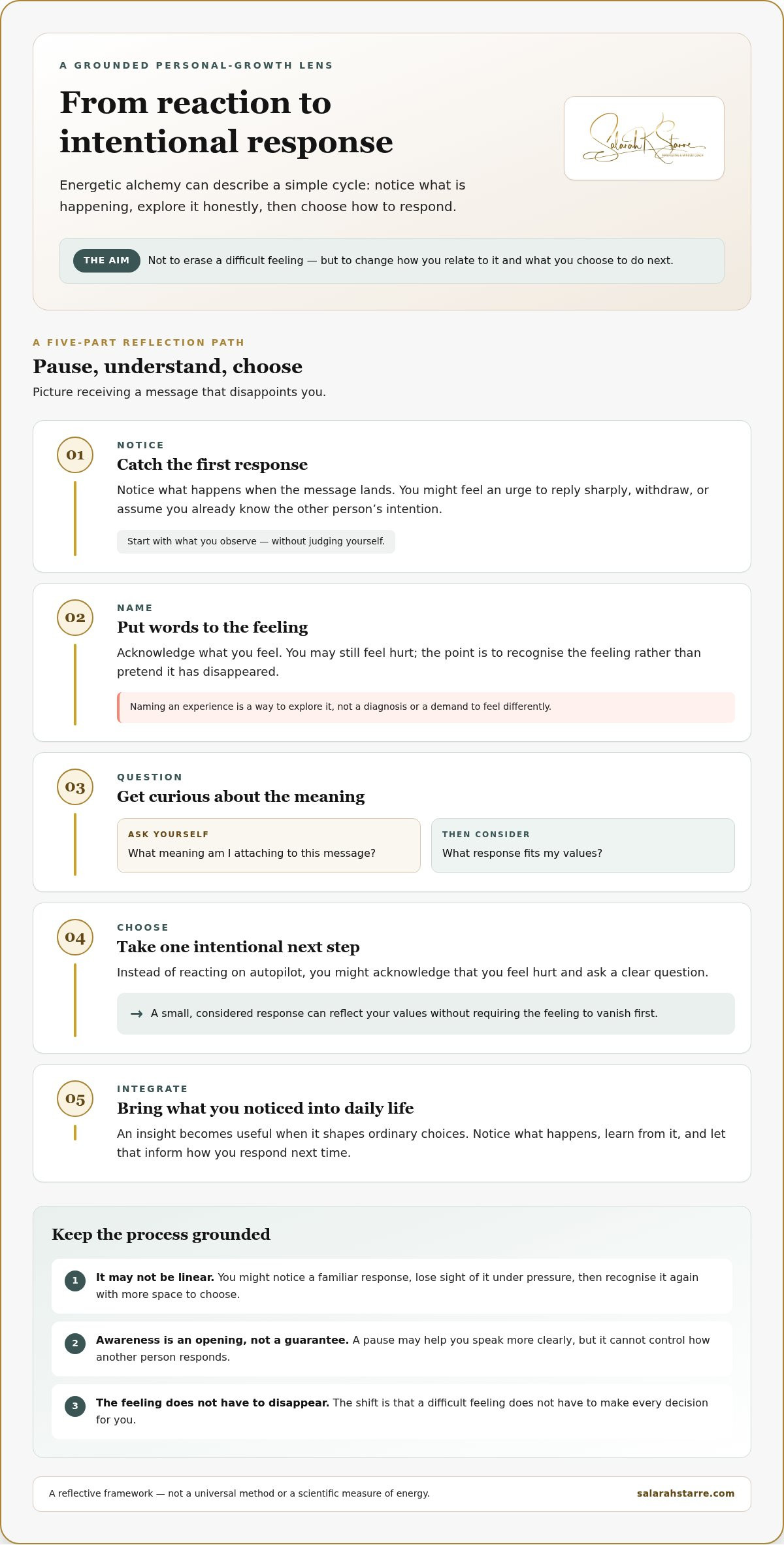
Imagine receiving a message that disappoints you. Your first impulse might be to reply sharply, withdraw or assume you know the other person’s intention. An alchemical lens invites a pause: what are you feeling, what meaning are you attaching to the message, and what response fits your values? You might still feel hurt. You can acknowledge that and choose to ask a clear question rather than react on autopilot.
Where Subconscious Patterns Meet Awareness
Familiar beliefs can quietly influence choices, boundaries and reactions. If you’ve learnt to keep the peace at any cost, for example, you may agree to something before checking what you actually want. Recognising that tendency isn’t a diagnosis or a reason to blame yourself. It gives you a chance to notice the impulse and try a different response. This connects with the nervous system and manifestation, where inner experience can inform how you approach intentions and action.
Awareness creates an opening, not a guarantee. A pause may help you speak more clearly, but it can’t control how another person responds. Inner alignment means choosing actions that reflect your values; it does not give you control over other people or external events. That boundary keeps spiritual language from becoming a promise that the right mindset can command reality.
Some approaches to inner change sit alongside distinct spiritual practices rather than replacing them. For example, the International Center for Reiki Training describes Reiki as a specific practice; a personal-growth framework may use different tools or language. The labels matter less than understanding what a method involves and what it does not claim to control.
Why Integration Matters More Than a Sudden Breakthrough
An insight becomes useful when it starts shaping ordinary choices: the boundary you communicate, the conversation you stop avoiding, or the commitment you reconsider. Integration means bringing what you’ve noticed into daily behaviour, then learning from what happens. It may look modest, but it still counts.
Feelings such as anger, fear or sadness aren’t proof that you’ve failed to transform. They’re experiences to meet with curiosity, not enemies you must eliminate before moving forward. Change may involve trying a new response, slipping into an old one and beginning again. Give yourself room to practise without demanding perfection; patience and personal agency matter more than a dramatic breakthrough.
If you want support connecting reflection with everyday choices, one-to-one coaching offers a space to explore inner patterns and intentional action.
Energetic Alchemy Compared with Reiki, Manifestation and Positive Thinking
These terms can appear side by side in spiritual and personal-growth conversations, but they aren’t interchangeable. The question “what is energetic alchemy?” has no single answer shared by every practitioner, so compare the ideas by their focus rather than assuming they describe one method. The distinctions below are useful starting points, not fixed definitions for every tradition or approach.
| Idea | Typical focus | Key distinction |
|---|---|---|
| Energetic alchemy | Reflecting on inner experience and how you respond to it | A flexible metaphor or framework, not one standard practice |
| Reiki | A distinct energy-based practice | A named practice, not another term for energetic alchemy |
| Manifestation | Intention, desired outcomes and the actions connected to them | Focuses more directly on what someone hopes to create |
| Positive thinking | Choosing constructive or hopeful thoughts | By itself, it doesn’t address every emotion, belief or behaviour |
Is Energetic Alchemy the Same as Reiki or Spiritual Alchemy?
No. Reiki is a named practice, whilst energetic alchemy is used less consistently and may describe different personal-growth or spiritual approaches. A practitioner may include Reiki in their own interpretation, but that doesn’t make Reiki part of every version. Spiritual alchemy can also refer to inner transformation, depending on the tradition and the meaning its practitioners give the term.
Some approaches look beneath visible reactions to explore beliefs and patterns that may influence them. For instance, shadow work for self-sabotage is one way to examine a recurring response without assuming it defines you. It’s a reflective lens, not proof of a hidden force or a diagnosis.
How Is It Different from Manifestation or Positive Thinking?
Manifestation often centres on an intention or desired outcome. Energetic alchemy may instead focus on what’s happening internally as you relate to that intention: the feelings, assumptions and choices involved. These ideas can overlap, but wanting a particular result doesn’t mean you can guarantee it or control other people and events. Intentions can inform action; they can’t command the world to comply.
Constructive thinking can help you notice possibilities and keep moving. But insisting on positivity may leave little room to acknowledge disappointment, fear or ambivalence. Those feelings aren’t evidence that you’re doing personal growth badly. Honest reflection can help you understand what’s underneath a response, while a practical next step gives that understanding somewhere to go. The aim isn’t to replace difficult thoughts with approved ones. It’s to respond with more awareness and choice.
Use the labels as prompts, not promises. Ask what a practice means by “energy”, what it invites you to do, and whether its claims stay within what you can reasonably know. A grounded approach makes room for spiritual meaning without confusing metaphor with measurement or aspiration with guaranteed results.
How to Explore Energetic Alchemy Without Forcing a Transformation
If you’re exploring what is energetic alchemy in everyday life, begin with curiosity, not pressure to become a different person. This four-step reflection is a self-reflection prompt, not treatment, a diagnostic tool or a guaranteed way to transform how you feel. You can use it briefly, write your answers down or set it aside if it doesn’t feel useful.
A Simple Reflection for Noticing Your Current State
Choose a manageable situation rather than the hardest thing you’ve ever faced. Notice what’s happening without judging yourself or deciding that one feeling reveals a hidden cause. Then use the four prompts below to create space between an automatic response and your next choice.
- Notice: Describe the situation in plain terms. What happened, and what do you notice in your thoughts, feelings or body?
- Name: Put a simple name to the emotion or impulse, such as irritation, worry or the urge to withdraw. It doesn’t need to be the perfect word.
- Question: Ask whether a familiar belief or response might be present. For instance, are you assuming you must say yes to avoid disappointing someone? Treat this as a possibility to consider, not a fact or diagnosis.
- Choose: Identify one realistic action that reflects your values. You might ask for time to think, make a clear request or decide to revisit the situation later.
In brief: notice what’s happening, name what you feel, question a familiar response, then choose one small action aligned with your values. You don’t have to solve the entire situation in one sitting. The aim is to respond with a little more awareness, not to force an instant breakthrough or label every reaction as a pattern.
When Self-Reflection Is Not Enough
Reflection can help you organise your thoughts, but you don’t have to push through if it starts to feel overwhelming. Pause, ground yourself in the present or return to the exercise another time. If distress persists or you need help with your wellbeing, seek appropriate support. Spiritual reflection and coaching aren’t substitutes for clinical care.
Coaching can offer a structured space for reflection, accountability and personal development. A coach may help you examine beliefs, clarify what matters to you and consider actions that fit your goals. Coaching is not clinical psychotherapy or crisis support, and it can’t promise a particular emotional outcome. If you’re already receiving clinical care, don’t replace or change it on the basis of a spiritual practice.
If you’d like support turning reflection into intentional action, explore one-to-one coaching with Salarah.
How Coaching Can Put Energetic Alchemy into Everyday Practice
There’s no official coaching definition of energetic alchemy. Salarah K Starre’s approach is one grounded perspective: spiritual language can prompt reflection, whilst practical work connects inner patterns with choices in everyday life. With nearly two decades of experience in mindset and manifestation coaching, she brings together shadow work, subconscious awareness, nervous system awareness and energetic alignment as part of her personal-growth approach. These ideas offer a framework for exploration, not a promise of a particular result.
In this context, “energy” can describe someone’s felt experience or emotional tone, rather than a measurable force. The useful question is what you notice about your thoughts, reactions and behaviour, and how that awareness might inform your next choice.
What a Subconscious-Focused Coaching Perspective Adds
Some responses feel automatic because familiar beliefs and learned behaviours can shape how we interpret situations. Coaching offers space to examine those patterns with curiosity. For example, someone who often dismisses their own needs might explore the belief behind that response, consider what they value and practise expressing a preference. That doesn’t mean every recurring behaviour has one hidden cause, or that the same approach suits everyone.
Shadow work can invite reflection on thoughts or impulses a person would rather avoid. Subconscious awareness can help bring familiar assumptions into view, whilst energetic alignment may be used to explore whether a person’s actions feel consistent with their intentions. Together, these ideas can support reflection on self-trust and agency. Insight matters, but it isn’t the whole process: a person still decides what, if anything, they want to do differently.
Readers curious about how these themes can be explored together can find a practical overview in the energetic alignment workshop guide. It offers one practitioner’s perspective, not a universal blueprint for energetic alchemy.
A Thoughtful Next Step for Curious Readers
Keep the central idea simple: use energetic language as a prompt to notice inner experience, reflect on patterns and consider aligned action. You don’t need to adopt a particular spiritual explanation to ask whether your choices reflect what matters to you. Nor must every difficult moment become a project to fix. Sometimes the next step is simply recognising what’s happening and giving yourself time to respond.
Explore at your own pace. Coaching can offer a space to reflect and develop personal insight, but it isn’t clinical psychotherapy or crisis support, and it can’t guarantee healing or manifestation outcomes. Choose the ideas that help you think more clearly, leave what doesn’t resonate, and let change take shape through considered choices rather than pressure.
To learn more about this personal-growth perspective, explore Salarah’s approach.
Let Your Next Choice Be the Starting Point
You don’t need to settle on one spiritual explanation before making a meaningful change. If you’re still asking what is energetic alchemy, let the question lead to something practical: what would it look like to meet your next decision with more honesty and intention? Start there. Small choices can bring reflection into real life without demanding instant transformation.
Salarah K Starre brings nearly two decades of experience in mindset and manifestation coaching to her work as a bestselling author and podcast host. Her perspective connects inner awareness with personal growth, while leaving room for you to decide what resonates and what action feels right for you.
Ready to explore this perspective with support? Explore Salarah’s one-to-one coaching and take a grounded next step towards greater self-trust and personal power.
Frequently Asked Questions
Is energetic alchemy a recognised psychological therapy?
No. Energetic alchemy is used as a spiritual or personal-growth idea, not as a standardised psychological therapy. Different practitioners may use the phrase for different approaches, so it doesn’t tell you exactly what a session involves. If you’re looking for help with a mental health concern, speak with your GP or an appropriate mental health professional. Spiritual reflection or coaching shouldn’t replace clinical care.
Can energetic alchemy be practised without following a religion?
Yes. You don’t have to belong to a religion to use energetic alchemy as a reflective idea. Some people connect it with spiritual beliefs or traditions; others find the metaphor useful for considering their reactions and choices without adopting a faith. You can decide which language feels meaningful to you and leave aside explanations that don’t fit. A particular practitioner’s spiritual framework isn’t automatically universal.
How long does energetic alchemy take to work?
There’s no set timeframe and no guaranteed result. The phrase can refer to different practices, so what someone means by “working” also varies. You might notice a new perspective quickly, whilst changing a familiar behaviour could take repeated attention and practice. Rather than measuring progress by a dramatic breakthrough, look for specific changes you can observe, such as expressing a boundary more clearly or making a decision with greater care.
What does energetic alchemy feel like?
There isn’t one sensation that proves energetic alchemy is happening. Some people may describe feeling reflective, emotionally stirred or more settled; others may notice no distinct physical sensation at all. A strong feeling is not proof of a spiritual mechanism, and a quiet experience doesn’t mean you’ve failed. Focus on what you can identify, such as a thought, emotion or choice, rather than trying to produce a particular sensation.
Can I explore energetic alchemy on my own?
Yes, you can explore it through gentle reflection, journalling or meditation, without treating any one exercise as essential. For example, after a tense interaction, write down what happened, what you felt and what you might want to do next time. Keep the reflection manageable. If it brings up distress that feels hard to handle, stop and seek appropriate support rather than pushing yourself to uncover an explanation.
Is energetic alchemy based on scientific evidence?
There isn’t an agreed, standardised energetic-alchemy method whose effects can be assessed as one defined intervention. The phrase “what is energetic alchemy” has different meanings between practitioners, and spiritual claims about energy shouldn’t be presented as established scientific measurements. You can still find personal meaning in reflection, but separate that meaning from claims of proven effects. Look for clear explanations of what a practice involves and avoid treating promises as evidence.
Does energetic alchemy mean changing other people or external events?
No. It shouldn’t be taken as a way to control another person’s choices or guarantee a particular event. You can influence your own decisions, communication and boundaries, but other people retain their agency and circumstances may remain uncertain. If you’re hoping for a specific outcome, consider what actions are within your control, what depends on someone else and how you might care for yourself if events unfold differently.


