

What if you don’t need to feel fearless before taking the next step? When you’re dealing with a fear of failure, even an ordinary decision can feel like a verdict on your worth. You might rehearse every possibility, put things off until you feel completely ready, or take a setback as proof that you’re not capable. These responses can feel protective, but they can also keep you stuck.
Fear can become easier to work with when you build self-trust through action and learn from what happens. You don’t have to dismiss what feels difficult or force a giant leap. Start with a manageable move and notice what you learn.
This article explores patterns that can sit beneath fear, including perfectionism and tying your value to achievement. It also offers five practical steps to help you move forward, build self-trust through experience and recognise when deeper reflection or personalised support could help. The goal isn’t to guarantee success. It’s to stop waiting for fear to disappear before you begin.
Key Takeaways
- Recognise when fear is making a meaningful next step feel more dangerous than it may be.
- Explore how past experiences, uncertainty and anticipated judgement can shape your expectations.
- When dealing with a fear of failure, question a prediction without pretending the outcome is guaranteed.
- Use five manageable steps to turn hesitation into action and learn from what happens.
- Notice when recurring patterns may call for deeper reflection or personalised coaching support.
Dealing with a fear of failure: how to recognise what is holding you back
A meaningful next step can start to feel like a high-stakes test. You might want to apply for a role, share an idea or try something new, yet find yourself rehearsing every possible mistake. Dealing with a fear of failure begins by noticing how the possibility of getting something wrong is influencing your choices. That response deserves attention, not judgement.
Fear of failure is the anticipation of a setback or negative judgement, and the protective behaviours you use to try to avoid it. It’s an experience, not an identity. It may shape your decisions, but it doesn’t define your character or capacity. For some people, the worry centres on embarrassment; for others, it’s about disappointing someone, losing an opportunity or finding that a hoped-for goal is difficult to reach. The related concept of fear of negative evaluation describes concern about how others may judge or assess us.
What fear of failure can look like in everyday life
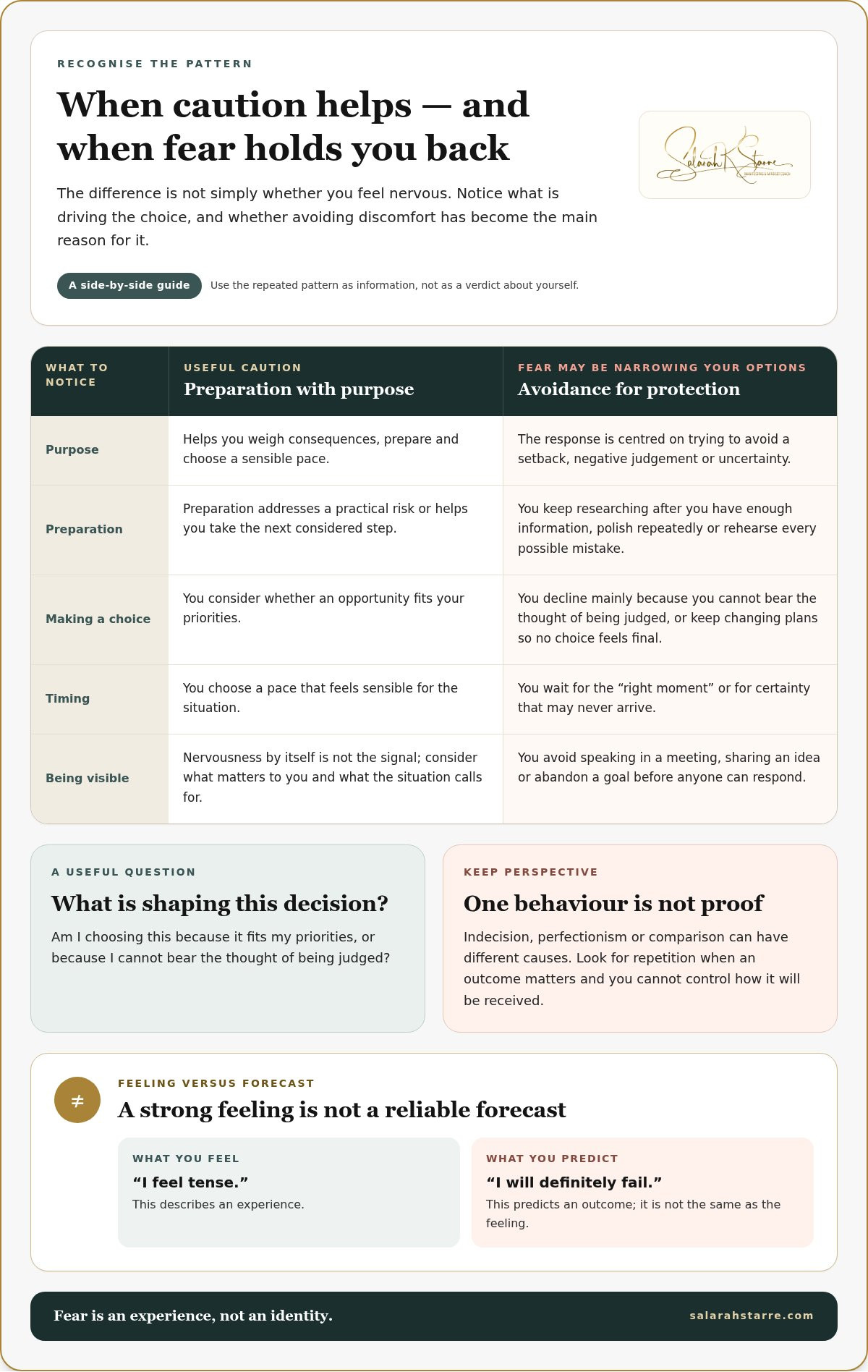
Fear doesn’t always feel like panic. It can look like diligence, caution or high standards. You might research a task long after you have enough information, polish your work repeatedly or wait for the “right moment” to share it. You may avoid being visible, such as speaking up in a meeting, or abandon a goal before anyone can respond.
Other patterns include indecision, perfectionism and constant comparison. You might scan other people’s progress for proof that you’re behind, or keep changing your plan so no choice feels final. These behaviours can have different causes, and none alone proves that fear of failure is at work. Look for repetition: what do you tend to do when an outcome matters and you can’t control how it will be received?
When caution starts limiting the life you want
Some caution is useful. It helps you weigh consequences, prepare and choose a sensible pace. The signal to examine isn’t simply “I feel nervous”. It’s whether avoiding discomfort has become the main reason for your decision. Are you declining an opportunity because it doesn’t fit your priorities, or because you can’t bear the thought of being judged? Are you preparing, or waiting for certainty that may never arrive?
Notice what keeps being postponed: a conversation, application, creative project or change you care about. You don’t need to force yourself into a dramatic leap. Name the pattern and consider what it costs you. Recognition isn’t weakness or another problem to fix. It’s useful information about where a protective response may be narrowing your options, and where a more considered choice could begin.
Why fear of failure can feel so powerful: patterns, protection and uncertainty
Fear of failure can feel larger than the task in front of you because you may be responding not only to the practical risk, but also to what an unwanted outcome seems to mean. A rejected application might feel like proof you’re not good enough. A mistake at work might seem likely to bring criticism or cost you trust. Fear can act as a protective response to anticipated judgement, loss or uncertainty, encouraging you to prepare, pause or avoid. Its intention may be protection, but its impact can still be restrictive.
That response isn’t a reliable forecast. It signals that something feels at stake. You may notice tension, a racing heart, restlessness or difficulty concentrating when facing an uncertain outcome. These bodily stress responses can accompany fear, but they don’t prove danger is present or reveal the cause. Ask yourself: “What is this reaction warning me about, and what do I actually know?”
How earlier experiences can shape expectations
Past experiences may colour how you approach a new challenge. If an early attempt was met with sharp criticism, you might expect similar judgement when sharing your work now. High expectations, a painful setback or repeated pressure to get things right may also influence what feels safe. These are possible connections to explore, not a diagnosis or a single explanation that fits everyone. Reflection can help you notice a pattern without treating it as proof of where it came from.
If the same response keeps appearing in different areas of life, shadow work for self-sabotage offers related context for exploring recurring patterns and the beliefs that may sit beneath them.
The role of stress and nervous system awareness
Uncertainty can be harder to tolerate when you’re already under pressure, tired or managing competing demands. In that state, a difficult conversation or unfamiliar task may feel more daunting than it would at another time. This doesn’t mean ordinary fear is trauma, or that a particular nervous system condition is present. It’s a reason to notice your state before deciding what the fear means.
Pause and identify what’s happening: the situation, the thought attached to it and the physical sensations you notice. Then separate the signal from the prediction. “I feel tense” describes an experience; “I will definitely fail” predicts an outcome. They aren’t the same. For a related perspective, explore the nervous system and manifestation.
Dealing with a fear of failure doesn’t require ignoring discomfort or obeying it automatically. Consider whether there’s a practical risk to address, a preparation step to take or an uncertainty you can’t resolve in advance. Salarah K Starre’s personalised one-to-one coaching focuses on mindset, manifestation and the subconscious patterns that can contribute to self-sabotage. Explore personalised coaching and personal change.
Fear of failure is not a fact: challenge the beliefs keeping it in control
Fear can sound like certainty: “If I put this forward, they’ll reject it.” “If I get it wrong, everyone will know I’m not capable.” Yet a strong feeling doesn’t make its prediction true. Fear is information about what feels at stake, not proof of what will happen. You don’t need to silence it or replace it with forced positivity. Listen, examine the evidence and choose your next move with care.
A common trap is waiting to feel no fear before acting. That can keep a decision in limbo, because confidence often grows through experience rather than arriving fully formed beforehand. The aim isn’t to guarantee success. It’s to make room for a considered choice, even while uncertainty remains.
Fear, evidence and prediction are not the same thing
When a feared outcome feels inevitable, separate three things: what you know, what you’re assuming and what remains unknown. You may know that a proposal will be reviewed. You may assume one critical comment would end your prospects. You may not know how the reviewer will respond. This isn’t a demand to think positively. It’s a way to see the situation clearly, without treating a prediction as fact.
| Belief | A more balanced view |
|---|---|
| “If this goes badly, it proves I’m incapable.” | “A disappointing result tells me about this attempt, not my entire worth or future potential.” |
| “I must feel confident before I begin.” | “I can prepare thoughtfully and still take a first step while feeling uncertain.” |
| “I can’t risk making a mistake.” | “I can consider the likely consequences, then decide what level of risk I’m willing to take.” |
A balanced view doesn’t erase real consequences or promise that everything will work out. It stops one possible outcome from becoming a total verdict on who you are.
Why perfectionism can make every attempt feel high-stakes
Rigid standards can turn a task into a test of personal worth. If a presentation must be flawless to count as acceptable, every draft may feel exposing. Preparation helps when it meets a genuine need, such as checking facts or practising your opening. It becomes a barrier when you keep polishing to avoid the moment someone else might see the work.
Try a more workable standard: deliberate effort, useful learning and room for imperfection. Before you begin, decide what “ready enough” means for this attempt. You might check the key information, rehearse once and then share the draft for feedback. That doesn’t guarantee praise. It gives you real information to work with instead of another round of imagined outcomes.
When dealing with a fear of failure, you can challenge the rule that you must be flawless or fearless before moving. Salarah K Starre’s personalised one-to-one coaching helps clients explore recurring patterns, self-sabotage and ways to build self-trust.
Overcoming fear of failure: 5 steps to take action
You don’t have to wait for fear to vanish before moving. Make the next step small enough to approach, clear enough to complete and useful enough to teach you something. This isn’t about forcing confidence or guaranteeing a particular result. It’s about responding to fear with curiosity and choice, rather than letting it make every decision for you.
Small actions create evidence you can use to build self-trust. Start with one situation that matters to you, then work through these steps at a manageable pace.
- Name the fear. Describe the feared outcome plainly, without making it bigger or brushing it aside. “I’m worried my manager will question my idea” is more workable than “Everything will go wrong”. Naming the concern helps you identify what feels at stake and what you’re trying to protect.
- Test the prediction. Write down what you know, what you’re assuming and what you can’t know yet. Ask what evidence supports the prediction and what other outcomes are possible. You don’t need to persuade yourself that success is certain. Check whether fear is presenting one possibility as the only one.
- Reduce the task. Break the challenge into a first action that fits your circumstances. If your larger goal is to present an idea, a smaller step might be drafting three points or sharing an early version with one trusted colleague. Choose something that moves you forward without requiring you to solve the whole challenge at once.
- Act within your control. Identify what you can influence, such as preparing your notes, setting aside time or asking for relevant information. Then complete the chosen action. Measure progress by whether you took that step, not by whether you controlled another person’s response or secured a perfect outcome.
- Reflect and choose what comes next. Note what you expected, what actually happened and what you learned. Acknowledge your effort without forcing a positive interpretation. The outcome may have been disappointing, or less difficult than expected. Either way, use what you know to choose a proportionate next step.
Keep the review simple. You might write: “I expected ____. What happened was ____. I learned ____. Next, I’ll ____.” This record helps distinguish what fear predicted from what the experience showed, giving you a practical reference point the next time uncertainty appears.
Dealing with a fear of failure isn’t about taking the biggest leap or pretending risk doesn’t exist. It’s about choosing an action that respects your limits and goals, then learning from the result. If you’d like personalised support as you explore your patterns and next steps, explore Salarah K Starre’s approach.
When fear of failure keeps returning: explore deeper support and next steps
You’ve reflected, tried manageable actions and still find the same fear returning. That doesn’t mean you’ve failed to make progress. The pattern may be persistent, hard to see clearly on your own or connected to beliefs that appear in more than one area of life. Self-guided reflection can help, but you don’t have to work everything out alone.
Signs that personalised reflection may help
Notice whether you repeatedly avoid something that matters, even after making sincere efforts to respond differently. Perhaps you delay sharing your work, withdraw when an opportunity becomes real or find a new reason to postpone each time you get close. Ask whether the same fear appears across different goals, relationships or decisions. This isn’t a test to pass. It’s a way to recognise a pattern and consider whether another perspective could help.
You may prefer to keep practising independently, talk things through with someone you trust or take time to reflect. Consider additional support if the pattern feels entrenched, causes ongoing distress or repeatedly pulls you away from choices that matter. Seeking support can be a practical step, not an admission that you’re incapable.
What a grounded coaching approach can make space for
Personalised coaching can make space to examine the beliefs and emotional patterns influencing your decisions, and to explore what self-trust might look like in practice. The work can move at your pace. It offers reflection, perspective and considered next steps, rather than a guaranteed outcome or clinical treatment.
Salarah K Starre’s approach combines subconscious reprogramming, shadow work and nervous system awareness as part of personal exploration. These perspectives can help you look beneath a repeated response without assuming there is one universal cause. The aim is not to label you or force a particular choice, but to explore what may be shaping your behaviour and what you want to do next.
The Magnetic Recalibration is Salarah K Starre’s signature transformational programme, designed to align energetic states and clear emotional blocks. It focuses on recalibrating the subconscious mind to move away from fear-based manifesting and towards more authentic choices. Coaching and the programme offer different ways to explore personal patterns and change.
Dealing with a fear of failure can involve both practical action and deeper reflection. Start where you are, choose the kind of support that feels right for you and move at a pace you can sustain. Visit Salarah K Starre’s website to explore her coaching and transformational programmes.
Choose one next step that belongs to you
You don’t have to make a sweeping promise about who you’ll become. Choose one action that reflects what matters to you, even if it feels imperfect or uncertain. That might mean trying again, changing your approach or deciding that this particular goal no longer fits. The power lies in making the choice consciously, rather than letting fear make it for you.
Dealing with a fear of failure is an ongoing practice of meeting uncertainty with honesty and care. You can take a step, learn from it and decide what comes next. There’s no need to demand instant confidence from yourself.
If you’d value support as you explore what’s shaping your choices, Salarah K Starre brings nearly two decades of experience in coaching and personal transformation to her work as a bestselling author and podcast host. Her approach integrates shadow work, nervous system awareness and energetic alignment. Explore Salarah K Starre’s coaching and transformational work as a possible next step.
Start where you are. One considered move is enough to begin.
Frequently Asked Questions
Is fear of failure normal?
Yes, feeling apprehensive about getting something wrong is a common human response, especially when an outcome matters to you. It might show up before an exam, a work presentation or an honest conversation. The feeling alone doesn’t mean something is wrong with you. Notice its impact: if it repeatedly stops you doing things you value or causes ongoing distress, consider what support or reflection might help.
Can fear of failure be useful?
It can prompt you to prepare, check a decision or think through genuine consequences. Concern about a presentation, for example, might encourage you to practise and clarify your key points. Fear is less useful when it keeps demanding more preparation without helping you decide. Ask whether it’s pointing to a practical issue you can address, or urging you to avoid all uncertainty.
What is atychiphobia?
Atychiphobia is a term used for an intense fear of failure. The word may help describe a distressing experience, but it isn’t enough on its own to establish a diagnosis or explain what’s causing the fear. People’s experiences vary. If fear feels overwhelming, persistent or disruptive to daily life, speaking with a qualified health professional can help you understand what’s happening and discuss appropriate support.
Why am I afraid of failing even when the stakes seem low?
A seemingly small task can carry a personal meaning that isn’t obvious from the outside. Sending a message, for instance, may bring up worry about sounding foolish, disappointing someone or being misunderstood. Stress, previous experiences and the importance you attach to another person’s opinion may all play a part. Ask what you fear the outcome would say about you, rather than judging yourself for feeling anxious.
Can fear of failure affect relationships?
Yes, it may influence how someone communicates or handles closeness. A person might avoid raising a concern for fear of an argument, hold back affection to avoid rejection or seek repeated reassurance that they haven’t upset their partner. These behaviours can have many causes and won’t apply to everyone. Noticing a pattern can help you decide whether an honest conversation or outside support could be useful.
Does fear of failure ever go away completely?
There’s no single answer, and nobody can promise that fear will disappear for good. It may ease in some situations and return in others, particularly during change or uncertainty. A more practical aim is to notice it sooner and make choices that reflect your needs, rather than waiting for perfect confidence. If it continues to interfere with everyday life, consider discussing your experience with a qualified professional.


