

What if the thoughts you call “bad with money” began as ways to feel safer when resources were uncertain? The signs you have a poverty mindset can include feeling guilty about necessary spending, bracing for good opportunities to vanish, or struggling to believe success will last. These patterns aren’t proof of personal failure, and they don’t mean your financial hardship is all in your head.
If money has felt tight or unpredictable, caution may be a reasonable response to real conditions. Scarcity can also narrow your attention towards the most urgent problem, making it harder to think beyond what needs handling now. Both realities matter. You deserve understanding, not blame.
This article explores nine possible scarcity-driven patterns and how past experiences may shape your present responses. You’ll learn to notice them without turning them into a label, distinguish emotional habits from material pressures, and choose a grounded next step. Treat each sign as a prompt for reflection, not a diagnosis or a verdict on your character.
Key Takeaways
- Use the signs you have a poverty mindset as prompts for reflection, not a score, diagnosis or fixed identity.
- Explore how family messages, instability and lived experience may have shaped your expectations around money.
- When a scarcity thought appears, notice the trigger, name the thought, check the facts and choose one response.
- Look beneath recurring patterns by considering their context, what they may be protecting you from and how they affect you now.
- Subconscious work, shadow work and nervous-system awareness can offer lenses for reflection without replacing practical support for financial hardship.
What does “poverty mindset” mean - and what does it not mean?
A poverty mindset is a non-clinical shorthand for recurring thoughts and behaviours shaped by an expectation of scarcity, such as believing resources will run out or opportunities won’t last. It describes a possible pattern in how someone responds to money and security. It is not a diagnosis, a measure of character or an explanation for why someone is poor.
That distinction matters. Poverty is not a personal failure or proof of a flawed mindset. Low income, insecure work, rising household costs, limited access to opportunities and unexpected expenses can create real financial constraints. A change in attitude cannot make those pressures disappear.
The signs you have a poverty mindset, as this phrase is commonly used, are best understood as invitations to notice recurring expectations, not evidence that you caused your circumstances. External pressure and internal beliefs can exist at the same time, but they aren’t the same thing.
Scarcity mindset is a pattern, not a diagnosis
“Poverty mindset” isn’t a formal mental-health diagnosis. It’s an informal label for thoughts or responses that may develop around a sense of not having enough. For example, someone might struggle to use a day off even when they’re entitled to it, because resting feels unsafe or undeserved. That reaction may be worth exploring, but it proves nothing on its own.
Careful spending can be sensible, especially when money is genuinely tight. Worrying about a bill, comparing prices or prioritising essentials may reflect the facts of your situation, not a harmful pattern. Look at how often a response occurs and what is happening around it, rather than treating one decision as a verdict on who you are.
Why financial hardship must not be reduced to mindset
Financial security is shaped by more than individual thinking. Income, housing costs, health, caring responsibilities, employment conditions and unequal access to resources all affect what choices are realistically available. Telling someone to think positively cannot pay rent, create stable work or replace practical support. Mindset language becomes harmful when it turns structural pressures into personal blame.
Ideas about how beliefs and behaviours may persist across generations are sometimes discussed through the Culture of poverty concept. It’s a contested framework, not a simple explanation for poverty or a label to place on individuals. Family messages and lived experience can shape expectations, but they don’t determine a person’s future or remove the impact of material conditions.
A grounded approach holds both realities together. You can ask whether an old expectation is influencing your choices, while also naming what is currently outside your control. Reflection may help you understand your responses; it should sit alongside practical action, such as identifying immediate needs and seeking appropriate support. You don’t have to deny hardship to explore a pattern, and you don’t have to blame yourself to begin changing how you relate to it.
Signs you have a poverty mindset: patterns worth noticing
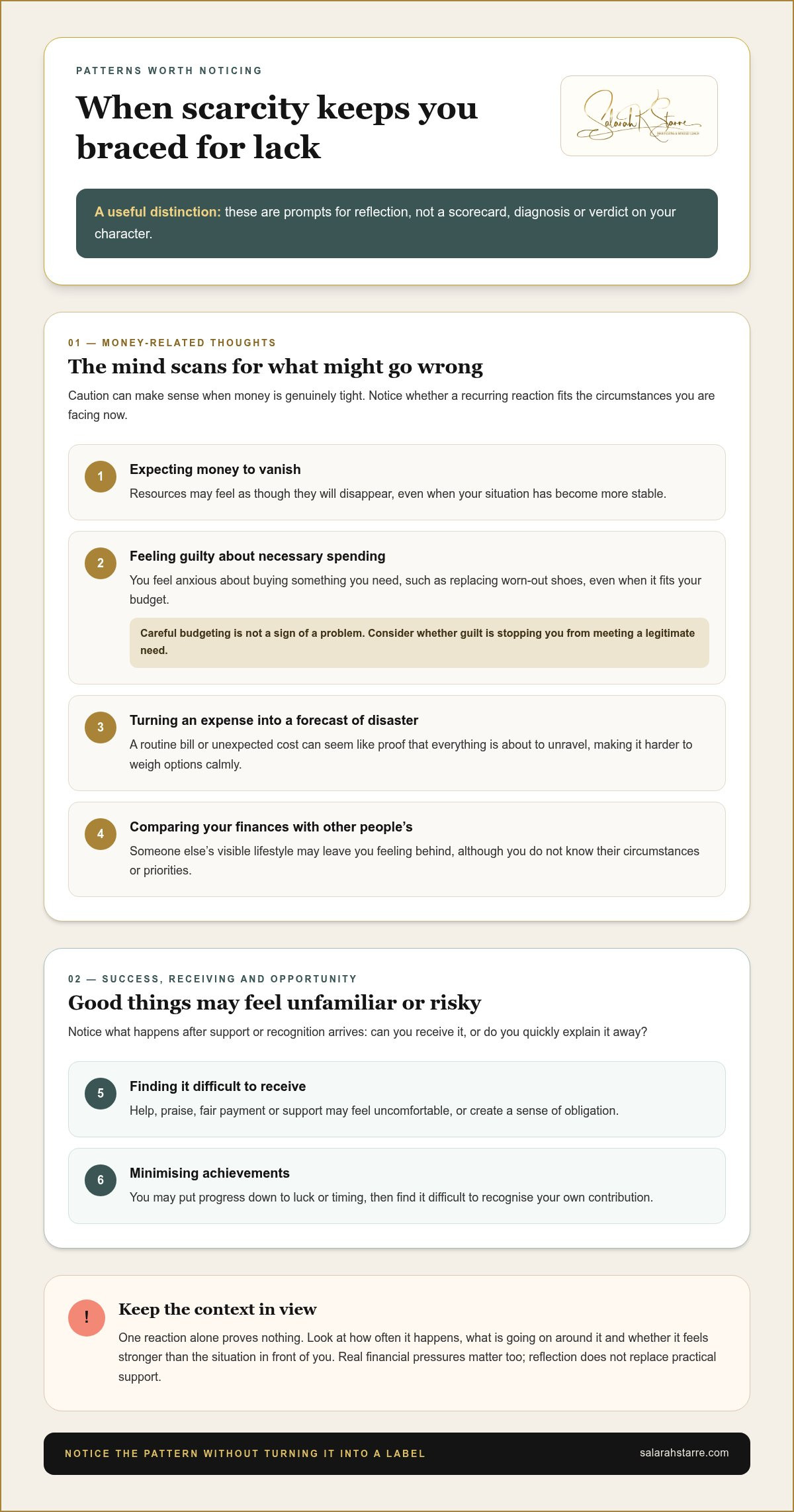
These possible signs are prompts for reflection, not a scorecard. One sign alone proves nothing about your mindset, character or financial circumstances. A repeated reaction may be worth noticing if it feels stronger than the situation in front of you, particularly if it continues after your circumstances have changed.
The signs you have a poverty mindset can look different from person to person. Some relate to spending; others show up around success, work or connection. Use the examples to get curious, not to label yourself.
Money-related thoughts that keep you braced for lack
Scarcity can keep the mind scanning for what might go wrong. That vigilance may be useful when money is genuinely short, but exhausting when it takes over every decision. Consider whether your response fits your current circumstances. Ask what information you have, what remains uncertain and whether the fear is making it harder to weigh your options.
- Fear that money will vanish: You may expect resources to disappear, even when your situation has become more stable.
- Guilt about reasonable spending: You feel anxious buying a necessary item, such as replacing worn-out shoes, despite knowing it fits your budget. Careful budgeting is not a sign of a problem; consider whether guilt is stopping you from meeting a legitimate need.
- Expecting financial disaster: A routine bill or unexpected expense immediately becomes proof that everything is about to unravel. This can narrow your attention to the next threat and make it harder to weigh options calmly.
- Comparing your finances with others: You measure your progress against someone else’s visible lifestyle and decide you’re falling behind, without knowing their circumstances or priorities.
Success, receiving and opportunity may feel unsafe
Scarcity patterns can reach beyond spending. Support, recognition and possibility may feel unfamiliar or risky, even when they’re welcome. Notice what happens just after something good arrives. Do you let yourself receive it, or quickly explain it away, work harder to earn it again or prepare for it to be taken from you?
- Difficulty receiving: You dismiss help, praise, fair payment or support because accepting it feels uncomfortable or creates a sense of obligation.
- Minimising achievements: You attribute progress to luck or timing, then struggle to recognise your own contribution.
- Bracing for setbacks: Success brings little relief because you’re already expecting a reversal.
- Overworking to feel secure: You keep taking on more, even when rest is needed, because slowing down feels like risking everything.
- Dismissing opportunities: You turn down a possible next step before exploring it, perhaps to avoid disappointment, scrutiny or the fear of not being able to sustain success.
None of these reactions automatically means you should say yes, spend more or push beyond your limits. Instead, ask: “Is this choice responding to what’s true now, or to what I fear might happen?” If a pattern keeps constraining your choices, personalised mindset coaching can offer space to explore it with curiosity and care.
Why scarcity patterns take hold: past learning, protection, and present stress
Money responses rarely appear in a vacuum. Messages heard growing up, periods of instability and personal experience can all influence what feels safe, possible or deserved. Context, learned expectations and present-day reactions can intersect, shaping how someone responds to money without determining their future.
For one person, saving every spare pound may reflect a current need for security. For another, the same impulse may continue even after their circumstances have shifted, because uncertainty still feels close. The signs you have a poverty mindset are not proof of a particular past or a flaw in your character. They’re a reason to explore what a response might be connected to, while staying open to other explanations.
Learned money messages and family stories
Think about the phrases you heard, directly or indirectly: “We can’t afford that”, “people like us don’t get ahead”, or “you have to work twice as hard to feel secure”. Some messages may have been practical in a particular period; others may have carried fear, pride or beliefs about who deserves comfort. Your family may have talked openly about money, avoided the subject or held views shaped by a different experience.
These stories can influence behaviour, but they don’t dictate it. You might notice that a familiar message still guides a decision, then ask whether it fits your life now. There’s no need to condemn the people who passed it on or assume every reader shares the same family or cultural history.
When staying small or hypervigilant once felt safer
Avoiding attention, risk or help can sometimes feel protective. If change once brought uncertainty, keeping expectations low may have seemed safer than hoping for more and facing disappointment. That response doesn’t guarantee trauma, and it isn’t a defect. It may simply be one way a person learnt to manage what felt unpredictable.
Nervous-system awareness can be one reflective lens. Notice whether a money-related choice brings urgency, tension or a strong urge to retreat. These sensations aren’t a diagnosis or proof that danger is present. They can prompt a pause before deciding what the situation calls for. Salarah explores the nervous system and manifestation as related context for considering how felt safety and expectations may interact.
Try separating the present fact from the prediction. What’s happening now: an actual shortfall, an uncertain bill or a new opportunity? What does the fear expect will happen next? Check the available information, such as the due date or current budget, without dismissing a real constraint. If money is genuinely tight, practical pressures need practical responses. If the alarm feels bigger than the evidence, that may be a pattern to explore with patience, not a command you must obey.
How to reflect on these signs without shaming yourself
Self-reflection works best when it creates space between a trigger and your response. The aim isn’t to prove you have a particular mindset or force yourself to feel differently. It’s to notice what’s happening, check what’s true and choose a next step that respects both your feelings and your circumstances.
A four-step check-in for a scarcity-driven reaction
Try this brief sequence when a money-related response feels intense. A few notes on your phone or in a notebook are enough. Keep the tone curious, not prosecutorial.
- Notice the trigger. What happened just before the reaction? Perhaps you received an unexpected bill, were offered help or considered applying for a new role. Name the feeling that surfaced, such as fear, guilt, pressure or embarrassment.
- Name the thought. Write it as a thought, not a fact: “I’m thinking this will go wrong” or “I’m telling myself I shouldn’t accept help.” This small shift can help you observe the belief without treating it as an instruction.
- Check what you know. Separate observable facts from predictions. What does the bill say? What support has actually been offered? What information is still missing? Don’t talk yourself out of a genuine financial concern; give it a clear name.
- Choose one grounded response. Pick a step that fits your needs and values. You might check a due date, ask a question, review what you can afford or accept support with a clear boundary.
Over time, you can record the situation, thought, feeling and response. Look for repetition, not perfection. If your notes turn into a list of everything you think you’ve done wrong, pause and rewrite them in neutral language: “I felt anxious after…” Journalling can help you spot patterns, but it isn’t a guaranteed fix for deeper distress or financial difficulty.
Keep emotional reflection separate from money decisions that require practical information. A journal can help you notice fear; it can’t replace checking your budget, understanding a commitment or getting suitable financial guidance. If the numbers don’t work, respond to the numbers. A mindset exercise should never pressure you to spend, borrow or take risks that don’t fit your situation.
When a deeper pattern may need supported exploration
Notice whether the same fear appears across different parts of life: money, work, relationships or receiving support. Recurring reactions may be worth exploring, but they aren’t a diagnosis. Shadow work for self-sabotage offers related pattern-focused learning, while coaching can help you examine beliefs and responses without treating reflection as financial advice.
If this feels like a pattern you’re ready to explore, explore one-to-one mindset coaching as a space to reflect on what may be driving it. For immediate money pressures, focus on practical support suited to the specific issue. You can acknowledge the emotional weight and address the material facts, one step at a time.
What working beneath a scarcity pattern can involve
Recognising a repeated reaction is a starting point, not a demand to fix yourself. Deeper reflection asks what may be shaping the response, what purpose it serves and how it affects your choices now. That exploration can sit alongside practical steps for real financial pressures. It doesn’t require pretending those pressures are only thoughts or feelings.
The signs you have a poverty mindset don’t point to one universal cause or a single route to change. A belief, an emotion and a behaviour may reinforce one another, but the pattern can look different for each person. The aim is understanding, not forcing a tidy explanation.
From spotting the pattern to understanding what it protects
Instead of deciding “I’m broken” or “I sabotage everything”, try asking what a response might be doing for you. Avoiding a promising opportunity, for instance, might reduce the immediate fear of disappointment, even if it also limits your options. That doesn’t mean avoidance is always the cause or that it must be changed in the same way for everyone.
Subconscious work can help bring less conscious beliefs into view. Shadow work offers a way to reflect on parts of yourself you may have learnt to hide or judge. Nervous-system awareness can add another lens by helping you notice how safety or tension feels in the moment. These are approaches for reflection, not diagnoses, and they don’t establish that a particular past event caused a current pattern.
As you explore, consider the context, the response’s possible protective function and its present-day impact. Does it still help you meet your needs? Does it make it harder to ask for support, receive fair recognition or consider choices that feel aligned with your values? You don’t need to rush towards a conclusion. Curiosity can make room for a different response without dismissing why the old one developed.
When personalised coaching may help you explore further
If a pattern keeps repeating and feels difficult to examine alone, personalised support may give you space to explore it with more structure. Salarah K Starre’s one-to-one coaching and The Magnetic Recalibration draw on subconscious work, shadow work and nervous-system awareness to support reflection on patterns and self-trust. The focus is personal development, not clinical psychotherapy or financial advice.
Coaching can help you look at how a belief connects with your feelings and actions, then consider what you want to practise instead. It can’t change external financial conditions through mindset alone, and there’s no guaranteed outcome. If your immediate concern is meeting essential costs or making a financial decision, practical support suited to that need matters too.
You can take this work at your own pace. If you’d like to explore whether this kind of reflective support feels right for you, explore Salarah’s work.
Choose one small shift you can practise
You don’t have to overhaul your relationship with money today. Choose one moment this week to pause before an old reaction takes over. Ask what you need now, what the facts show and what choice would feel both grounded and self-respecting. Small, deliberate shifts can help build trust in your own judgement over time.
The signs you have a poverty mindset aren’t a verdict. They can prompt you to meet yourself with honesty, question what no longer serves you and make room for choices that reflect your present life. If genuine financial pressure is part of the picture, your next step can include practical support as well as personal reflection.
Salarah K Starre brings nearly two decades of experience in mindset and transformation work. As a bestselling author and podcast host, she offers perspectives for people ready to explore their inner patterns with care and intention. Explore Salarah’s work if you’d like to consider a next step.
You are not your old patterns. You can meet them with curiosity and move forward one grounded choice at a time.
Frequently Asked Questions
Is a poverty mindset a real diagnosis?
No. “Poverty mindset” is an informal phrase, not a recognised mental-health diagnosis. It can describe repeated beliefs or reactions around scarcity, but it can’t establish a condition or explain someone’s financial circumstances. If anxiety, low mood or difficulty coping is affecting daily life, speak with your GP or a qualified mental-health professional. They can help you consider what support is appropriate without reducing your experience to a label.
Can you have a poverty mindset if you are not poor?
Yes. Someone with a comfortable income may still worry that money will disappear, feel uneasy accepting help or struggle to enjoy success. Those reactions can have different roots and don’t prove a person has a particular mindset. The signs you have a poverty mindset are best considered in context: ask whether the fear reflects a current financial risk, an expectation from past experience or a mix of both.
How do I tell careful budgeting from a poverty mindset?
Careful budgeting helps you plan for real needs and make choices that fit your means. A pattern may be worth exploring if fear repeatedly stops you meeting an essential need, even after you’ve checked the cost and your budget allows it. For example, delaying a necessary prescription because spending feels unsafe deserves attention, but so does a genuine inability to afford it. The first may call for reflection; the second needs practical support.
Can a poverty mindset affect relationships?
It can influence how someone gives, receives and talks about money. A person might refuse a partner’s offer to share a cost, feel ashamed discussing debt or worry that accepting help will create an obligation. These responses don’t automatically indicate a scarcity pattern, and they don’t reveal someone’s character. Clear, non-blaming conversations can help: discuss the specific decision, what each person needs and what boundaries would make support feel comfortable.
Can a poverty mindset change?
Patterns can shift, although change is personal and rarely follows a fixed timetable. Start by choosing one recurring situation and testing a small alternative response, such as asking for time to consider support rather than refusing immediately. Notice what happens without demanding instant confidence. If the pattern feels entrenched, one-to-one coaching may offer a space to explore beliefs and practise self-trust; it isn’t a guarantee or a substitute for mental-health care.
What should I do if money worries are affecting my wellbeing?
Take both the practical pressure and its emotional impact seriously. Write down the immediate concern, such as a bill deadline, and identify one useful next step, such as contacting the organisation involved or seeking reputable debt guidance through MoneyHelper. If worry is disrupting sleep or daily life, consider speaking with your GP or someone you trust. If you feel at immediate risk, contact emergency services on 999.


