
What if feeling “out of alignment” isn’t a sign that you need to think more positively, but a prompt to look at the choices you’re making? Energetic realignment can sound abstract, especially when good intentions keep colliding with familiar habits. In practical terms, it can help you notice where your values, emotional patterns and everyday behaviour aren’t moving in the same direction.
You don’t need to treat energy as a measurable force or accept spiritual language as proven science to explore the idea. Used reflectively, it can help you ask clearer questions: what feels out of sync, what pattern keeps repeating, and what small choice would bring you closer to what matters?
This article explains what energetic realignment can mean, how it relates to spiritual practice and psychological self-reflection, and how to begin at a workable pace. You’ll find grounded ways to turn intention into action, as well as signs that guided support, such as coaching or deeper personal-growth work, might help you explore recurring patterns. Start with one honest observation, not a demand for an instant breakthrough.
Key Takeaways
- Use energetic realignment as a reflective lens for noticing where your values, feelings and everyday choices diverge, not as a scientific diagnosis.
- Explore how familiar emotional responses may shape your boundaries and decisions without assuming they explain every circumstance.
- Understand how realignment differs from positive thinking, manifestation and therapy, including why difficult feelings needn’t be pushed aside.
- Try a five-step reflection: pause, name what’s happening, notice a pattern, choose one manageable action and review it.
- Consider guided coaching if recurring patterns make change difficult to sustain; structured reflection can help you explore them at your own pace.
What does energetic realignment mean in everyday life?
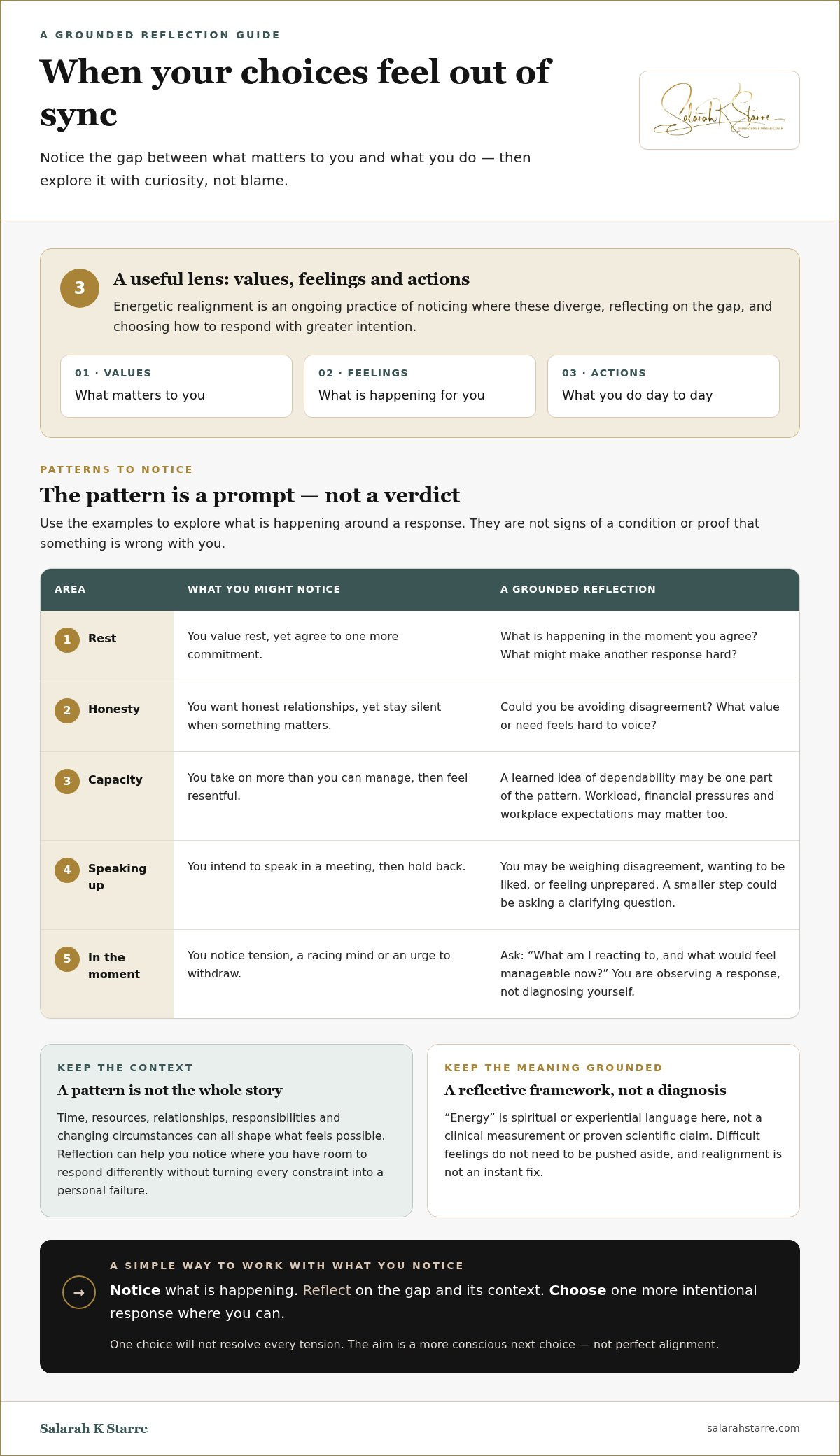
You can know the direction you want to move in and still find yourself repeating choices that pull you elsewhere. You value rest, yet agree to one more commitment. You want honest relationships, yet stay silent when something matters. That gap is worth examining, without treating it as evidence that something is wrong with you.
In this article, energetic realignment is a reflective framework for reconnecting what you value, what you feel and how you act. It asks whether your everyday decisions reflect what matters to you, and what might influence the moments when they don’t. It’s a prompt for inquiry, not a test you can pass or fail.
Energetic realignment is the ongoing practice of noticing where your values, feelings and actions diverge, then choosing how to respond with greater intention.
Here, “energy” is spiritual or experiential language for how life may feel to you, not a clinical measurement. In discussions of Energy medicine, energy fields and their rebalancing belong to a spiritual or healing framework. The term shouldn’t be mistaken for an established clinical measure. You can find the language meaningful as a metaphor without treating it as proven science.
What might feeling out of alignment look like?
Look for recurring situations rather than judging yourself on a single difficult day. Do you regularly take on more than you can manage, soften your views to avoid disagreement, or make choices that conflict with values you say are important? These are prompts for reflection, not signs of a condition. Ask what’s happening around the pattern, what you feel in the moment and what makes another response hard.
Discomfort can have many causes, including pressure, changing circumstances, health concerns or competing responsibilities. Labelling every struggle “low energy” can flatten that complexity. Start with curiosity, not blame.
What energetic realignment is, and is not
Think of it as an ongoing process: notice what’s happening, reflect on the gap, then make a more intentional choice where you can. That might mean pausing before agreeing to a request or naming a value you’ve been setting aside. One choice won’t resolve every tension, but it can help you see a pattern more clearly.
Spiritual language such as “energy” or “alignment” describes an experience or belief. Thoughts, emotions and behaviour are more familiar terms for reflecting on what you think, feel and do. These ideas may overlap in personal-growth conversations, but they aren’t interchangeable clinical concepts. Realignment isn’t an instant fix, either. Change can involve uncertainty, repeated practice and support. For those drawn to exploring restorative, energy-focused environments alongside personal reflection, wellness centres like soulfulwaves.com offer dedicated spaces designed to support relaxation and well-being. The useful question isn’t whether you feel perfectly aligned, but whether your next choice is a little more conscious.
How can emotional patterns shape a sense of energetic misalignment?
A repeated response can start to feel like proof that you’re stuck. But habits often make sense in context: they may have helped you avoid conflict, meet expectations or get through a demanding period. Over time, learned responses can influence what you notice, which boundaries feel possible and what you choose by default. That’s one useful way to explore energetic realignment, not a complete explanation for why life unfolds as it does.
Repeated patterns can point towards choices worth examining, but they don’t tell the whole story of why you make them. Circumstances matter, as do time, resources, relationships and responsibilities. Reflection can help you see where you have room to respond differently without turning every constraint into a personal failure.
Subconscious influences are best treated as a lens, not a verdict. You might notice that you agree to extra work before checking your capacity, then feel resentful later. Perhaps you learnt that being dependable meant never saying no. That could be part of the pattern, but it isn’t the only possible explanation. Your workload, financial pressures or workplace expectations may also be relevant.
Why intention and behaviour can pull in different directions
You may intend to speak up in a meeting, then hold back because you’re weighing the risk of disagreement, wanting to be liked or simply feeling unprepared. Hesitation doesn’t automatically point to hidden trauma or a lack of commitment. Ask what competing needs are present, what the situation allows and whether a smaller action, such as asking a clarifying question, feels possible. Understanding the tension creates room for choice without adding blame.
Where self-awareness, shadow work and the nervous system fit
Shadow work can mean examining parts of your experience you tend to avoid, dismiss or hide from others. The aim isn’t to uncover a single cause or promise a cure; it’s to approach those parts with honest curiosity. Nervous system awareness is similarly practical: notice what happens in the present, such as tension, a racing mind or an urge to withdraw. In some cases, somatic support or traditional bodywork—such as the meridian and Tui Na practices shared by ensospace.co.nz—can help ease this physical tension as part of restoring balance. You’re observing a response, not diagnosing yourself or expecting yourself to control every feeling.
That pause can help you ask, “What am I reacting to, and what would feel manageable now?” It won’t always reveal an answer, and you don’t need to force one. For a closer look at how body responses may relate to manifestation, explore the nervous system and manifestation.
If you’d value structured reflection on recurring patterns, Salarah’s coaching and guided personal-growth work offers a space to explore them and practise more intentional choices. Support can help you ask better questions; it can’t remove every external pressure or guarantee a particular outcome.
Energetic realignment compared with positive thinking, manifestation and therapy
These ideas can overlap in personal-growth conversations, but they aren’t interchangeable. Energetic realignment is a reflective framework, positive thinking focuses on thought habits, manifestation is a spiritual practice, and therapy offers a different kind of support. Knowing the distinction helps you choose language that feels useful without expecting one approach to do every job.
| Approach | What it focuses on | What it doesn’t promise |
|---|---|---|
| Energetic realignment | Reflecting on whether values, feelings and actions feel in step | A diagnosis or instant solution |
| Positive thinking | Encouraging constructive or hopeful thoughts | That difficult feelings will disappear or every problem will resolve |
| Manifestation | A spiritual practice connecting intention with desired possibilities | Control over other people, circumstances or outcomes |
| Therapy | Clinical or therapeutic support shaped around a person’s needs | The same role as personal-growth coaching |
Is energetic realignment just positive thinking?
No. Here, energetic realignment means examining where your experience and choices feel incongruent, not forcing optimism. Constructive thinking may help you approach a challenge differently, but it doesn’t automatically address every difficulty behind a repeated response. You can acknowledge frustration, grief or uncertainty and still consider what you want to do next.
An affirmation might remind you that your needs matter. Reflection goes further by asking whether your choices make room for those needs, and what could make a different choice more realistic. The point isn’t to ban positive thoughts. It’s to avoid using them to silence what you genuinely feel.
How does coaching differ from clinical therapy?
Coaching is reflective, goal-oriented support for personal growth and chosen change. It can help you explore patterns, clarify intentions and practise decisions that feel more consistent with your priorities. It isn’t clinical psychotherapy, doesn’t diagnose or treat mental health conditions, and can’t replace appropriate clinical support.
If you’re dealing with distress or needs beyond personal-growth coaching, seek support from a suitable clinical professional. These forms of support have different purposes and boundaries. Being clear about that distinction can help you decide what kind of help you’re looking for.
Manifestation may sit alongside reflection for people who find spiritual intention meaningful. But it isn’t a guaranteed way to control events or make a particular outcome happen. A grounded approach holds intention and reality together: clarify what you hope for, notice what is within your influence and stay open to uncertainty.
If you want support turning reflection into intentional next steps, Salarah’s one-to-one coaching provides a personal-growth context for exploring patterns and practising choices, without promising a particular result.
How to begin an energetic realignment practice without forcing change
Start with one recurring situation, not your whole life. A manageable focus might be how you respond when plans change, whether you make space for a personal priority, or what happens just before you put off a decision. The aim isn’t to force a breakthrough. It’s to gather enough information to choose one next step with care.
A five-step check-in for noticing misalignment
Use this sequence in a few minutes, on paper or in your head. Move through it in order, but pause or stop if reflection feels unhelpful. Keep the focus on a specific moment rather than turning it into a judgement about who you are.
- Pause. Describe what happened in plain language: “I postponed the conversation.” Leave out labels such as “I’m hopeless”.
- Name. Identify the feeling or need that’s present. You might feel unsure and need more information, or feel disappointed and need time to process.
- Notice. Ask which value, boundary or intention matters here. Is there a tension between what you want and what feels possible in the circumstances?
- Choose. Pick one realistic action. You might write down the question you want to ask, set aside a short period to consider your options, or decide to revisit the issue tomorrow.
- Review. Afterwards, note what you learned. Did the action fit your capacity? What would you keep, change or leave for another time?
Turn reflection into one specific next move: choose an action that honours a value and fits the reality of your day. That’s more useful than demanding certainty or a complete change of direction before you begin.
How to keep reflection grounded and sustainable
Keep check-ins brief and regular enough to notice patterns, but flexible enough to fit real life. A few lines in a journal can capture the situation, your response and the action you chose. Review those notes for useful observations, not proof that you’re progressing perfectly. Skip a day if you need to; consistency doesn’t require a rigid routine.
Pair accountability with self-compassion. You can acknowledge that a choice had consequences while also recognising the pressures and limits you were working with. Neither harsh self-criticism nor excusing every response helps you see clearly. Ask what you can learn and what remains outside your control.
Journalling is a reflection tool, not a substitute for professional care. If writing brings up distress that feels difficult to manage, pause and seek appropriate support. For a deeper exploration of recurring patterns, shadow work for self-sabotage offers another perspective on examining what may sit beneath familiar responses.
If you’d like structured support to reflect on patterns and practise intentional choices, explore Salarah’s one-to-one coaching. Energetic realignment doesn’t require you to rush or get every choice right. Begin with one moment, one honest observation and one next step you can actually take.
How guided energetic realignment can support deeper personal work
Working alone can bring useful insights, but a familiar pattern may be hard to see clearly from inside it. Guided reflection may help if the same response keeps returning, if you struggle to sustain choices that matter to you, or if you want more structure than a journal can provide. The aim isn’t to hand someone else control of your decisions. It’s to make room to examine what’s happening and decide what feels workable for you.
Salarah K Starre’s personal-growth approach brings together shadow work, subconscious pattern exploration and nervous system awareness. These perspectives offer different prompts for reflection: what you tend to avoid, what familiar responses may influence a choice, and what you notice in the present moment. They are ways to explore experience, not diagnoses or proof of a single cause.
What guided work can bring to the process
In one-to-one coaching, a coach can help you slow down a recurring situation, consider the needs and values involved, and clarify an intention that feels personally meaningful. You might explore why a decision that seems clear in principle becomes difficult in practice, then identify a realistic way to approach it. The work can move at your pace. Your choices remain yours.
Support should help you reflect and practise, not promise a transformation or dictate what you must do. Energetic realignment is personal-growth work, not clinical psychotherapy, crisis support or financial advice. Coaching doesn’t diagnose or treat mental health conditions, and it can’t replace appropriate clinical care. Being clear about that boundary helps you consider what kind of support fits your needs.
Explore a structured route for deeper recalibration
For readers drawn to a more guided process, The Magnetic Recalibration is a transformational programme focused on energetic states and emotional blocks. It can help you explore how these ideas connect with your own patterns and sense of alignment. Treat it as an invitation to reflect, not a promise of healing, manifestation or a particular outcome. You remain responsible for deciding what resonates and what steps you choose to take.
Deeper work doesn’t have to mean pushing harder. It can mean approaching a difficult pattern with more attention, support and honesty, then allowing time to consider what you want to change. If that kind of structured exploration feels relevant, Explore The Magnetic Recalibration.
Let your next choice create a little more clarity
You don’t need to solve every tension before you move. Choose one moment this week to respond with greater intention, then notice what that choice tells you. Progress may look less like a dramatic breakthrough and more like a decision you make with your values in view.
If you’d like structured support for that exploration, Salarah K Starre’s work brings together shadow work, subconscious pattern exploration and nervous system awareness. As a bestselling author and podcast host with nearly two decades of experience, Salarah helps people explore hidden patterns and practise choices that feel more authentic. The Magnetic Recalibration offers a guided route focused on energetic states and emotional blocks, without promising a particular outcome.
Explore it when the timing feels right, and take the next step at your own pace: Explore The Magnetic Recalibration. A more intentional choice is a meaningful place to begin.
Frequently Asked Questions
Is energetic realignment spiritual or psychological?
It can be approached through spiritual language or practical self-reflection, depending on what feels meaningful to you. For example, you might describe a decision as feeling energetically off, then look at observable details: what you felt, what mattered to you and what you chose. Neither description proves a hidden force or explains every response. Keep the distinction clear, and treat this practice as reflection rather than diagnosis or clinical support.
Can energetic realignment change circumstances outside my control?
No practice can guarantee that another person will change, that an opportunity will appear or that difficult circumstances will resolve. You can, however, use reflection to decide what response is available to you. If a colleague repeatedly changes plans, for instance, you may not control their behaviour, but you could clarify your limits or reconsider how you plan your own work. That difference protects you from blaming yourself for outcomes you can’t direct.
How long does energetic realignment take?
There’s no fixed timeline or guaranteed result. You may find that one decision becomes clearer quickly, whilst a recurring pattern takes longer to understand or respond to differently. Rather than measuring progress by whether a particular wish comes true, notice smaller signs: did you make a choice more deliberately, or recognise a familiar response sooner? Let your circumstances and capacity shape the pace. There’s no need to turn reflection into another deadline.
Is energetic realignment the same as manifestation?
No. The ideas can sit alongside each other, but they have different emphases. Manifestation commonly focuses on intention and desired possibilities; this article uses realignment to examine how your choices relate to your values and emotional patterns. You might use both by naming a hope, then asking what practical step is within your control. Neither practice guarantees an external result or gives you power over another person’s decisions.
Can I practise energetic realignment without a coach?
Yes. You can try a private check-in after a decision: write down what happened, what mattered to you and what you might do differently next time. Keep it brief, and choose a situation that feels manageable rather than the most painful issue in your life. A coach can provide structure and guided exploration, but isn’t required for personal reflection. If you need clinical or crisis support, this practice isn’t a substitute.
What if reflection brings up feelings I find difficult to manage?
Pause and return to something manageable in the present, such as naming what you need right now or setting the exercise aside. You don’t have to keep writing or uncover a deeper explanation. Reflection isn’t a test of strength. If distress is significant, persistent or affecting daily life, consider seeking support from a GP or an appropriately qualified mental health professional. Coaching and spiritual practices aren’t treatments for mental health conditions.


