
What if going deeper means slowing down, not forcing your way through? Shadow work can bring hidden beliefs, emotions and recurring reactions into view, but trying to uncover everything at once can make reflection feel destabilising. Understanding the relationship between shadow work and nervous system awareness offers a grounded place to start: notice what’s happening, respect your capacity and choose a pace you can sustain.
If you’re unsure what shadow work looks like in practice, or where personal-development language ends and clinical support begins, you’re not alone. This article explains how body responses can inform self-reflection without treating them as a diagnosis or proof of trauma. You’ll find practical ways to notice patterns in manageable steps, along with signs that it may be time to pause and seek clinical support.
We’ll also clarify how coaching can support guided reflection without being psychotherapy. The principle is simple: let your capacity guide your curiosity. There’s no need to excavate for its own sake. Start with steady attention, honest boundaries and the freedom to stop.
Key Takeaways
- Notice how a recurring pattern shows up in your thoughts, feelings or body, without assuming what it means.
- Shadow work and nervous system cues can inform each other, but a bodily response isn’t, by itself, proof of a specific cause.
- Depth doesn’t depend on a dramatic breakthrough. A small, present-focused reflection can be a more manageable place to begin.
- Use the suggested steps flexibly: skip, adapt or stop whenever reflection feels like too much.
- Learn how guided coaching can support reflection on recurring patterns, and where its role differs from clinical support.
Shadow work and the nervous system: what does the connection mean?
Self-exploration can feel intense when it brings attention to feelings or reactions you’d rather avoid. That doesn’t mean you need to push harder. Reflection is more useful when you can stay curious about what’s happening without demanding an immediate revelation or explanation. Pace matters: choose a question you can consider without losing sight of what you need in the present.
In personal-development settings, shadow work describes exploring aspects of yourself that may be disowned, overlooked or less conscious, such as a need you find hard to acknowledge or a reaction you habitually suppress. The idea draws on analytical psychology; Shadow (psychology) describes the shadow as an unconscious aspect of personality. The phrase is used in different ways, so it’s best understood as a reflective approach, not a clinical term.
Your nervous system is the body’s network of the brain, spinal cord and nerves. It helps coordinate functions and responses to what’s happening inside and around you. In coaching, phrases such as “nervous system energy” may be used metaphorically; they aren’t precise physiological descriptions. Keeping that distinction clear lets you take bodily experience seriously without treating every sensation as a diagnosis.
Shadow work is a reflective personal-development practice, not a clinical diagnosis or a substitute for clinical assessment or treatment.
What does shadow work involve beyond the phrase?
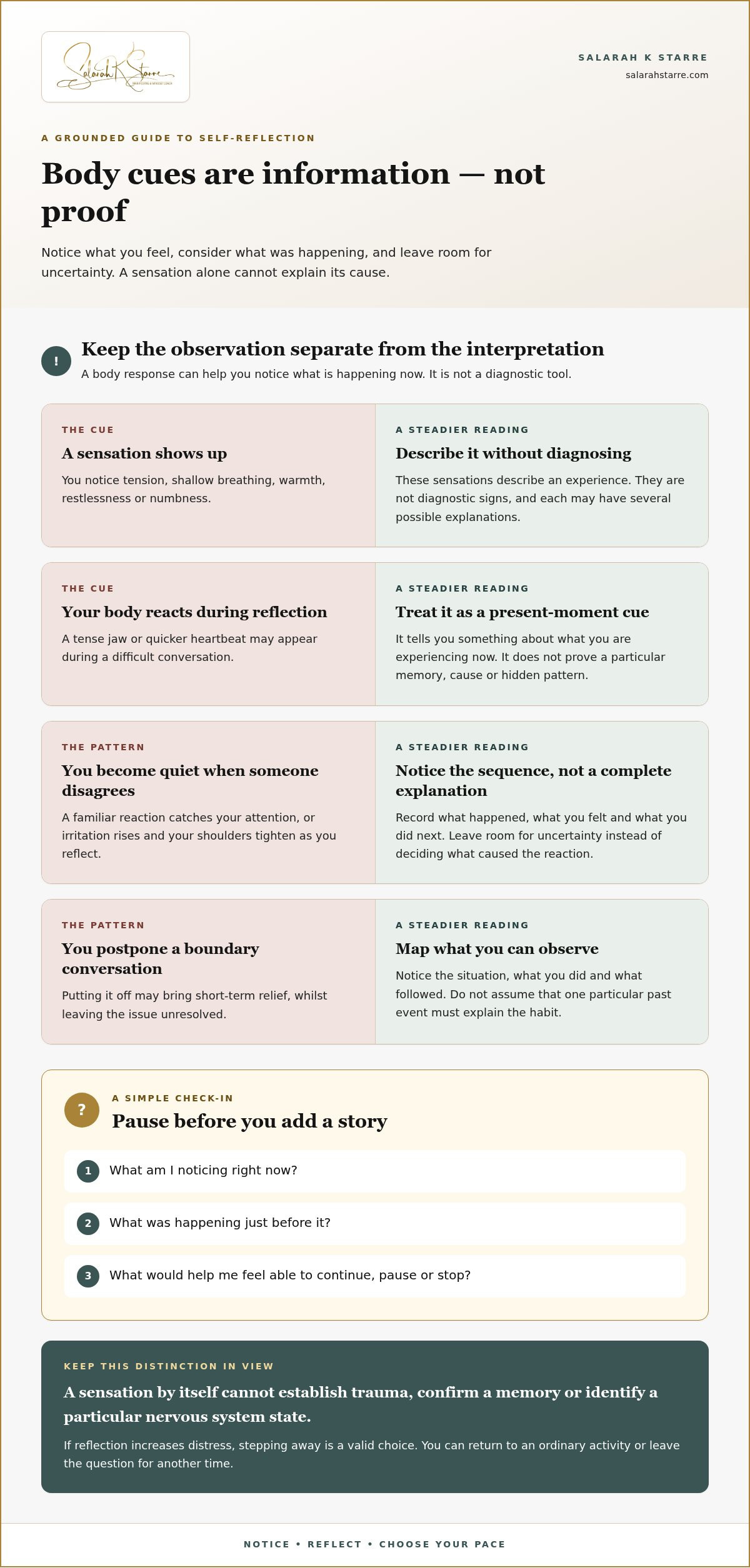
It can be as simple as noticing a feeling, belief or behaviour you tend to push away, then considering what you observe without labelling yourself as flawed. For instance, you might recognise that you become quiet when someone disagrees with you. Note the reaction and its present-day context without deciding what caused it or searching for a hidden memory.
What does nervous system awareness add to self-reflection?
It invites you to notice bodily sensations and stress responses alongside your thoughts. You might observe a tense jaw or quicker heartbeat during a difficult conversation. Those sensations tell you something about what you’re experiencing now, not prove a particular memory, cause or hidden pattern. Treat each sensation as a cue to notice, not a conclusion.
Capacity and choice matter. You can reflect briefly, return to an ordinary activity or leave the question for another time. You don’t need to prove you’re ready by tolerating distress, and you don’t have to continue just because an exercise has begun. Consider the body as one source of information, alongside the situation and your own interpretation.
The connection between shadow work and nervous system awareness is best approached as a conversation between reflection and present-moment observation, not a decoding system. A recurring response may be worth exploring, but its meaning isn’t automatically obvious. Start with what you can observe: what happened, what you felt and what you did next. Leave room for uncertainty. That isn’t avoidance; it’s a way to explore without forcing a story onto your experience.
How shadow work and nervous system responses may interact
Reflecting on a difficult moment can coincide with a shift in emotion, attention or bodily sensation. You might feel irritation rise, lose your train of thought or notice your shoulders tighten as you consider a familiar behaviour. These experiences can be relevant to your reflection, but they don’t reveal a complete explanation on their own.
The nervous system is involved in regulating body functions and responding to internal and external demands. Stress can be accompanied by changes such as a faster heartbeat, altered breathing or heightened attention. Responses vary from person to person, though, and don’t fit neatly into a universal sequence or a simple set of fixed states. Some personal-development frameworks offer interpretations of these responses. Treat those as interpretations, not established conclusions about what your body is doing.
A body response is information to notice, not proof of a hidden cause. This distinction keeps curiosity alive without turning a sensation into a certainty. Shadow work and nervous system responses may intersect during reflection, but the relationship isn’t a diagnostic tool.
Why protective patterns can persist even when they no longer help
Familiar habits can feel easier to repeat than unfamiliar ones, even when they’re frustrating. That doesn’t mean there’s one mechanism behind every pattern. Imagine avoiding a conversation about a boundary: postponing it may bring short-term relief while leaving the issue unresolved. You can notice the sequence, the situation and what you do next without deciding that a particular past event must explain it. If you want to explore recurring patterns further, a guide to shadow work for self-sabotage can offer a related lens.
What body cues can and cannot tell you
Tension, shallow breathing, warmth, restlessness or numbness describe an experience; they aren’t diagnostic signs. A sensation may have several possible explanations, and its meaning can depend on the person and circumstances. By itself, it can’t establish trauma, confirm a memory or identify a particular nervous system state. Stay with what you can observe before adding an interpretation.
A practical check-in might be: “What am I noticing right now? What was happening just before it? What would help me feel able to continue, pause or stop?” You don’t need to solve the pattern in the moment. If reflection increases distress, stepping away is a valid choice, not a failure of commitment.
Be especially careful with neuroscience and trauma language. Terms such as “fight or flight” can describe broad stress-related responses, but they shouldn’t be used to explain every sensation or assign someone a particular history. When considering a claim, distinguish evidence-based physiology from coaching language. If guided reflection feels useful, personal-development coaching can offer space to examine recurring patterns without presenting that work as clinical treatment.
Does shadow work overwhelm the nervous system? Myths and realities
It can feel intense to examine thoughts or reactions you usually avoid. But depth doesn’t require forcing a dramatic emotional breakthrough. The aim isn’t to produce the strongest possible feeling; it’s to reflect in a way that leaves room for choice. The relationship between shadow work and nervous system responses varies from person to person, and no single exercise can guarantee calm, regulation or healing.
Feeling calm isn’t a prerequisite for reflection, either. You might feel unsettled and still choose to consider a present-day pattern, or feel calm without uncovering anything significant. Distress isn’t proof that you’re making progress. Treat intensity as a reason to check what you need, not as a measure of how deeply you’ve worked.
Myth: you must uncover everything or relive painful memories
Pressure to recover an origin story or reach catharsis can turn reflection into a search for answers you may not have. You can notice that you withdraw when someone disagrees, for example, without trying to reconstruct when that response began. Present-day observations can be useful in their own right; they don’t need to lead to a memory or dramatic release.
Memory and trauma call for particular care. A strong feeling or image doesn’t, by itself, establish what happened. Avoid leading questions or treating a suggested explanation as fact. If painful memories are part of what you’re facing, you don’t need to force your way through them in a self-guided exercise.
Reality: pacing, consent and choice matter
You can pause, change the question or end an exercise. You can also decide not to start. These are valid choices, not signs of weakness or resistance. If you notice yourself becoming increasingly distressed, shift your attention to something ordinary and present, such as the room around you, or step away from the reflection altogether. There’s no need to push on to prove commitment.
Use this compact myth-versus-reality check before continuing:
- Myth: A powerful emotional reaction means the work is succeeding. Reality: Reactions vary, and intensity alone says nothing definitive about progress. Consider whether continuing feels manageable.
- Myth: I must feel calm before I can reflect. Reality: Calm isn’t a pass mark. You can choose a smaller question or wait until another time.
- Myth: Every recurring pattern needs its hidden cause uncovered. Reality: Noticing what happens now can be enough for reflection; you don’t have to pursue a painful memory.
If distress persists or begins disrupting daily life, seek support from a qualified clinical professional. Personal-development coaching may offer guided reflection on goals and recurring patterns, but it isn’t mental-health assessment or treatment. That distinction matters: coaching can support exploration, while clinical care is the appropriate setting for assessing or treating mental-health concerns. Choose support that fits what you’re experiencing, and don’t mistake pushing past your limits for courage.
A paced way to explore shadow work and nervous system cues
Keep the enquiry small and anchored in what’s happening now. You don’t need to open every difficult memory or find a definitive explanation. This optional reflection can help you notice a pattern and choose a response; it isn’t a test. Skip, adapt or stop at any point. The aim is to keep choice in the process, not to push through.
A four-step reflection: notice, name, enquire and choose
Choose one recent, manageable situation, such as putting off a task or holding back an opinion. If simply thinking about it feels too intense, leave it for another time. Move through these prompts in order only if they feel useful.
- Notice. Describe the situation in plain terms. What happened, and what did you do next? Stick to observable details rather than searching for an old memory that might explain it.
- Name. Note the thoughts, feelings and physical sensations you recall or notice now. For instance: “I thought they’d disagree; I felt uneasy; my shoulders felt tight.” These are observations, not a diagnosis.
- Enquire. Ask, “What might this reaction be trying to protect?” Treat any answer as a possibility, not a fact. “Perhaps I wanted to avoid conflict” leaves room for other explanations; you don’t need to settle on one.
- Choose. Identify one small response that fits your values in the present. You might ask a clarifying question, take time before replying or decide the issue can wait. Choose only what feels appropriate and manageable.
Pause, notice what’s happening in the present, and choose whether to continue, change focus or stop. That’s the whole practice. It doesn’t promise to regulate your nervous system or resolve a pattern. It gives you a moment to respond deliberately rather than automatically.
When to pause or seek different support
Stop if the exercise feels too intense, disorientating or difficult to manage. You can turn your attention to an ordinary task or contact someone you trust; you don’t owe the reflection a conclusion. Shadow work and nervous system cues are prompts for self-observation, not instructions to stay with distress.
Everyday reflection is different from support for persistent or severe distress. If distress continues, affects daily life or relates to trauma concerns, consider speaking with a suitably qualified mental-health professional. Coaching can support personal-development reflection, but it isn’t a substitute for clinical care or urgent crisis support.
If guided reflection on recurring patterns feels like a useful next step, explore one-to-one coaching as a personal-development option.
How Salarah K Starre brings shadow work and nervous system awareness together
After exploring what reflective practice can and can’t do, you may be wondering what guided personal-development support looks like. Salarah K Starre’s coaching approach brings together shadow work, nervous system awareness and energetic alignment. It creates space to examine recurring patterns and consider how you want to respond, without treating a body sensation as a diagnosis or promising a particular outcome.
Guided work can offer structure when a pattern feels hard to see alone. Rather than assuming there’s one hidden explanation, coaching can help you consider your thoughts, feelings and choices, and build awareness of what matters to you. You remain the decision-maker: reflection doesn’t require revisiting painful memories or continuing when you want to pause.
What guided personal-development work can offer
In one-to-one coaching, guided questions can help you look at subconscious patterns and explore how they show up in everyday decisions. For example, you might consider what happens when you hold back an opinion, what you tell yourself in that moment and what response would feel more aligned with your values. The purpose is reflection and personal development, not clinical assessment.
The Magnetic Recalibration is a signature transformational programme within Salarah’s work. Her broader approach integrates shadow work, nervous system awareness and energetic alignment. These are personal-development offerings, not clinical psychotherapy: coaching does not diagnose or treat mental-health conditions. If you need assessment or treatment for ongoing mental-health concerns, clinical support is the appropriate route.
That boundary doesn’t diminish the value of self-exploration. It makes the purpose clearer. Coaching may offer space to examine recurring patterns, clarify what you want to practise and strengthen your sense of agency, without promising a guaranteed transformation or clinical result.
Choose a next step that respects your needs
There’s no need to decide on the spot. You could revisit the reflection prompts in this article, take time to notice what feels useful or read more about the relationship between nervous system awareness and manifestation. Let your next step match what you’re looking for and what feels manageable right now.
If guided personal-development work feels relevant, you can explore Salarah K Starre’s coaching and transformational programmes. Take time to decide. Waiting, reflecting further or seeking a different kind of support are valid next steps too.
Let your next step match your capacity
You don’t have to turn self-reflection into a dramatic breakthrough. Let what you’ve noticed inform one small choice: a boundary you want to honour, a conversation you’re ready to have or a question you want to keep exploring. The connection between shadow work and nervous system awareness can prompt greater curiosity, not pressure to uncover everything at once.
If you’d value support exploring recurring patterns, Salarah K Starre’s coaching approach brings shadow work and nervous system awareness together with energetic alignment. With nearly two decades of experience, Salarah is also a bestselling author. Her coaching and transformational programmes are personal-development support, not clinical psychotherapy, and don’t promise a particular outcome.
When you’re ready to explore guided personal-development support, explore Salarah K Starre’s coaching and transformational programmes. You can move forward at your own pace, with curiosity, choice and respect for what you need.
Frequently Asked Questions
Is shadow work a recognised form of therapy?
No. “Shadow work” is generally used as a personal-development term, not the name of a regulated mental-health treatment or diagnosis. The idea of the shadow comes from analytical psychology, but people may use the phrase differently in coaching, self-help or therapeutic conversations. If a therapist uses it, ask what they mean in practice and how the work fits your care. The label alone doesn’t tell you the method or its suitability.
Can you do shadow work without journalling?
Yes. Writing is only one way to reflect. You could talk through a recent interaction with someone you trust, make a private voice note or simply notice a repeated choice as it happens. For example, after agreeing to something you didn’t want, pause and consider what influenced your answer. Pick a format that helps you stay specific and honest; you don’t need to produce a polished account or keep written records.
How often should you practise shadow work?
There’s no universal schedule that suits everyone. Instead of setting a demanding daily target, try a brief check-in after a particular situation, then notice whether reflection feels useful afterwards. You might note whether it affected your sleep, concentration or mood that day. If you feel unsettled for a long time or find yourself repeatedly ruminating, ease off and seek appropriate support. Consistency matters less than responding to your needs.
Does shadow work have to involve childhood memories?
No. You can explore a current belief or behaviour without investigating childhood. For instance, if you often say yes to extra work, ask what you hoped to achieve in that specific moment and what alternatives you have now. There’s no requirement to find an origin story. If memories arise unexpectedly and concern you, avoid trying to fill in gaps or force a meaning; consider discussing them with a qualified professional.
Can you do shadow work whilst working with a therapist?
Potentially, yes, but make the overlap clear. Tell your therapist what you mean by shadow work, what exercises you’re considering and how they affect you. This gives you both a chance to discuss whether self-guided reflection fits with your therapy. For example, if you’re using prompts between appointments, agree how to handle material that feels difficult. Your therapist can help you make decisions in the context of your care.
Is feeling calm the same as having a regulated nervous system?
No. Calm is a feeling, not a reliable test of your nervous system or overall wellbeing. You might feel calm while avoiding a difficult issue, or feel activated because you’re excited, concentrating or exercising. Everyday descriptions such as “regulated” can be useful shorthand, but they don’t establish a clinical state. Consider the broader context and how you’re functioning, rather than treating one mood as a definitive measure.
Can a body sensation prove that you have uncovered a hidden memory?
No. A racing heart, tight chest or sudden unease can’t verify a memory or show what caused the sensation. Physical feelings can have different explanations, and trying to force a story around them may increase uncertainty. If a memory or sensation troubles you, avoid leading yourself with questions that assume something happened. You can record what you experienced in neutral terms and discuss ongoing concerns with a suitably qualified mental-health professional.


