
What if body awareness could deepen personal growth without making coaching the same as therapy? If you’re searching for a shadow work coach UK-wide, it can be difficult to separate terms such as Somatic Experiencing and nervous system awareness. You may also wonder whether exploring painful emotions could feel overwhelming. Understanding the difference between these approaches can help you decide what kind of support you’re looking for.
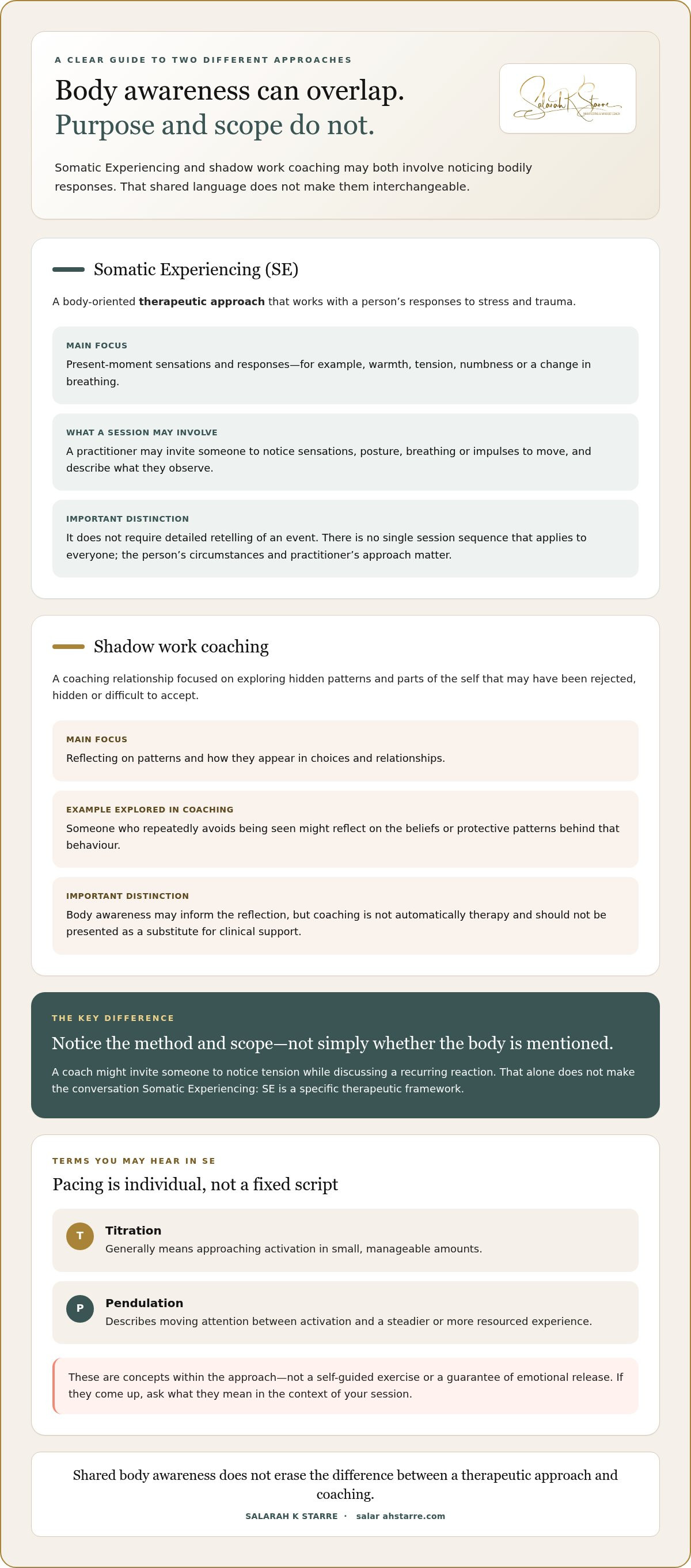
Somatic Experiencing (SE) is a body-oriented therapeutic approach that works with a person’s responses to stress and trauma. It doesn’t require detailed retelling of an event. Shadow work coaching, by contrast, explores hidden patterns and disowned parts of the self within a coaching relationship. Body awareness may inform that work, but it doesn’t turn coaching into clinical therapy.
This article explains SE in plain English, compares its aims and approach with shadow work coaching, and offers practical questions to consider when choosing support. You’ll also learn how Salarah K Starre’s coaching incorporates shadow work and nervous system awareness, so you can assess whether that personal-development approach fits your goals.
Key Takeaways
- Learn what Somatic Experiencing may involve, without assuming every practitioner follows the same session sequence.
- Compare therapy and coaching by purpose, focus and practitioner role, so body-based language doesn’t blur their different scopes.
- Clarify your goals, boundaries and questions before exploring emotional work, so you can make a considered choice.
- Understand how a shadow work coach UK may help you explore hidden patterns, and how that differs from trauma-focused therapy.
- Discover how Salarah K Starre brings shadow work, nervous system awareness and energetic alignment into her coaching approach.
What is Somatic Experiencing therapy, and how does it relate to shadow work?
It’s easy to see why these terms get blurred. Somatic Experiencing involves attention to the body; shadow work may also include noticing bodily responses; and therapy and coaching can both involve exploring difficult experiences. But shared language doesn’t make the approaches interchangeable. If you’re looking for a shadow work coach UK-wide, knowing what each approach involves can help you decide what kind of support you’re considering.
In plain English, Somatic Experiencing is a body-oriented therapeutic approach that pays attention to sensations and responses in the present moment when working with stress and trauma. Developed by Peter Levine, it’s described in this Somatic Experiencing (SE) therapy overview. Descriptions of its clinical aims or effectiveness should be considered in light of appropriate clinical evidence; a general overview can’t show whether it will suit or benefit a particular person.
What does Somatic Experiencing mean in plain English?
“Somatic” means relating to the body. A sensation is something a person notices physically, such as warmth, tension, numbness or a change in breathing. The nervous system is the body’s network for receiving and responding to signals. In SE, attention to such experiences is part of the approach, rather than a demand to recount every detail of a distressing event.
There isn’t one session sequence that applies to everyone. The practitioner’s training and the person’s circumstances matter. This explanation is educational, not an assessment: it can’t establish a diagnosis, determine whether someone needs treatment or predict what a session would be like for them.
Body awareness is not exclusive to SE. A coach might invite someone to notice tension while discussing a recurring reaction, for example, but that alone doesn’t make the conversation Somatic Experiencing. SE involves a specific therapeutic framework, not simply body-focused language. Claims about how it works physiologically or what outcomes it produces need careful consideration before being treated as fact.
Is Somatic Experiencing the same as shadow work?
No. They describe different approaches. Shadow work commonly means exploring traits, feelings or needs a person has hidden, rejected or found difficult to accept. In coaching, this may involve reflecting on patterns and how they show up in choices and relationships. It isn’t automatically therapy, and it shouldn’t be presented as a substitute for clinical support.
For instance, someone who repeatedly avoids being seen might explore the beliefs or protective patterns behind that behaviour through shadow work. They may also notice physical sensations as part of reflection. That observation does not turn coaching into SE. The useful distinction is the method and scope, not whether a conversation mentions the body. Explore how these patterns may connect with shadow work for self-sabotage.
Keep the labels precise. Somatic Experiencing is a named therapeutic approach; shadow work coaching explores inner patterns within a coaching relationship. Body awareness can appear in both, but it doesn’t erase the difference. Knowing the distinction gives you a clearer starting point for deciding what you want to explore and what kind of support you’re seeking.
How does Somatic Experiencing therapy work with body awareness?
Somatic Experiencing (SE) is often described through what happens in a session, but there isn’t one script every practitioner follows. A practitioner may invite a person to notice present-moment sensations, posture, breathing or impulses to move, then explore what they observe at a manageable pace. The focus is not necessarily on recounting an event in detail. Attention can return to what’s happening now, including the person’s surroundings and their own responses.
For example, someone discussing a stressful situation might notice their shoulders tightening or their breath changing. In an SE session, the practitioner may invite them to observe that response and describe it, rather than insist they revisit the situation. What follows depends on the individual and the practitioner’s approach. The Somatic Experiencing® International website provides information about the method and its professional training. This can help distinguish SE from other conversations that happen to include body awareness.
What might happen during a Somatic Experiencing session?
A session may involve conversation alongside noticing sensations and responses. The practitioner might ask what the person feels in their body as they speak, or whether their attention shifts when they describe a particular moment. These are examples, not a standard sequence or a promise of what any individual session will include. The person’s context, needs and practitioner’s approach all matter.
Some SE materials use the terms titration and pendulation. In this context, titration generally means approaching activation in small, manageable amounts; pendulation describes moving attention between activation and a steadier or more resourced experience. These terms describe concepts within the approach, not a self-guided exercise or a guarantee of emotional release. If they come up, ask what they mean in the context of your own session.
Why are pacing and choice part of the conversation?
Body-focused work can bring attention to experiences a person finds uncomfortable. Consent and choice help keep the process collaborative: the person should be able to say when something feels too much, ask to pause or take a break. Pacing matters because meaningful exploration should leave room for choice, communication and a pause when needed. That doesn’t promise difficult feelings won’t arise. It means the person’s boundaries belong in the conversation.
Before a session, consider what you want from it, what feels off limits and how you’ll signal that you need to slow down. You might ask how the practitioner handles pauses and what happens if you feel uncomfortable. Clear questions are not resistance. They’re part of making an informed decision.
This article offers general information, but it can’t assess your circumstances or replace individual clinical care. If you’re considering coaching rather than therapy, keep the distinction clear: a shadow work coach UK may support reflection on patterns and self-understanding, but body awareness alone doesn’t make coaching Somatic Experiencing. If coaching feels like the right direction for exploring shadow work, learn about Salarah’s coaching approach.
Somatic Experiencing therapy vs shadow work coaching: what is the difference?
Both approaches may involve reflection, emotions and body awareness, which can make them sound interchangeable. They aren’t. Somatic Experiencing (SE) is a named therapeutic approach; shadow work coaching is a coaching process for exploring inner patterns. A coach noticing physical responses with a client does not, by itself, make that work SE therapy.
| Aspect | Somatic Experiencing therapy | Shadow work coaching |
|---|---|---|
| Purpose | A therapeutic approach that works with responses associated with stress and trauma. | Personal development through recognising and exploring hidden or disowned parts of the self. |
| Typical focus | Present-moment bodily sensations and responses, within the SE framework. | Recurring patterns, limiting beliefs, self-sabotage and how these influence choices. |
| Practitioner role | A practitioner trained in Somatic Experiencing, working within their therapeutic role and scope. | A coach supports reflection, awareness and personal goals within a coaching relationship. |
| Scope | Therapeutic work. What it involves depends on the practitioner and individual context. | Coaching, not a clinical diagnosis or treatment for mental illness. |
What is the difference between a therapist and a coach?
Salarah K Starre’s work is coaching, not clinical psychotherapy. Coaching can support someone to examine self-trust, beliefs and repeated behaviours, but it shouldn’t be represented as diagnosing or treating mental illness. If your needs are clinical, coaching should not be treated as a replacement for appropriate clinical care.
When might shadow work coaching be a useful fit?
Shadow work coaching may be relevant if you want to understand why a familiar pattern keeps resurfacing. Perhaps you hold back from opportunities, struggle to voice a need or undermine a goal just as it becomes attainable. The work can bring those reactions into view and help you question the beliefs beneath them. It isn’t about labelling every difficulty as a hidden wound or forcing an emotional breakthrough.
Salarah’s coaching approach integrates shadow work, nervous system awareness and energetic alignment. Nervous system awareness is part of her coaching perspective, not evidence that the work is Somatic Experiencing therapy. Her exploration of nervous system and manifestation offers another perspective on how bodily awareness can inform personal growth.
The right fit depends on what you’re seeking: therapeutic support, coaching for patterns and goals, or a combination of different forms of support. Be clear about the aim, the practitioner’s role and the scope of the work. That can help you choose without ranking one approach above another.
How can you approach body-focused emotional work thoughtfully?
Depth doesn’t require force. Before beginning emotionally focused work, get clear on what you want to explore and what would help you feel able to speak up. Preparation can give you language for your needs and help you make considered choices, even if not every moment feels comfortable.
What questions can help clarify what support you want?
Start with the concern, not the label. You might notice that you repeatedly avoid opportunities, find it hard to set boundaries or feel stuck in a relationship pattern. You don’t need a perfect explanation before you begin. A simple description of what you’ve noticed gives the conversation somewhere concrete to start.
Before a session, consider these prompts:
- What pattern or concern do I want to understand? Name what happens and where it tends to show up in your life.
- What would feel meaningful to explore? Perhaps you want more clarity about a choice or to recognise a belief that keeps shaping your behaviour. Avoid setting a required outcome or demanding a dramatic breakthrough.
- What kind of support am I seeking? Are you looking for coaching around personal development, therapy for distress or mental health concerns, or general information to help you decide?
- What are my boundaries and questions? Note subjects you’re not ready to discuss and anything you want explained before taking part in an exercise.
These prompts can help you explain your needs without disclosing more than you choose. If you’re considering a shadow work coach UK, be clear about the distinction between coaching and clinical care. Salarah’s work is coaching, not clinical psychotherapy.
How can you keep emotional exploration grounded?
Stay with what you can genuinely notice in the present, rather than pushing yourself to revisit painful memories or manufacture an emotional response. You might simply name that you’re feeling uncertain or that a topic feels uncomfortable. You don’t have to interpret every sensation or treat distress as evidence that the work is succeeding.
Agree on straightforward ways to communicate. You can say, “I need a moment,” ask for a break or explain that you don’t want to continue with a particular topic. If an exercise feels uncomfortable, pause and speak up. You can also ask what an exercise involves before deciding whether to take part. Choice matters; a boundary isn’t a failure of commitment.
Afterwards, give yourself space to notice how you feel without judging the session by whether you experienced a breakthrough. If you’re dealing with severe distress, feel unable to keep yourself safe or need urgent mental health support, coaching isn’t crisis care. Contact your GP or local urgent mental health service; if there’s immediate danger, call 999 or go to A&E.
If coaching feels like a suitable space to explore personal patterns and goals, explore Salarah’s one-to-one coaching.
How can Salarah K Starre’s coaching approach support shadow work?
Shadow work asks you to look beneath familiar reactions and question the patterns shaping your choices. Salarah K Starre is a UK-wide mindset and manifestation coach with nearly two decades of experience. Her coaching brings together shadow work, nervous system awareness and energetic alignment. This personal-development perspective considers inner beliefs and how they influence the way you show up.
The distinction matters. This is coaching, not Somatic Experiencing therapy or clinical psychotherapy. Nervous system awareness may inform the coaching perspective, but it doesn’t make the work a named therapeutic modality. The focus is reflection and personal development, not diagnosing or treating mental illness.
What can shadow work coaching explore with Salarah?
Coaching can help you examine patterns that feel automatic: holding back when you want to be seen, doubting your judgement or repeating choices that don’t reflect what you say you want. Shadow work brings attention to the beliefs, fears or disowned qualities that may be influencing those reactions. The aim is greater awareness and a clearer relationship with your own choices, not blame or a promise of instant change.
That exploration can include self-sabotage, self-trust and personal power. For example, you might want a new opportunity yet repeatedly find reasons to avoid it. Coaching can help you question the story behind that pattern and consider what you want to do differently. It remains coaching support, not diagnosis or clinical treatment. Reflections on breaking toxic relationship patterns offer a related perspective on how subconscious patterns can shape relationships.
Salarah’s approach also incorporates nervous system awareness and energetic alignment. These elements inform her perspective on personal growth, but they shouldn’t be confused with Somatic Experiencing or presented as clinical treatment. If you’re searching for a shadow work coach UK, understanding this scope can help you decide whether coaching matches what you want to explore.
What is The Magnetic Recalibration?
The Magnetic Recalibration is Salarah’s named transformational programme, designed to align energetic states and clear emotional blocks. That description conveys its focus without implying a particular format, duration or guaranteed result. It is distinct from Somatic Experiencing therapy and clinical psychotherapy. You can consider it as a coaching-related personal-development programme, not a substitute for clinical care.
You don’t have to decide everything at once. If this coaching perspective resonates with the patterns you want to explore, you can learn more about Salarah’s coaching and consider whether it feels like a suitable next step.
Choose a next step that honours your needs
Personal growth doesn’t have to mean pushing into every difficult feeling at once. Start by asking what you want support with now: developing self-understanding, working towards a personal goal or getting help with mental health concerns. Your answer can guide your next move, and it can change over time.
If coaching aligns with the work you want to do, Salarah K Starre’s approach brings shadow work and nervous system awareness into a personal-development context. She is also a bestselling author and podcast host. A shadow work coach UK-wide may suit you if you’re ready to explore patterns and strengthen self-trust through coaching, rather than seeking clinical treatment.
There’s no need to force a decision or pursue a dramatic breakthrough. Consider what feels useful, which boundaries matter to you and what kind of support matches your situation. Then explore Salarah K Starre’s coaching approach as a possible next step. Move forward at a pace that feels grounded and true to you.
Frequently Asked Questions
What is Somatic Experiencing therapy in simple terms?
Somatic Experiencing is a therapeutic approach that pays attention to how stress and trauma-related responses show up in the body. For example, a person might notice their hands clenching whilst talking about a difficult situation. That observation can become part of the conversation, but it doesn’t diagnose a condition or explain its cause on its own. The approach is distinct from simply using relaxation or breathing exercises.
Is Somatic Experiencing therapy the same as shadow work?
No. They have different frameworks and aims. Shadow work might help someone explore why they dismiss compliments or hide their ambition; Somatic Experiencing uses its own therapeutic framework to work with bodily responses linked to stress and trauma. Both may invite self-observation, but a shared interest in feelings or bodily sensations doesn’t make them the same method.
Can a shadow work coach provide Somatic Experiencing therapy?
A coach’s title alone doesn’t establish training in Somatic Experiencing. Someone may have separate training in more than one approach, but shadow work coaching shouldn’t be described as SE therapy simply because it includes body awareness. If you’re searching for a shadow work coach UK-wide, consider whether the service’s stated purpose and scope match the support you want. Salarah’s work is coaching, not clinical psychotherapy.
What happens during a Somatic Experiencing session?
A session may include talking about what brings you in and noticing what you experience physically as you speak. The practitioner might invite you to describe a sensation or notice whether it changes, but there isn’t a single sequence that applies to everyone. You can ask what an activity involves before taking part. Don’t assume that a session includes touch, a detailed account of trauma or a particular outcome.
Is Somatic Experiencing therapy suitable for trauma?
Somatic Experiencing is described as an approach for working with trauma-related responses, but that doesn’t mean it’s suitable for every person or situation. Individual needs, current circumstances and the practitioner’s scope all matter. If trauma is affecting your daily life or you’re unsure what support you need, seek advice from an appropriate clinical professional. An article can explain an approach, but it can’t assess your circumstances or recommend treatment.
Can I try Somatic Experiencing techniques by myself?
You can learn general information about SE, but reading about a method isn’t the same as receiving individual support. Avoid trying to deliberately trigger or process distressing memories alone, particularly if you have a history of trauma or feel overwhelmed. If simply noticing a sensation increases distress, stop and orient to what feels manageable in your surroundings. Seek clinical support if you need help deciding what is safe for you.
How is body awareness used in shadow work coaching?
In coaching, body awareness may help someone notice an immediate response alongside a pattern they’re discussing. For instance, they might recognise a clenched jaw when describing a conversation they keep avoiding. That observation can prompt reflection about what they feel or need; it doesn’t identify a diagnosis or make the exercise Somatic Experiencing. The client can choose whether to explore the observation and how it relates to their personal goals.


