

What if healing from codependency UK doesn’t mean caring less or ending a relationship? It can begin with a sharper question: where does care end and self-abandonment begin? If you’re used to managing someone else’s feelings, setting a boundary may bring up fears of conflict, rejection or losing the relationship. Those fears deserve attention, but they don’t have to make every choice for you.
Codependent patterns aren’t a verdict on who you are. They’re behaviours and beliefs you can notice, understand and begin to shift. You don’t need to condemn your capacity to care or make a dramatic decision before you’re ready. Start by noticing what happens when you say yes automatically, silence your needs or look outside yourself for permission to trust what you feel.
This guide explores how these patterns can take hold, how to practise boundaries without turning them into ultimatums, and how self-awareness can strengthen self-trust. It also compares coaching, therapy and peer support, so you can consider a next step suited to your circumstances and safety. The aim isn’t to force an outcome, but to help you reclaim choice, one grounded step at a time.
Key Takeaways
- Understand codependency as a way to describe recurring relationship patterns, not a diagnosis or a fixed identity.
- Use a four-stage process to notice a pattern, identify the need beneath it, try a proportionate boundary and reflect on what happens.
- Compare therapy, coaching and peer support by their purpose and scope to find a next step that fits your needs.
- Use clear, first-person boundary language to express what you need without trying to control another person’s response.
- Healing from codependency UK can include personal-development support that builds awareness of subconscious patterns and strengthens self-trust.
Healing from codependency in the UK: recognise the pattern without judging yourself
You may care deeply about someone and still feel confused, drained or unsure where your own needs fit. Perhaps you keep the peace, take responsibility for another person’s feelings or worry that a boundary will make things worse. Noticing these habits isn’t an admission that you’re broken. It’s a way to see what’s happening without shame and consider practical next steps.
“Care supports both people; self-abandonment repeatedly makes your needs disappear.” This isn’t a test you have to pass. It’s a prompt to ask whether a relationship leaves room for your wellbeing, choices and limits as well as care for the other person.
Codependency is commonly used to describe relationship patterns, rather than a formal diagnosis or fixed identity. Its meaning and use have shifted over time; Codependency on Wikipedia offers an overview of the term’s history and commonly discussed characteristics. One difficult relationship, or one behaviour you regret, doesn’t establish that you’re codependent. Look for recurring patterns and their impact, rather than a label to pin on yourself or someone else.
What can codependent patterns look like in daily life?
Patterns can include taking responsibility for someone else’s problems, repeatedly seeking reassurance before trusting your judgement, or struggling to say what you want. They can arise in romantic relationships, with family or friends, and at work.
- You cancel plans or neglect rest because your partner is upset and you feel you must fix it.
- You repeatedly check whether a friend is angry, despite having no clear reason to think so.
- You accept extra tasks at work, then feel resentful because saying no seems too risky.
These examples aren’t a diagnostic checklist. Instead, ask yourself: does this happen repeatedly, what does it cost me, and can I make a choice that includes my needs? The recurring pattern matters more than a single moment.
Why can the pattern feel difficult to change?
A familiar response can feel protective. Keeping quiet may seem safer than risking an argument; solving a loved one’s problem may ease anxiety in the moment. Even if that response narrows your choices over time, the immediate relief can make trying something different difficult.
Fear of conflict, rejection or uncertainty may be part of your experience, but there’s no single explanation that fits everyone. These responses can have different histories and meanings. You don’t need to settle on a childhood, attachment or trauma explanation before taking your experience seriously.
Start with curiosity, not a verdict. Notice what tends to happen before you override a need, what you hope to prevent, and how you feel afterwards. That observation can make the pattern visible without turning it into your identity. Healing from codependency UK can begin with this distinction: you are not the behaviour, and awareness creates room to choose what comes next.
How healing from codependency works: build awareness before forcing change
Change doesn’t have to begin with a dramatic confrontation or a promise to behave differently from now on. It can start by noticing when a familiar response takes over. That pause gives you a chance to recognise what you feel, consider what you need and choose your next move rather than acting on autopilot.
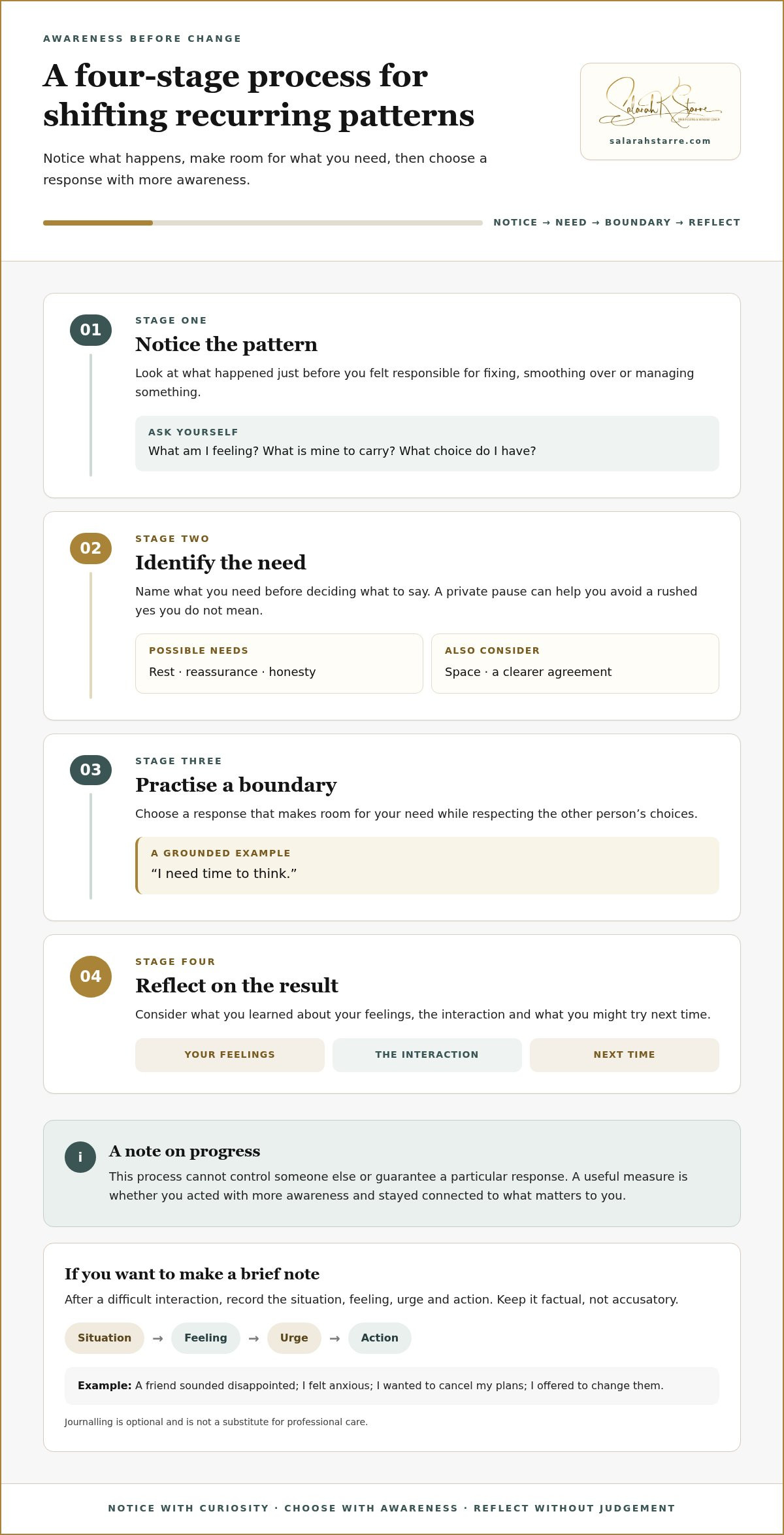
Use this sequence to work with a recurring situation without expecting perfection:
- Notice the pattern. What happened just before you felt responsible for fixing, smoothing over or managing something?
- Identify the need. Are you looking for rest, reassurance, honesty, space or a clearer agreement?
- Practise a boundary. Choose a response that makes room for your need while respecting the other person’s choices.
- Reflect on the result. What did you learn about your feelings, the interaction and what you might try next time?
This isn’t a way to control someone else or guarantee a particular response. It’s a way to recover choice. A boundary may feel uncomfortable, and the other person may not respond as you hope. A useful measure is whether you acted with more awareness and stayed connected to what matters to you.
Notice the moment you move into over-responsibility
After a difficult interaction, make a brief note of the situation, feeling, urge and action. For example: “A friend sounded disappointed; I felt anxious; I wanted to cancel my plans; I offered to change them.” Keep it factual, not accusatory. Ask: What am I feeling? What is mine to carry? What choice do I have? A few words are enough. Journalling is optional and isn’t a substitute for professional care.
Looking across repeated moments can reveal when care turns into automatic obligation. If the same dynamic keeps resurfacing, breaking toxic relationship patterns offers another perspective on recurring relationship dynamics. Use it as a prompt for reflection, not a reason to label yourself or another person.
Reconnect with your needs and emotional signals
Before deciding what to say, name the need privately. “I need time to think” is clearer than a rushed yes you don’t mean. Nervous system awareness can simply involve noticing signs that you feel activated, such as tension or a racing mind, and pausing before you respond. It isn’t a diagnosis. For related grounding and self-awareness, explore nervous system and manifestation.
Progress can be uneven; a pause, a clearer choice and an honest reflection still count. Healing from codependency UK isn’t a guarantee of a fixed outcome. If you want guided personal-development support to explore your patterns and agency, Salarah K Starre’s coaching and transformational work is one option.
Therapy, coaching or peer support: compare routes for codependency healing
There isn’t one route that suits everyone. The right support depends on what you’re facing, what you want help with and whether you need clinical care, personal-development guidance or connection with people who share similar experiences. These approaches have different purposes and boundaries, so comparing their scope is more useful than treating them as interchangeable.
| Support route | Purpose and typical focus | Format | Scope |
|---|---|---|---|
| Therapy or counselling | Explore emotional difficulties, relationship experiences and, where relevant, clinical concerns. | Often individual sessions; approach and setting vary. | Clinical work sits within the practitioner’s training and professional scope. |
| Coaching | Reflect on goals, choices, self-trust and personal-development patterns. | Often one-to-one, with a focus agreed between coach and client. | Not diagnosis, clinical treatment or crisis care. |
| Peer support | Share experiences, learn from others and reduce the sense of facing a pattern alone. | May involve group meetings or other shared formats. | Mutual support, not a substitute for clinical assessment or treatment. |
These are broad descriptions, not guarantees of what every practitioner or group provides. In the UK, the titles “counsellor”, “psychotherapist” and “therapist” aren’t legally protected. Professional bodies such as BACP, UKCP and BPC hold voluntary accredited registers, which can help you check a practitioner’s training and standards. Therapy and counselling can address clinical concerns within the practitioner’s professional scope, though the approach varies.
What coaching can and cannot offer
Coaching can provide structured space to examine recurring personal-development patterns, clarify what matters to you and explore choices that strengthen self-trust and agency. It may help you reflect on how you respond in relationships, but it doesn’t diagnose or clinically treat codependency, mental illness or trauma. It isn’t crisis care, and no coach can guarantee healing or a particular relationship outcome. Salarah K Starre’s one-to-one coaching supports personal development and exploration of patterns and choices, not clinical care.
When clinical or specialist support may be more appropriate
If distress is persistent or severe, or makes everyday functioning difficult, consider support from a suitably qualified clinical professional. You don’t need to diagnose yourself or decide alone which route fits. Describe what you’re experiencing and its impact on daily life. Depending on your circumstances, more than one type of support may be appropriate.
If abuse or immediate danger is present, prioritise safety and suitable urgent support over relationship exercises or boundary experiments. Personal-development work should never require you to take a step that puts you at greater risk. For healing from codependency UK, the useful question isn’t which option is universally best, but which support matches your needs and the level of care required now.
Practical steps for healing from codependency in everyday relationships
Big declarations can feel powerful, but lasting change is often built through small, observable choices. Pick one recurring situation where you tend to override your needs, then work through these steps:
- Choose the moment. Name a specific situation, such as agreeing to plans when you’re exhausted.
- Name your need. You might need rest, time to think or a clearer division of responsibilities.
- Plan one proportionate response. Decide what you can say or do to respect that need.
- Reflect afterwards. Notice what felt difficult and what you learnt, without grading yourself.
A boundary isn’t proof that you’re selfish. It isn’t punishment, and it doesn’t automatically mean you’re leaving a relationship. It’s a clear statement about what you will do to protect your time, wellbeing or limits. You can care about someone without taking responsibility for every request.
Practise a boundary without making it an ultimatum
Try a low-stakes situation where speaking up feels appropriate and safe. Imagine a friend asks you to help them move on a day when you need to rest. You could say, “I care about you, but I can’t help that day. I’m free to talk for a little while on Sunday.” It’s direct, respectful and grounded in your choice.
Compare that with, “You have to stop asking me for help.” The first explains what you can offer; the second tries to control what the other person does. You can’t dictate their response, but you can decide what you’ll do if a request doesn’t work for you. Start small. If direct communication could increase risk, don’t confront the person; prioritise your safety and seek suitable support.
Strengthen self-trust through small, observable choices
Once a day, choose one personal preference without immediately asking someone else to confirm it’s acceptable. It could be what you eat, how you spend a free hour or whether you need time before replying to a message. The aim isn’t to make the “right” choice, but to practise hearing your preference and acting on it when it’s safe and reasonable.
Afterwards, ask what felt aligned, difficult or useful. Perhaps you felt uneasy but kept your choice. Perhaps you changed your mind after getting new information. Both are worth noticing. Self-trust grows through honest attention, not by never hesitating or getting everything right.
If you want to explore beliefs that may shape repeated choices, shadow work for self-sabotage offers related reflection on subconscious patterns. These everyday practices can make healing from codependency UK feel less like a single dramatic test and more like a series of choices you can observe and adjust.
Structured coaching can help you reflect on patterns and strengthen personal agency. Explore one-to-one coaching with Salarah K Starre as a personal-development option focused on reflection and change, not clinical treatment or a guaranteed relationship outcome.
How Salarah K Starre’s coaching can support personal change
Recognising a recurring pattern can raise a new question: how do you work with it without handing someone else the authority to decide what your life should look like? Salarah K Starre is a mindset and manifestation coach whose personal-development work explores subconscious patterns and personal agency. The focus is reflection and choice: understanding what may influence a response, then considering what you want to practise instead.
Her approach includes personalised one-to-one coaching, shadow work and nervous system awareness. These are elements of a transformational approach, not clinical interventions. Coaching doesn’t diagnose or treat a mental health condition, and it can’t promise a cure, a particular relationship outcome or a fixed path to change.
A coaching approach centred on patterns, awareness and agency
In coaching, you might explore what tends to happen before you agree to something you don’t want, avoid expressing a need or feel compelled to take responsibility for someone else. Reflection can bring underlying assumptions into view, such as “I have to keep everyone happy” or “If I say no, I’ll be rejected”. These are starting points for inquiry, not clinical assessments or conclusions about your past.
From there, you can consider what you value, what you need and which choices feel more aligned with the person you want to be. The pace and focus are personal. You might work towards speaking more honestly, making space for your priorities or noticing when an old response takes over. The aim isn’t to follow a script, but to strengthen your ability to choose.
Shadow work, in this context, means exploring thoughts or patterns you may find uncomfortable to acknowledge. Nervous system awareness can involve noticing your reactions and making space to reflect before acting. Neither is clinical assessment or treatment. Your autonomy remains central: coaching shouldn’t dictate whether a relationship continues. That decision belongs to you, informed by your circumstances, needs and safety.
The Magnetic Recalibration is Salarah’s signature programme, offering a further personal-development route to explore. It doesn’t guarantee an outcome or replace clinical support.
Choose a next step that fits your needs
Before deciding on support, consider what you want help with, how much structure feels useful and what you have capacity for right now. You may be ready to examine patterns in depth, or prefer to begin with a small, practical focus. There’s no benefit in moving faster than feels manageable. Choose a step that respects your circumstances.
If distress is severe or persistent, or you’re struggling to function, seek support suited to those clinical needs. If you’re in crisis or facing immediate danger, prioritise appropriate urgent help. Coaching is personal-development support, not crisis care or a replacement for clinical treatment.
If this reflective, agency-centred approach fits what you want to work on, explore Salarah’s coaching and transformational work. Consider your needs and whether it feels like a useful next step.
Choose one next step that brings you back to yourself
Healing from codependency UK doesn’t require you to have every answer before you begin. Let your next step be proportionate: notice one choice you want to make differently, decide what support feels right and move at a pace that respects your wellbeing. Progress isn’t measured by how quickly you change a relationship. It’s about becoming more able to hear your needs and act with intention.
Salarah K Starre brings nearly two decades of experience to her work as a mindset and manifestation coach, bestselling author and podcast host. Her personalised coaching, workshops, programmes and retreats offer ways to explore personal development and strengthen agency. Coaching is not clinical care, so choose support that reflects what you need.
If this approach feels relevant, explore Salarah’s coaching and transformational work and consider whether it fits the step you’re ready to take. You can begin with one honest choice, made for yourself.
Frequently Asked Questions
How long does healing from codependency take?
There’s no set timetable for healing from codependency; progress depends on your circumstances, the support available and what you’re working through. Rather than waiting to feel completely different, look for small signs of increased choice, such as noticing discomfort sooner or taking time before agreeing to something. If you’re tracking change, review what feels different over a few weeks, not just after one difficult conversation.
Can old codependent patterns return after I have started healing?
Yes, familiar responses can reappear, especially during stress, change or uncertainty. That doesn’t erase what you’ve learnt. You might agree automatically, then catch yourself and revisit the decision: “I answered too quickly. I need time to think.” Treat the moment as useful information. Notice what was happening and what helped you return to a more deliberate choice.
How can I support someone with codependent behaviours without enabling them?
Offer care without taking over responsibilities that belong to the other person. You might listen, help them think through options or encourage them to seek suitable support, whilst declining to conceal the consequences of their choices. For instance, you can express concern about missed commitments without making excuses on their behalf. Focus on what you can offer consistently, rather than trying to manage their behaviour or recovery for them.
Can codependency affect friendships and family relationships as well as romantic ones?
Yes. These patterns can arise in any close relationship, including friendships, family connections and relationships with colleagues. You might feel obliged to mediate every disagreement between relatives, or become anxious when a friend takes longer than usual to reply. Consider whether the pattern is repeated, how it affects your wellbeing and whether responsibility feels balanced. The type of relationship alone doesn’t establish what’s happening.
What should I do if a relationship feels controlling or unsafe?
Prioritise your safety over trying to improve communication or test a boundary. If direct discussion could increase the risk, don’t confront the person alone. Consider speaking privately with someone you trust or contacting a specialist domestic abuse service to explore safer options. If you’re in immediate danger, call 999. You don’t need to prove that a situation is “serious enough” before seeking help.
Is setting boundaries selfish when I am used to putting others first?
No. A boundary can protect your capacity without rejecting someone you care about. Ask whether the limit addresses your own actions and wellbeing, rather than demanding that another person feel or behave a certain way. For example, you might decide not to discuss a difficult topic when either of you is too upset to continue respectfully. You can care and still have limits.


