
What if the retreat setting matters less than the work you’re ready to do within it? If the same emotional or relationship pattern keeps returning, another weekend of rest or surface-level encouragement may not help you understand what’s driving it. Searching for a “deep healing retreat UK” can bring up everything from spa breaks to focused inner work, and the difference isn’t always clear.
It’s understandable to feel drawn to deeper change and wary of exploring difficult emotions. Real inner work isn’t about forcing a breakthrough or pushing past your boundaries. It’s about noticing underlying patterns with honesty, awareness and care, then considering what you want to do differently.
This article explains what sets a deep healing retreat apart, how shadow work and nervous-system awareness can shape the experience, and what to consider when deciding whether it suits you. You’ll find practical ways to think about readiness, pace and expectations, so you can approach the process with greater clarity. A retreat can make space for reflection, but it can’t guarantee a particular outcome.
Key Takeaways
- A deep healing retreat UK experience centres on guided reflection and personal-development work, rather than simply offering time away.
- Shadow work can help you notice feelings and familiar reactions that may shape choices beneath conscious intentions.
- A retreat may create space for perspective and focused reflection, but lasting change isn’t instant or guaranteed.
- Before taking part, clarify what you hope to explore, which boundaries matter to you and what you want to understand about the experience.
- Salarah K Starre’s deep healing programmes and retreats integrate shadow work and nervous-system awareness.
Deep healing retreats vs wellness breaks explained
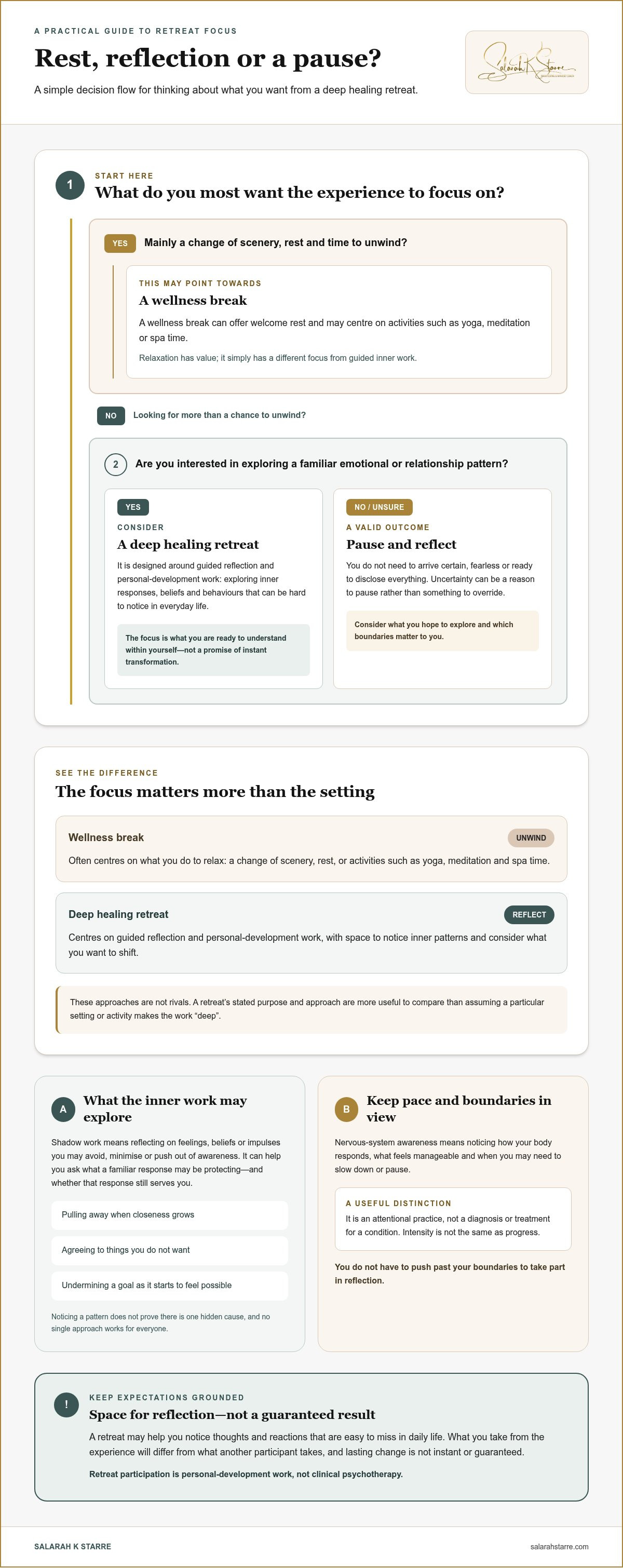
You may be looking for more than a change of scenery. If a familiar emotional or relationship pattern keeps resurfacing, a wellness break can offer welcome rest. It may not, however, give you the focused space to examine what sits beneath that pattern.
A deep healing retreat is an immersive setting for guided reflection and personal-development work. Rather than centring mainly on activities such as yoga, meditation or spa time, it makes space to explore inner responses, beliefs and behaviours that can be difficult to notice in everyday life. These approaches aren’t rivals: while restorative offerings such as Massoga® Massage Yoga provide deep physical relaxation by pairing hands-on bodywork with restorative movement, a deep healing retreat focuses specifically on exploring subconscious patterns and emotional drivers. The difference is what the experience is designed to focus on.
A wellness break often centres on what you do to unwind; a deep healing retreat centres on what you’re ready to understand within yourself. “Deep healing” describes the focus of the work, not a promise of instant transformation. Retreat participation is personal-development work, not clinical psychotherapy, and it can’t guarantee a particular outcome.
What happens during a deep healing retreat?
There’s no single schedule or set of facilities that defines a retreat. The experience may include facilitated inner work, guided reflection and time away from familiar routines. The purpose is to pause, notice what may be happening beneath your usual reactions, and consider what you want to shift. When comparing retreats, look at the stated purpose and approach rather than assuming that a particular setting or activity is what makes the work “deep”.
This focus on inner patterns connects with depth psychology, which explores how unconscious processes may influence behaviour. That doesn’t mean every reaction has one hidden cause, or that a retreat will uncover a definitive answer. It means a repeated response may have more to it than the situation in front of you.
Who might be drawn to deeper retreat work?
You might be curious about deeper work if you recognise recurring self-sabotage, emotional blocks or relationship patterns that don’t seem to change through encouragement alone. Perhaps you know what you’d like to do differently, yet find yourself reacting in familiar ways. That gap can be worth exploring without labelling yourself as broken or assuming there’s a simple explanation.
Curiosity and apprehension can sit side by side. You don’t need to arrive certain, fearless or ready to disclose everything. Consider whether you’re willing to reflect, respect your boundaries and engage with questions that may not have immediate answers. A deep healing retreat UK experience won’t suit everyone at every point in life. Uncertainty is a reason to pause and reflect, not something to override.
How shadow work and subconscious patterns shape deep healing
Repeating patterns can be frustrating, especially when you know what you’d rather do. Shadow work offers a way to look beneath the visible reaction. It involves exploring feelings, beliefs or impulses you may avoid, minimise or push out of awareness. The aim isn’t to uncover something “wrong” with you. It’s to meet your experience with curiosity and take responsibility for the choices available to you now.
What does shadow work explore?
It might involve reflecting on why you pull away when closeness grows, agree to things you don’t want, or undermine a goal just as it starts to feel possible. Fear-based responses and familiar relationship dynamics can persist even when your conscious intention is different. Recognising a pattern doesn’t prove there’s one hidden cause, and no single approach works for everyone. It gives you a chance to ask what the reaction may be protecting and whether that response still serves you.
Awareness creates a pause between a familiar reaction and your next choice, making room for a different response.
Why awareness matters beyond positive thinking
Affirmations can help you focus on what you want, but repeating a positive statement may not address a deeper belief or felt response shaping your behaviour. For example, you might tell yourself to trust whilst bracing for rejection. The words and your reaction may be moving in opposite directions. Inner work looks at that gap without treating it as a personal failure.
Nervous-system awareness adds another layer: noticing how your body responds, what feels manageable and when you may need to slow down or pause. It’s an attentional practice, not a diagnosis or treatment for a condition. A responsible deep healing retreat UK experience makes room for personal pace and boundaries rather than equating intensity with progress. For wider context on trauma and recovery, see SAMHSA on Trauma and Healing.
Positive thinking has a place, but it may not be enough to shift a pattern that operates beneath conscious intention. The related discussion of nervous system and manifestation explores why mindset, bodily responses and behaviour may need to be considered together. The point isn’t to reject optimism. It’s to bring honest awareness to what’s happening, so change can be grounded in more than words.
Will a deep healing retreat create lasting change or just temporary relief?
A focused retreat can create valuable space to reflect, but it isn’t an instant fix or a guarantee that familiar patterns will disappear. Stepping away from daily demands may help you notice thoughts and reactions that usually move too quickly to examine. That perspective can feel meaningful, but it’s one part of a longer process. What you take from the experience will differ from what another participant takes.
What a retreat can and cannot promise
A deep healing retreat UK experience may offer guided reflection, opportunities to recognise recurring patterns and space to renew your intentions. It can’t promise a particular breakthrough, lasting transformation or the same outcome for everyone. Emotional intensity doesn’t prove that useful work is happening, either. Reflection can be challenging, but distress isn’t a requirement for growth. A retreat is personal-development support, not clinical care, and it shouldn’t be presented as a substitute for it.
Retreat insights can inform change, but they can’t guarantee it. A moment of clarity might help you see a choice you hadn’t noticed before. Turning that insight into a different response takes place in everyday life.
How to think about change after the retreat
Ordinary routines and relationships will still be there when you return. Old reactions may resurface, especially in familiar situations. That doesn’t automatically mean the retreat “failed”; it may show that awareness and change are not the same thing. Integration means making sense of what stood out, then choosing a practical next step that feels relevant and manageable for you.
Keep expectations grounded. You might leave with a clearer question rather than a complete answer, or need time to reflect before deciding what to do differently. There’s no single pace you must meet, and you don’t have to turn every insight into immediate action. If self-sabotage is a pattern you’re exploring, the article on shadow work for self-sabotage offers another perspective on noticing what may sit beneath repeated choices.
Lasting change is shaped by what happens beyond the retreat as well as within it. Give yourself room to reflect, revisit your intentions and choose your next steps without demanding instant proof that everything has shifted. A retreat can be a meaningful point of focus, not a promise that the work is finished.
How to prepare for a deep healing retreat with clarity and boundaries
Preparation isn’t about arriving with everything figured out. It’s about getting honest with yourself: what you hope to explore, what feels manageable and which boundaries you want to honour. These reflections can help you approach a deep healing retreat UK experience with greater clarity, but they’re not entry requirements. You’re allowed to arrive with questions, uncertainty or no polished intention at all.
Questions to reflect on before attending
Use this framework to check in with yourself. Write your thoughts down or sit with them quietly; there’s no one right way to prepare.
- Name an area of curiosity. Is there a recurring pattern, relationship dynamic or response you’d like to understand more clearly? Keep it as an open question, not a problem you must solve.
- Consider your capacity. How do you feel about making space for reflection at this point in your life? You don’t need to force readiness. Notice what feels manageable and where you might need to pause.
- Define your boundaries. Think about what helps you feel grounded and what you’d prefer not to share or explore. Taking part doesn’t require disclosing everything.
- Hold your expectations lightly. Rather than demanding a breakthrough, consider what you’d value from the experience, such as greater perspective or a clearer question to take home.
What to consider in emotionally focused retreat work
Be clear about the purpose of the experience and the nature of its personal-development work. Is the emphasis on guided reflection and inner patterns, or primarily on activities designed for relaxation? Neither is automatically better; the right fit depends on what you’re seeking. “Depth” should describe the focus, not pressure to share, push past your limits or produce a dramatic result.
Salarah K Starre’s deep healing programmes and retreats integrate shadow work with nervous-system awareness. The work explores patterns and responses with curiosity whilst paying attention to pace and personal boundaries. Her approach is personal development, not clinical mental-health care. If you need support for a mental-health concern or crisis, seek appropriate clinical help, such as speaking with your GP or using NHS urgent support. If there’s immediate danger, contact emergency services.
Preparation is a way to meet yourself honestly, not another test to pass. You can bring questions, change your mind about what you’re ready to explore, and take the process at your own pace. Explore Salarah’s deep healing retreats to learn more about this inner-work approach.
How Salarah K Starre approaches deep healing retreats
Salarah K Starre is a mindset and manifestation coach with nearly two decades of experience in coaching and personal development. Her deep healing programmes and retreats integrate shadow work and nervous-system awareness, focusing on deeper patterns that can shape behaviour, self-sabotage and self-trust.
A direct approach to subconscious patterns
Rather than treating a recurring pattern as proof that you’re broken, this approach invites you to look at it with honesty and curiosity. You might notice that you repeatedly hold back from a goal or react in a familiar way even when you want a different outcome. Exploring what may sit beneath those responses can help you understand yourself more clearly and consider new choices.
Nervous-system awareness brings attention to your responses and pace. It can mean noticing when reflection feels manageable and when you need to pause, rather than pushing through simply to make the work feel more intense. Alongside shadow work, Salarah’s wider practice includes energetic alignment. The related topic of an energetic alignment workshop connects with this focus on personal development, though each experience has its own purpose.
This is inner work for personal development. It isn’t clinical psychotherapy, a treatment for mental-health conditions or a promise of emotional healing. The aim is to create space to explore patterns and build self-awareness, without guaranteeing what any individual will experience or achieve.
Deciding whether this kind of retreat fits your next step
An immersive retreat may appeal if you want focused space to reflect on recurring behaviours, explore emotional blocks or strengthen your relationship with yourself. It may not feel right for every person or at every point in life. You remain in charge of your pace, boundaries and decisions. Meaningful reflection doesn’t require you to disclose more than you’re comfortable sharing or pursue a particular breakthrough.
If you’re considering a deep healing retreat UK experience, focus on whether its purpose matches what you’re seeking: personal-development work centred on deeper patterns, rather than a guaranteed fix or a purely activity-led break. Let your interest and reservations both have a voice. Clarity comes from understanding the nature of the work and deciding whether it feels like a considered next step for you.
Explore Salarah’s work to learn more about her approach to deep healing and personal development.
Choose your next step with clarity
A deep healing retreat UK experience differs from a wellness break because its focus is guided inner work, not simply time away. Shadow work and nervous-system awareness can help you notice recurring patterns, whilst honest boundaries and realistic expectations keep the process grounded. A retreat may offer perspective, but it can’t guarantee lasting change; what you take forward is personal.
Salarah K Starre brings nearly two decades of coaching and personal-development experience to an approach that integrates shadow work, nervous-system awareness and energetic alignment. A bestselling author and podcast host, she centres her work on exploring deeper patterns and strengthening self-trust, without promising a particular outcome.
If this approach feels aligned with what you’re ready to explore, take time to learn more. Explore Salarah’s deep healing retreats and consider whether this could be a meaningful next step for you. Move at your own pace. Your curiosity, boundaries and choices all matter.
Frequently Asked Questions
What is a deep healing retreat?
A deep healing retreat is an immersive personal-development experience focused on guided reflection and exploring deeper patterns, rather than activities alone. A deep healing retreat UK experience may include space to consider recurring behaviours, beliefs and emotional responses. Formats vary, so the purpose and approach matter more than a particular setting. It isn’t a guaranteed route to transformation, and participants’ experiences can differ.
What happens at a deep healing retreat?
Activities and schedules vary, but the broad purpose is to create space away from routine for reflection and facilitated inner work. This may involve exploring familiar reactions, personal beliefs or areas of life you want to understand better. Some retreats also include relaxation practices, but these aren’t a defining feature of deep inner work. Consider the retreat’s stated focus rather than assuming a particular schedule or activity.
Is a deep healing retreat the same as therapy?
No. A deep healing retreat is personal-development work, not clinical psychotherapy or a substitute for mental-health care. It may offer guided reflection on patterns and self-trust, but it doesn’t diagnose or treat a mental-health condition, and it can’t promise a particular outcome. If you need clinical support, speak with an appropriate health professional. If you’re in crisis, seek urgent help through suitable services rather than relying on a retreat.
Can a deep healing retreat help with recurring patterns?
A retreat may give you focused space to notice recurring patterns, such as withdrawing from close relationships or holding back from a goal. Shadow work invites curiosity about feelings or beliefs you may usually avoid, without treating you as broken or assigning one cause to your behaviour. Greater awareness can help you consider different choices, but it doesn’t guarantee a pattern will change. Ongoing reflection after the retreat may also matter.
How do I know if I am ready for a deep healing retreat?
Readiness doesn’t mean feeling fearless or knowing exactly what you want to explore. Consider whether you feel curious about reflection, able to respect your own boundaries and willing to move at a personal pace. Apprehension can coexist with interest. If you need support for a mental-health concern or crisis, prioritise appropriate clinical care. A personal-development retreat isn’t designed to replace that support or meet every need.
What should I bring or prepare for a healing retreat?
Follow the practical instructions for the specific retreat, since arrangements and requirements vary. For your own reflection, you could note an area you’re curious about, questions you may want to hold and boundaries that matter to you. A notebook may be useful if writing helps you reflect, but you don’t need a perfect intention or a prepared story. Give yourself permission to participate at a pace that feels appropriate.
Will a deep healing retreat create lasting change?
A deep healing retreat can offer perspective and concentrated time for reflection, but lasting change isn’t guaranteed or instant. Insights may become useful as you return to ordinary routines and choose how to respond in familiar situations. Integration can mean revisiting what stood out and identifying a practical next step that feels manageable. Your experience will be personal, and emotional intensity isn’t proof of progress.


