

What if the relationship cycle you keep repeating isn’t proof that something is wrong with you, but a learned response you can understand and change? Overcoming unhealthy relationship patterns starts with noticing the familiar pull: pursuing someone who withdraws, abandoning a boundary to keep the peace, or holding on because hope feels safer than letting go.
If you recognise these cycles but can’t see what keeps them going, you’re not alone in feeling confused or frustrated. Attachment, fear and past experiences can make a different choice feel difficult, even when you know what you need. That doesn’t mean you’re broken. It means the pattern deserves attention, not shame.
This article explores why painful dynamics can repeat and how to practise choices that better reflect your needs and values. You’ll find practical ways to notice triggers, strengthen boundaries and pause before familiar reactions take over. It also distinguishes changeable relationship habits from abuse and other safety concerns, where specialist or urgent support matters more than trying to change the pattern together. Lasting change begins with awareness, safety and a different response, one step at a time.
Key Takeaways
- Recognise recurring relationship dynamics as patterns of response, not proof that something is wrong with you.
- Trace how a cue can lead to an interpretation, an emotional response and an action, then notice what keeps the cycle going.
- Separate changeable relationship difficulties from coercion, threats, intimidation or violence, where safety must come first.
- Begin overcoming unhealthy relationship patterns by recording what happens, identifying your needs and practising one values-led response.
- Understand how coaching can support reflection and personal growth, whilst recognising that it doesn’t replace clinical care or urgent support.
What does overcoming unhealthy relationship patterns really involve?
It can be unsettling to recognise the same painful dynamic returning, especially when each relationship or disagreement seems different on the surface. You might wonder whether you’re choosing badly, reacting too strongly or somehow causing the problem. Before turning that confusion into a verdict about yourself, look at what is actually repeating.
A relationship pattern is a recurring response or interaction, not a diagnosis or a character flaw. It may involve how you respond to tension, what you accept, or how two people repeatedly relate to one another. Noticing your own responses can help you make different choices, but it never makes you responsible for someone else’s abuse. Responsibility for threats, intimidation, coercion or violence belongs to the person choosing that behaviour.
What can an unhealthy relationship pattern look like?
Patterns show up through repetition, not one imperfect moment. Perhaps you regularly set a boundary, then feel pressured to withdraw it. Or you find yourself carrying most of the emotional labour, initiating difficult conversations and repairing the connection alone. These are descriptions of recurring interactions, not fixed labels for either person.
A single difficult disagreement doesn’t establish a pattern. Ordinary conflict can include frustration and hurt, but both people can speak, disagree and take responsibility. Recurring distress is different: the same issue keeps returning, boundaries are repeatedly disregarded, or one person’s needs consistently disappear. Consider what happens over time, including whether there is repair and whether behaviour changes afterwards.
Coercive control, threats, intimidation and violence aren’t mutual communication problems to solve together. If you feel unsafe or are in immediate danger, prioritise your safety and contact emergency services on 999. The cycle of abuse is one framework for describing recurring behaviour in abusive relationships, but it shouldn’t be used to predict every situation or explain away harm.
Why does the same dynamic feel familiar?
Learned expectations can shape what feels recognisable in a relationship. If you’ve become used to smoothing over tension, for example, speaking up may feel risky even when your need is reasonable. Your past doesn’t determine your future. Familiarity can be noticed, questioned and met with a different response.
Subconscious responses offer one lens for reflecting on this: a cue may stir an expectation before you’ve had time to consider what’s happening now. It isn’t a universal explanation or a diagnosis. The aim is curiosity, not blame. For another perspective on this reflective work, explore the guide to breaking toxic relationship patterns. Overcoming unhealthy relationship patterns begins with seeing what repeats while staying clear about who is responsible for harm.
How do subconscious responses and emotional cues keep relationship cycles going?
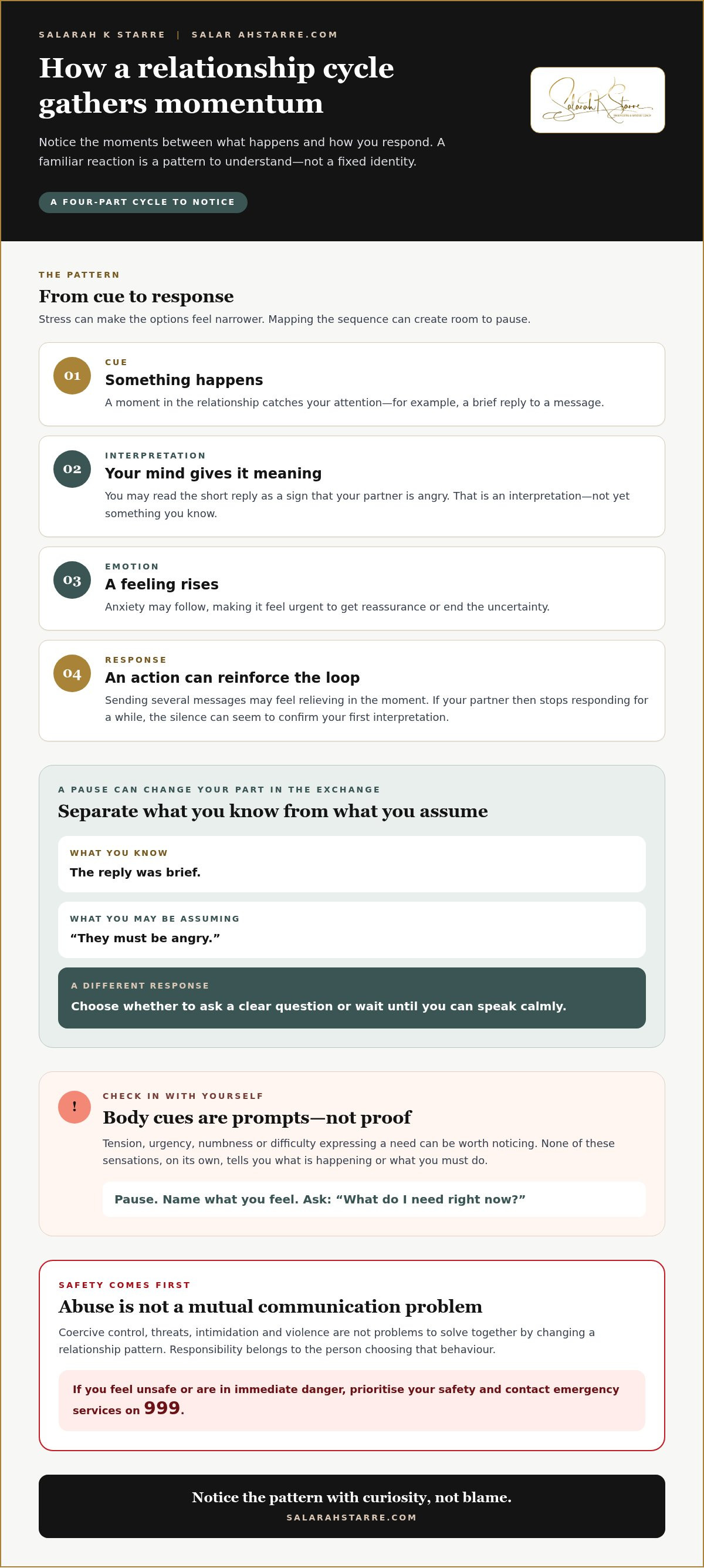
A relationship cycle can gather momentum in a few moments. Something happens, your mind assigns meaning to it, emotion rises and you respond. That response may bring short-term relief while leaving the original concern untouched. Seeing this sequence can help you pause before the familiar reaction takes over.
A cycle is a pattern to notice, not a fixed identity. It doesn’t prove you’re destined to react the same way or that your nervous system dictates your choices. Stress can make options feel narrower: you might focus on ending the tension immediately rather than considering what you need or want to say.
How can familiar responses influence adult relationships?
Past experiences may shape expectations, but they don’t determine what every future relationship will be like. If conflict has felt threatening before, you might avoid raising a concern or agree quickly to prevent rejection. Someone else may seek reassurance urgently when communication changes. These are possibilities, not diagnoses or evidence of what happened in your childhood.
Illustrative example: Your partner replies briefly to a message. You interpret the short reply as a sign they’re angry; anxiety rises, so you send several messages asking what’s wrong. They feel pressured and stop responding for a while. Their silence then seems to confirm your first interpretation. This is one possible sequence, not a universal experience or proof that either person has a particular attachment style.
A different response can change your part in the exchange. First separate what you know from what you’re assuming about the silence. Then decide whether to ask a clear question or wait until you can speak calmly. The Gottman Institute’s discussion of how communication behaviours such as criticism, contempt, defensiveness and stonewalling can affect relationships helps define a toxic relationship. These concepts can offer a lens for reflection, not a diagnosis of a person or relationship.
What role can nervous system awareness play?
Noticing bodily cues can create a moment to reflect rather than react on autopilot. You might notice tension, urgency, numbness or difficulty expressing a need. None of these sensations, on its own, tells you what’s happening or what you must do. Try pausing, naming what you feel and asking, “What do I need right now?”
In reflective subconscious work, these cues can be prompts to explore expectations and habitual responses. That’s a personal-development lens, not a medical intervention or a proven explanation for everyone. For more context on this perspective, read the guide to the nervous system and manifestation.
Overcoming unhealthy relationship patterns doesn’t require perfect control over your reactions. It begins with recognising the cue, questioning the first interpretation and making room for a response that reflects your needs. If you’d like support exploring mindset and subconscious patterns, you can explore personalised one-to-one coaching.
How can you tell a changeable relationship pattern from a safety concern?
Some relationship difficulties can shift when both people can speak freely, take responsibility and respect each other’s limits. Abuse is different. Coercive control, threats, intimidation, stalking and violence are not mutual patterns to work through together. Self-reflection can support your agency, but it never transfers responsibility for abuse from the person causing harm to you.
| Recurring relationship difficulty | Safety concern |
|---|---|
| A disagreement repeats, but both people can express a view without fear. | You feel afraid to disagree or change your behaviour to avoid punishment. |
| A boundary is misunderstood, then discussed and respected in future. | Your movements, contacts, money or choices are controlled, or boundaries bring threats or intimidation. |
| Both people can acknowledge their part and choose whether to repair the issue. | There are threats, stalking, physical violence or pressure that makes you fear for your safety. |
This distinction isn’t a test you must pass before seeking help. If you’re unsure or feel unsafe, you can speak privately with a specialist domestic-abuse service. You don’t need to confront the person, announce a decision or prove that you recognise what’s happening. A support service can help you consider safer options and make a plan that fits your circumstances. If you’re worried your device or messages are monitored, use a safer device if you can.
When should safety take priority over relationship repair?
Prioritise safety if there are threats, stalking, coercive control, physical violence or fear of immediate harm. In an emergency in the UK, call 999. For confidential domestic-abuse support, contact a service in your nation: in England, the National Domestic Abuse Helpline is 0808 2000 247; in Wales, Live Fear Free is 0808 80 10 800; in Scotland, Scotland’s Domestic Abuse and Forced Marriage Helpline is 0800 027 1234; and in Northern Ireland, the Domestic and Sexual Abuse Helpline is 0808 802 1414. If it’s not safe to call, consider using the service’s online support options where available.
How do boundaries differ from trying to control someone else?
A boundary describes your own limit and what you’ll do to protect it. It doesn’t dictate another person’s choices, and it can’t guarantee they’ll respond safely. For example: “I’ll pause this conversation if shouting starts,” or “I’m ending the call now and will only continue when I feel safe.” If stating a boundary could increase risk, you don’t have to announce or enforce it face to face. Overcoming unhealthy relationship patterns must never mean putting relationship repair ahead of safety.
What practical steps help you begin changing unhealthy relationship patterns?
Change starts with a clear observation, not a demand to become a different person overnight. Try this sequence: notice what repeats, record what happened, identify what you needed, choose one response to practise, then review the outcome. Small experiments can build awareness and choice, but they don’t guarantee that another person will change.
How can you identify your own repeating relationship cycle?
After a difficult interaction, jot down what happened in a private place. Keep the record brief and safe. If someone might access your notes or device, don’t record details there. Your safety matters more than completing an exercise.
- Situation: What happened just before the familiar response?
- Feelings and fears: What did you feel, and what were you afraid might happen?
- Needs and boundaries: What mattered to you? What limit or need was hard to express?
- Choice and outcome: What did you do, what happened next, and what might you try another time?
Look for recurring cues and responses without turning your notes into a case against yourself. The aim is to understand the sequence, not decide you’re at fault. Reflective work such as shadow work for self-sabotage can offer another lens for exploring habits with curiosity.
How can you practise a different response safely?
Pick one low-risk change. You might pause before agreeing to a request, say what you’d prefer for dinner, or ask for time to think before answering. Notice what feels difficult. You’re practising a choice, not trying to control someone else’s reaction.
Afterwards, review what happened. Did your response reflect your needs? What would you keep or adjust next time? A difficult outcome doesn’t mean you’ve failed; it gives you information. If expressing a preference could put you at risk, don’t use it as an experiment. Focus on safety and seek specialist support instead.
Trusted people can help you stay grounded. A qualified therapist may be appropriate if distress feels persistent or connects with mental health concerns; specialist services can help with abuse or safety risks. Coaching can support personal reflection and choices, but it isn’t clinical care or crisis support. For personalised one-to-one coaching focused on mindset and subconscious patterns, explore coaching with Salarah K Starre.
Overcoming unhealthy relationship patterns is a process of noticing, choosing and reviewing. There’s no universal timeline. Let each small, safe step show you what supports the connections you want to build.
How can coaching support lasting change without replacing clinical care?
Once you’ve identified a pattern and considered what you need, coaching can offer structured space to reflect and make intentional choices. It’s personal-development support focused on awareness, goals and self-trust. It may help you examine recurring responses and practise new ways of relating, but it can’t promise a particular outcome or make another person change.
Coaching is distinct from clinical psychotherapy. It doesn’t diagnose or treat mental health conditions, and it isn’t crisis support. If you’re experiencing abuse, feel unsafe, or need help with significant mental health concerns, seek appropriate specialist, clinical or emergency support. Coaching mustn’t replace safeguarding or care you need.
What can relationship-pattern coaching help someone explore?
In coaching, you might reflect on situations that repeatedly unsettle you, the needs you find difficult to express and the choices available to you. The focus is on what you want to understand or work towards, not on assigning a diagnosis or blaming you for someone else’s behaviour.
Salarah K Starre’s coaching draws on mindset and subconscious-focused work, with shadow work and nervous-system awareness as reflective lenses. With nearly two decades of experience in mindset and manifestation coaching, she supports clients in exploring patterns and choices as personal-development work. This approach doesn’t establish a clinical explanation, treat trauma or replace specialist care. If safety is at risk, prioritise domestic-abuse support and a safe plan over relationship-pattern coaching.
Overcoming unhealthy relationship patterns isn’t about forcing a dramatic transformation. Begin by asking yourself: which response do I want to understand, what matters to me here, and what support would help me take a safe next step? You might choose one-to-one coaching for personalised reflection, or The Magnetic Recalibration for transformational personal-development work. Neither is a substitute for clinical or crisis care.
What is a grounded next step if you are ready for support?
Start with one honest reflection. Name the pattern you want to change, the choice you hope to make differently and the kind of support that feels appropriate. You don’t need to have the whole journey mapped out. One clearer choice, one boundary or one moment of self-honesty can be a meaningful beginning. Progress may take time, and your next step should fit your circumstances and safety.
Explore Salarah’s coaching and programmes for personal-development support with mindset and subconscious patterns.
Choose a different next step, one moment at a time
Overcoming unhealthy relationship patterns begins with noticing what repeats, without turning that awareness into self-blame. A cue or familiar emotional response can help you pause, name what you need and choose one action that better reflects your values. Small, realistic shifts matter more than demanding a complete overhaul.
Keep safety at the centre. Coercion, threats, intimidation or violence are not shared relationship habits to fix together, and reflecting on your own responses never makes you responsible for another person’s abuse. Seek specialist or urgent support if you’re unsafe or need help beyond personal-development work.
If you’d like support exploring your choices and subconscious patterns, Salarah K Starre brings nearly two decades of experience to her coaching. Her approach incorporates shadow work and nervous-system awareness as reflective tools, not promises of a particular outcome or a replacement for clinical care.
Explore Salarah’s coaching and programmes for support with mindset and subconscious patterns. Your next step can be simple: one clearer choice, one boundary, one honest reflection. Begin where you are, and let that choice count.
Frequently Asked Questions
Is it possible to overcome unhealthy relationship patterns?
Yes, change can begin with noticing what keeps repeating, identifying what you need and practising safer, clearer responses. Overcoming unhealthy relationship patterns is rarely a straight line, and a difficult moment doesn’t erase progress. You’re not responsible for another person’s harmful behaviour. If the relationship involves coercion, threats or violence, prioritise your safety and seek specialist support rather than treating it as a communication issue to solve together.
Why do I keep choosing unhealthy relationships?
There’s no single explanation, and repeating a relationship dynamic doesn’t mean you’re broken or destined to repeat it. Familiar expectations, unmet needs, fear or past experiences may influence what feels recognisable, but they don’t determine your choices. Explore what draws you into the dynamic and what you hope to receive, without turning the answer into self-blame. If the pattern causes distress or feels difficult to change, qualified support may help.
How do I recognise an unhealthy relationship pattern?
Look for recurring interactions, not one disagreement in isolation. You may notice that you repeatedly silence your needs, feel responsible for another person’s emotions or struggle to maintain boundaries. After an interaction, record what happened, how you felt and what followed, if it’s safe to do so. If you feel afraid, controlled, threatened or unsafe, seek specialist support. Self-reflection alone isn’t enough when safety is at risk.
Can setting boundaries change an unhealthy relationship?
Boundaries can clarify what you’re comfortable with and what you’ll do to protect your wellbeing. For example, you might say, “I’ll pause this conversation if shouting starts.” A boundary can support your choices, but it can’t make another person respect your limits or guarantee the relationship will change. If setting or communicating a boundary could increase your risk, put safety first and seek confidential guidance from a specialist domestic-abuse service.
What happens if I keep returning to the same relationship dynamic?
Returning to a familiar dynamic doesn’t erase your progress or prove you lack willpower. Pause, if it feels safe, and consider what drew you back, what you needed at the time and what support might help now. Treat the answers as information, not evidence against yourself. If there’s abuse or immediate danger, focus on safety and specialist help rather than analysing the cycle alone or trying to manage the other person’s behaviour.
Can coaching help me overcome unhealthy relationship patterns?
Coaching may help you reflect on recurring responses, clarify your needs and practise choices that align with your values. It’s personal-development support, not clinical psychotherapy, diagnosis, treatment or crisis care. Salarah K Starre’s one-to-one coaching focuses on mindset and subconscious patterns, with reflective approaches that include shadow work and nervous-system awareness. If you’re facing abuse, significant distress or immediate danger, seek appropriate specialist, clinical or emergency support instead.
How long does it take to change relationship patterns?
There’s no reliable timeline that applies to everyone. Change can depend on the pattern, your circumstances, safety, support and opportunities to practise different responses. Rather than demanding instant transformation, look for specific steps: noticing a dynamic sooner, expressing a need more clearly or reaching out for support. These can mark progress, but they can’t guarantee another person will change. Give yourself room to learn and adjust without self-judgement.


