
What if your chronic overthinking isn't a personality trait but a systemic collapse of your internal authority? You've likely spent years seeking answers in external validation, trapped in an exhausting cycle of indecision and survival mode. You've tried the soft affirmations. You've written the lists. Yet, you still don't know how to build self-trust because that visceral sense of certainty remains elusive whilst you continue to second-guess every move. It's draining, frustrating, and entirely unnecessary.
True power isn't found in surface-level habits; it's forged in the depths of your subconscious. This guide reveals how to reclaim your internal compass by moving beyond the noise and realigning your nervous system. We aren't just talking about confidence. We are talking about unshakeable, grounded, and visceral authority. You'll discover how to identify, dismantle, and reprogramme the hidden blocks that fuel self-sabotage. It's time to stop negotiating with your potential and start living with a magnetic personal power that commands respect, results, and peace.
Key Takeaways
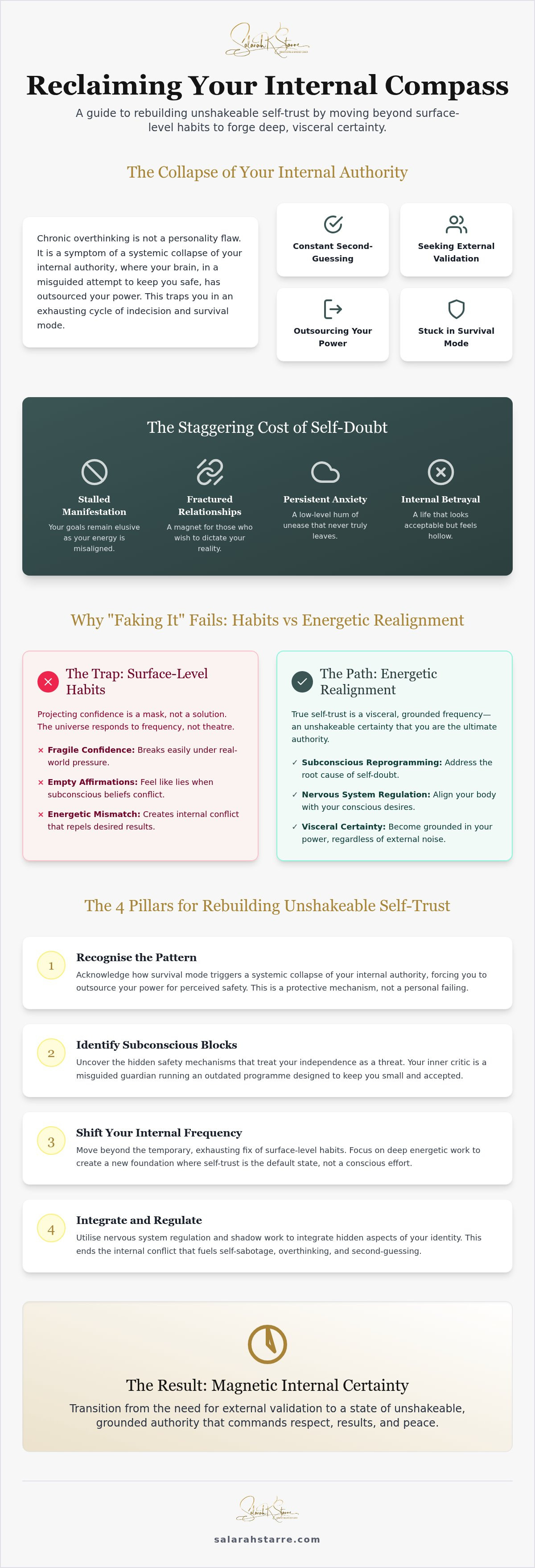
- Recognise how survival mode triggers a systemic collapse of your internal authority, forcing you to outsource your power for perceived safety.
- Identify the subconscious safety mechanisms that treat your independence as a threat and keep you trapped in a cycle of second-guessing.
- Master how to build self-trust by shifting your internal frequency rather than relying on the temporary, exhausting fix of surface-level habits.
- Utilise nervous system regulation and shadow work to integrate hidden aspects of your identity, ending the patterns of self-sabotage and overthinking.
- Reclaim your internal compass to transition from the need for external validation to a state of unshakeable, magnetic internal certainty.
Why Self-Trust is Your Ultimate Power Source (and Why You Lost It)
Self-trust is the engine of your existence. It is the precise point where intuition, authority, and action collide. When these three forces are aligned, you move through the world with a sense of inevitability. Without them, you are a ghost in your own life. You are reactive. You are hollow. You are stuck. Most people believe they lost their trust because of a "bad" decision or a failed venture, but the truth is far more structural. Your brain, in its primal wisdom, chose survival over sovereignty. It outsourced your authority to the collective, the partner, or the parent to ensure you remained safe within the tribe. This is the biological root of your hesitation.
The cost of this disconnection is staggering. It manifests as stalled manifestation, fractured relationships, and a persistent, low-level anxiety that never quite leaves your chest. You have been conditioned to believe that self-doubt is a safety mechanism, but it is actually a cage. Understanding how to build self-trust begins with the realisation that this state is your natural birthright. It isn't something you need to invent; it is a frequency you must return to by clearing the energetic blocks that have obscured your power for decades.
The High Cost of Seeking External Validation
When you constantly scan the room for permission, you dismantle your internal compass piece by piece. This chronic people-pleasing isn't a virtue; it is a survival strategy that makes breaking toxic relationship patterns nearly impossible. If you cannot trust your own pulse, you will always be a magnet for those who wish to dictate your reality. This erosion of understanding self-efficacy—the core belief in your own capacity to achieve—leaves you paralysed amongst a sea of conflicting advice. You begin to value the "favourite" opinions of others whilst ignoring the screaming truth of your own soul. This creates a life that looks acceptable to others but feels like a betrayal to yourself.
Moving Beyond the "Fake It Til You Make It" Trap
Projecting confidence is a mask, not a solution. You can wear the clothes, speak the jargon, and mirror the movements of a leader, but the universe responds to frequency, not theatre. When you attempt to manifest from a place of internal doubt, you create an energetic mismatch that repels the very results you desire. This is why learning how to build self-trust requires a surgical look at your subconscious architecture rather than a new set of surface-level habits. Superficial confidence is fragile and breaks under pressure. Self-trust is a visceral, grounded frequency rather than a mental concept. It is the unshakeable certainty that you are the ultimate authority in your own life, regardless of external noise.
The Subconscious Architecture of Self-Doubt
Your subconscious is not your enemy, but it is a stubborn guardian. It operates on a primal directive: keep you alive by keeping you included. If your early environment demanded compliance over curiosity, your brain categorised self-reliance as a threat to belonging. This is the "Subconscious Safety Mechanism" at work. It views how to build self-trust not as a goal, but as a risk to your social survival. You aren't "broken" or "weak"; you are simply running an outdated programme designed to keep you small, safe, and accepted by the tribe.
This early conditioning creates a blueprint for second-guessing that persists long into adulthood. Your inner critic acts as a misguided protector, screaming at you to stay in the familiar lane to avoid the pain of rejection. When exploring an integrative therapy perspective on self-trust, we see that internal listening is a skill often suppressed by these survival mechanisms. These blocks aren't just mental; they are physical. They manifest as a tight jaw, shallow breathing, or a heavy chest. You have been trained to ignore these visceral signals, prioritising the safety of external approval over the truth of your own body.
Why Positive Thinking Fails to Build Trust
Conscious affirmations often feel like lying because they lack an energetic foundation. If your subconscious believes that trust is dangerous, your conscious mind can shout "I am confident" until it's blue in the face, but nothing will shift. There is a violent conflict between your conscious desires and your hidden programming. To resolve this, you must move beyond surface-level positivity and engage in shadow work for self-sabotage. Only by looking into the basement of your psyche can you begin the surgical process of realigning your frequency with your goals. If you're ready to stop the internal war, exploring one to one coaching can provide the bespoke roadmap needed for this deep work.
Identifying Your Unique Trust Blocks
Self-doubt wears many masks. For some, it is the Perfectionist, who refuses to trust any action that isn't flawless. For others, it is the People-Pleaser, who outsources their authority to avoid conflict. Then there is the Procrastinator, who views movement as a threat and chooses stagnation instead. These archetypes serve to keep you anchored in a reality that is stagnant, safe, and suffocating. Your subconscious prefers a familiar hell to an unfamiliar heaven; building trust requires realigning that preference. Understanding how to build self-trust means recognising these patterns as they arise and choosing to stay grounded whilst you dismantle them. You are recalibrating your entire system to view sovereignty as safety.
Why "Faking It" Fails: Habits vs Energetic Realignment
Most mainstream advice on how to build self-trust focuses on the "Habit Approach." It suggests that if you wake up earlier, journal more, or tick off a checklist, you will eventually believe in yourself. This is behavioural theatre. Whilst these actions have value, they are merely surface-level adjustments. If your internal frequency is still tuned to doubt, these habits will eventually feel like a performance you can no longer sustain. You cannot out-work a subconscious belief that you are untrustworthy. This mismatch between your conscious actions and your energetic state is the primary driver of burnout.
True transformation requires an "Energetic Approach." This is the core of The Magnetic Recalibration. Instead of forcing new behaviours onto a fractured foundation, we realign the internal state to match your external goals. When your subconscious authority is reclaimed, the habits follow naturally. You stop fighting yourself. You stop negotiating. You start moving with a sense of inevitability. In the mechanics of manifestation, self-trust is the ultimate catalyst because it represents a total lack of resistance. You aren't just hoping for a result; you are certain of your capacity to hold it.
The Myth of Consistency
We are told that consistency is the only path to success. However, forcing consistency whilst you are out of alignment is a profound form of self-betrayal. It is a violent act against your own internal rhythm. When you learn how to build self-trust, you begin to honour your "ebb and flow" rather than a rigid, external schedule. You reclaim the power to pivot, rest, or change direction without a shred of guilt. This isn't laziness; it is high-level discernment. It is the unshakeable confidence that your authority is more reliable than a calendar.
Frequency and Magnetism
Your life is a mirror of your frequency. A lack of self-trust acts like a repellent, pushing away high-frequency opportunities and healthy, balanced relationships. You attract what you are, not what you want. If you are vibrating at the level of "I might fail" or "I am not enough," the universe will continue to provide evidence for those beliefs. Shifting this requires a visceral change in your energetic signature. This is the work of an energetic alignment workshop UK, where we move beyond the theory and into the actual reprogramming of your magnetic field. When you trust yourself, you become a match for the life you previously only dared to dream of.
4 Pillars to Rebuilding Unshakeable Self-Trust
Rebuilding trust isn't about surface-level tips or keeping a gratitude diary. It requires a structural overhaul of your internal architecture. Most advice on how to build self-trust fails because it ignores the biological and energetic foundations of your identity. To move from chronic indecision to unshakeable certainty, you must commit to four non-negotiable pillars that realign your subconscious with your conscious intent. Trust is a choice. It is a commitment. It is a frequency.
Pillar 1: Regulating the Nervous System
You cannot trust your intuition whilst your body is trapped in a state of fight or flight. When your nervous system is dysregulated, your brain perceives every choice as a potential threat, forcing you into survival mode. You must use somatic tools like box breathing, grounding, or intentional movement to signal safety to your cells. This biological baseline is essential for the nervous system and manifestation because abundance cannot land in a body that feels under siege. Safety is the precursor to authority.
Pillar 2: Engaging in Shadow Work
Your "Hidden Self" is often the architect of your self-sabotage. These are the parts of you that were shamed, judged, or hidden away to maintain belonging in early life. Shadow work is the surgical tool used to integrate these fragments. You must forgive your past "failures" by recognising them as survival strategies that are no longer required. View your shadow not as a flaw, but as a map to your power. By bringing these hidden drivers into the light, you stop the internal collision that drains your energy and fractures your confidence.
Pillar 3 & 4: Reprogramming and Responsibility
Subconscious reprogramming is built on evidence, not just hope. You must use micro-wins to prove to your subconscious that you are reliable. If you say you'll drink water, drink it. If you say you'll rest, rest. This builds a track record of integrity that overwrites the "unsafe to trust" script. This leads naturally to Radical Responsibility, where you adopt a "No-Blame" rule for your life. You must organise your reality around ownership rather than victimhood, setting non-negotiables that protect your energy and time. If you are ready to anchor these pillars into your daily experience, explore Manifestation Workshops to begin your visceral transformation. Understanding how to build self-trust is the first step; embodying it is the destination.
Recalibrating Your Internal Compass with Salarah K Starre
The journey from chronic hesitation to unshakeable authority is not a gentle stroll. It is a surgical, visceral, and definitive realignment of your entire being. You've dissected the biological triggers, dismantled the subconscious blocks, and anchored the four pillars of sovereignty. Now, the path forward requires a decision. You can continue to negotiate with your potential, or you can finally claim your power. Learning how to build self-trust is the ultimate act of rebellion against a life lived in survival mode. It is the moment you stop asking for permission and start commanding your reality.
Salarah K Starre acts as the high-frequency catalyst for this internal shift. With nearly two decades of expertise in mindset and manifestation, she provides the strategic depth and energetic force needed to break through decades of stagnation. This isn't about gentle encouragement; it's about a total systemic recalibration. You are moving beyond the noise of the world and returning to the frequency of your own truth. This is where your magnetism lives.
The Magnetic Recalibration Experience
The Magnetic Recalibration is the primary vehicle for this profound transformation. It is a bespoke journey designed to identify, target, and clear the emotional debris that keeps you trapped in a cycle of self-doubt. By addressing the root energetic causes of your trust blocks, the programme facilitates a shift that surface-level habits simply cannot reach. You'll move beyond the exhaustion of survival mode and into a state of purpose and personal power. Engaging with a transformational speaker UK can accelerate this process, providing the clarity and momentum required to collapse the timelines of your growth. You don't just learn how to build self-trust; you become it.
Take the First Step Today
Stop waiting for "clarity" to arrive from the outside. Clarity isn't a prerequisite for action; it is the reward for trust. Every moment you spend second-guessing is a moment you spend leaking your power to the collective. Whether you require the focused intensity of one to one coaching or the immersive energy of deep healing programmes and retreats, the time to anchor your authority is now. You have the tools, the pillars, and the roadmap. Now, you need the courage to lead yourself. Self-trust is the only bridge to the life of freedom you've been manifesting. Visit salarahstarre.com to book your consultation and begin the work that changes everything. Your future self is done waiting.
Reclaim Your Sovereignty and Command Your Reality
Self-trust is not a destination you reach through superficial habits; it is a visceral return to your internal authority. You have seen that the path involves more than just positive thinking. It requires a surgical approach to nervous system regulation, shadow work, and subconscious reprogramming. By moving beyond survival mode, you stop outsourcing your power and start anchoring your frequency in unshakeable certainty. Understanding how to build self-trust is the first step toward a life of magnetic manifestation and radical freedom.
Salarah K Starre brings nearly 20 years of expertise in subconscious reprogramming to this transformative process. As a bestselling author and mindset innovator, she provides a bespoke approach that blends deep shadow work with energetic alignment to collapse the timelines of your growth. It's time to stop negotiating with your potential and start leading with conviction. Reclaim your personal power and rebuild unshakeable self-trust with Salarah K Starre. You are ready to step into a reality that is brave, bold, and unshakeable; the universe is waiting for your command.
Frequently Asked Questions
How do I know if I have a self-trust issue or if I am just being cautious?
You have a self-trust issue if your hesitation is systemic and leads to chronic overthinking regardless of the facts. Being cautious is a logical response to external risks; whilst self-doubt is a visceral rejection of your own authority. If you feel stuck in survival mode or constantly outsource your decisions to others; you are likely struggling with how to build self-trust. This internal fracture prevents you from moving forward with certainty.
Can self-trust be rebuilt after a major failure or betrayal?
Self-trust can absolutely be rebuilt after significant setbacks because trust is a frequency; not a permanent state. Failures often leave behind subconscious debris that categorises your intuition as dangerous. By engaging in shadow work and nervous system regulation; you can integrate these experiences and reclaim your internal compass. This process involves proving to your subconscious that you are reliable through micro-wins and radical responsibility; ensuring you move beyond the exhausting cycle of self-sabotage.
How long does it take to reprogram the subconscious mind for self-trust?
The timeline for subconscious reprogramming varies between individuals; but visceral shifts often begin within four to six weeks of consistent work. Deep integration of unshakeable authority typically requires several months of dedicated practice. Programs like The Magnetic Recalibration are designed to accelerate this process by targeting the energetic root of trust blocks. Whilst the conscious mind wants a fast fix; your nervous system requires time to safely transition from survival to sovereignty.
Why do I trust others more than I trust myself?
You trust others more than yourself because your subconscious has categorised external validation as a safety mechanism. In early childhood; compliance often ensured belonging and survival; making self-reliance feel like a threat to your safety. This conditioning creates a blueprint where you prioritise the favourite opinions of the collective over your own truth. Breaking this pattern requires realigning your internal frequency so that your own authority becomes the safest place to land.
Is self-trust the same as confidence?
Self-trust and confidence are distinct energetic states. Confidence is often tied to your perceived ability to perform a task or project a specific image to the world. Self-trust is a visceral; grounded certainty that you can handle whatever outcome arises. It is the unshakeable relationship you have with your own soul. You can be confident in a skill whilst still lacking the internal authority needed to make high-stakes life decisions without external permission.
What happens to my relationships when I start trusting myself more?
Your relationships will undergo a significant recalibration as you learn how to build self-trust. You will likely find that your tolerance for toxic relationship patterns and situationships evaporates as your internal authority grows. Some people may react poorly to your new boundaries; whilst others will be drawn to your magnetic personal power. By ending the need for external validation; you create space for connections based on authentic alignment rather than survival-based people-pleasing.
Can shadow work help with indecision?
Shadow work is a surgical tool for resolving chronic indecision. Indecision is often caused by an internal collision between your conscious desires and a hidden part of yourself that views action as a threat. By identifying and integrating these saboteurs; you remove the friction that causes you to stall. Shadow work allows you to forgive past mistakes and reclaim the power that was previously trapped in shame; making decision-making a natural expression of your truth.
How does nervous system regulation affect my ability to make decisions?
Your nervous system acts as the filter for every decision you make. If you are in a state of fight or flight; your brain prioritises immediate survival over long-term alignment; making it impossible to access your intuition. Regulation signals safety to your body; allowing you to move from a reactive state into one of grounded authority. Without a regulated system; your choices will always be driven by fear rather than the unshakeable internal certainty of your true self.


