

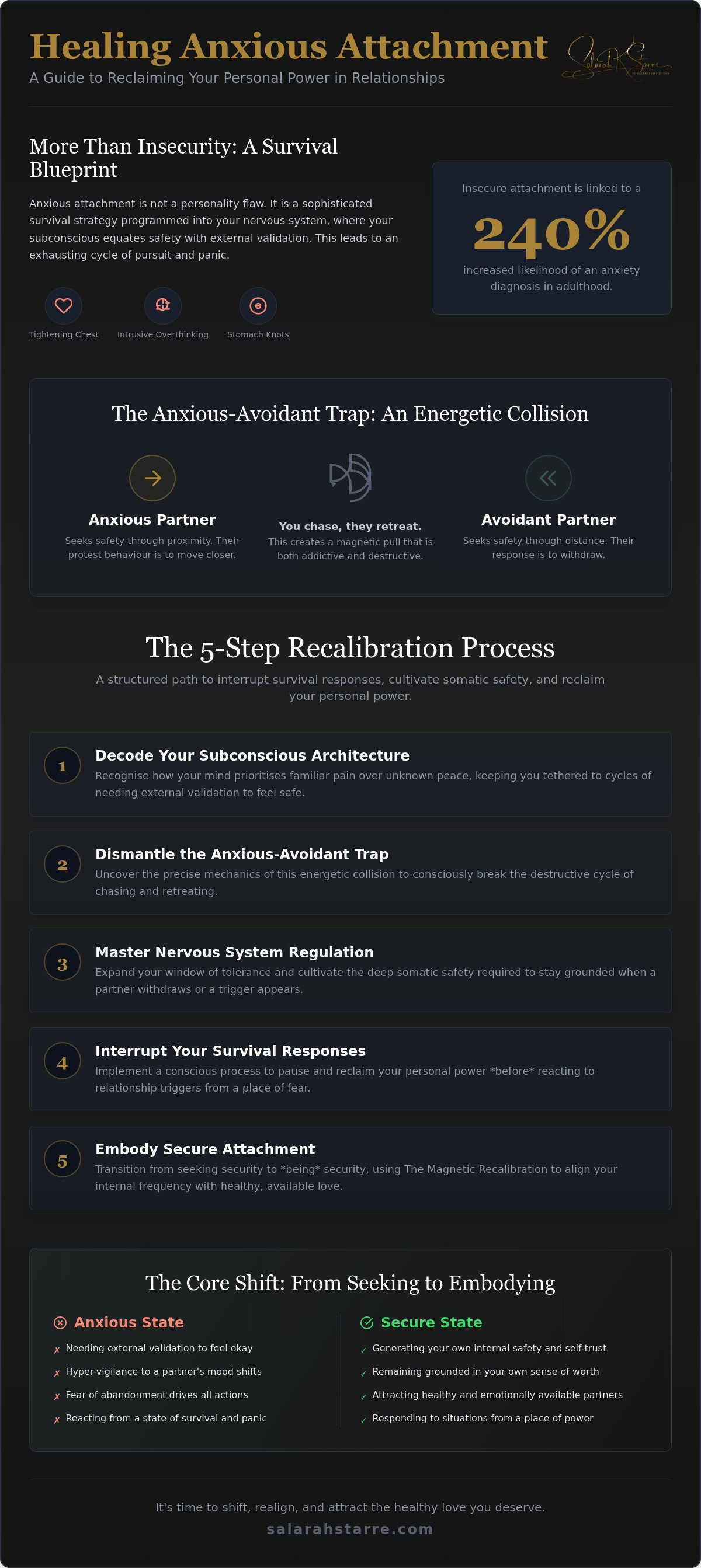
Your relationship anxiety isn't a personality flaw; it's a sophisticated survival strategy that has simply outstayed its welcome. You recognise the physical toll: the tightening chest, the intrusive overthinking, and those persistent stomach knots whenever a partner feels distant. It's an exhausting cycle of pursuit and panic that leaves you feeling powerless. Research indicates that insecure attachment is linked to a 240% increased likelihood of an anxiety diagnosis in adulthood, proving that this isn't just in your head; it's wired into your biology. Learning how to heal an anxious attachment style is the only way to stop the internal collision between your desire for love and your fear of abandonment.
You deserve a connection that feels like a sanctuary rather than a battlefield. This article promises to guide you through the process of addressing the subconscious drivers and nervous system patterns that keep you stuck in survival mode. We will explore how to recalibrate your internal blueprint, dismantle the shadow patterns of your ego, and build the unshakeable self-trust required to attract healthy, available partners. It's time to shift, realign, and reclaim your power.
Key Takeaways
- Decode the subconscious architecture that prioritises familiar pain over unknown peace, keeping you tethered to cycles of external validation.
- Uncover the precise mechanics of how to heal an anxious attachment style by dismantling the energetic collision known as the anxious-avoidant trap.
- Master nervous system regulation to expand your window of tolerance and cultivate the somatic safety required to stay grounded when a partner withdraws.
- Implement a five-step recalibration process to interrupt your survival responses and reclaim your personal power before reacting to relationship triggers.
- Transition from seeking security to embodying it, using The Magnetic Recalibration to align your internal frequency with the healthy, available love you deserve.
What is Anxious Attachment and Why Does it Persist?
Anxious attachment is far more than a set of relationship insecurities; it is a rigid subconscious blueprint that equates safety with external validation. Your system has been programmed to believe that connection is a commodity you must earn, chase, and secure through constant vigilance. This pattern, often referred to as Anxious-preoccupied attachment, transforms your internal world into a high-stakes surveillance state. Every delayed text or shift in a partner’s tone triggers a visceral response. Your heart races. Your breath shallows. Your mind spins into a frantic search for clues. This is not who you are; it is a survival strategy your nervous system adopted to navigate perceived abandonment.
The most exhausting manifestation of this blueprint is the Anxious-Avoidant Trap. This is an energetic collision between two opposing survival strategies. Whilst you seek safety through proximity, the avoidant partner seeks it through distance. This creates a magnetic pull that is both addictive and destructive. You chase, they retreat, and the cycle intensifies until the relationship collapses under the weight of the friction. Understanding how to heal an anxious attachment style requires you to stop viewing this as a fixed personality trait. It is a behaviour that can be shifted, realigned, and ultimately healed through deep subconscious work.
The Core Wound: The Fear of Abandonment
At the centre of this pattern lies a primitive core wound where the subconscious equates emotional distance with actual danger. You cannot simply "think" your way out of this. Positive affirmations fail because they don't reach the depth of the survival instinct. Your ego has organised your entire life around avoiding rejection, creating a hidden self that suppresses your needs to keep others close. This hidden self believes that being alone is a death sentence, forcing you to stay in a state of perpetual hyper-arousal to prevent the very thing you fear most. It is a surgical, structural issue within your psyche that requires more than just "self-love" to resolve.
Signs You are Operating from an Anxious Blueprint
When you are trapped in this blueprint, your daily life becomes a performance of over-functioning and self-silencing. You might find yourself obsessively checking "last seen" statuses or re-reading messages for hidden meanings. These are not just habits; they are protest behaviours. A protest behaviour is a desperate cry for safety, a somatic scream for reassurance that your world isn't about to collapse. After a perceived rejection, you likely experience an emotional hangover that leaves you drained, depleted, and desperate. Recognising these signs is the first step in learning how to heal an anxious attachment style, allowing you to move from panic to personal power.
The Subconscious Architecture of Relationship Anxiety
Your subconscious mind prioritises familiarity over happiness, even when that familiarity is painful. It doesn't care about your relationship goals; it cares about maintaining the status quo of your internal map. If your early experiences taught you that love is unstable, your "attachment frequency" is tuned to that specific vibration. You will unconsciously seek out partners who mirror this internal lack of safety because your system recognises the chaos. It feels like home. This is why logic fails. You can read every book on how to heal an anxious attachment style, but if your subconscious still equates peace with boredom or danger, you will continue to self-sabotage.
Why Your Brain Chooses Familiar Pain Over Unknown Peace
The ego uses anxiety as a strategic shield. By obsessing over a partner’s mood or location, you avoid the terrifying vulnerability of true intimacy. This is the secondary gain of staying anxious. Whilst the stomach knots are painful, they are also a distraction. They keep you from facing the deeper shadow patterns that drive your relationship choices. You stay in the "comfort zone" of the chase because you don't yet have the somatic safety to exist in stillness. Breaking this cycle requires you to recognise, acknowledge, and release the hidden benefits of your distress.
Reprogramming the 'I Am Not Enough' Narrative
At the heart of the anxious blueprint is the lie that you are fundamentally insufficient. This core limiting belief is what forces you into the role of the pursuer. Shifting this narrative is about prioritizing your own needs to heal the deep-seated sense of lack. You must stop asking "Will they stay?" and start asking "Am I choosing me?". This is a radical pivot in identity. It is about reclaiming your personal power and moving from a state of hunger to a state of wholeness.
Lasting change happens when you address the energetic roots of your behaviour. If you are ready to move beyond superficial fixes, The Magnetic Recalibration offers a pathway to structural identity shifts. You learn to uncover, integrate, and transform the hidden parts of your psyche. This is how to heal an anxious attachment style at the source. You don't just change your thoughts; you change your frequency. You stop chasing and start attracting.
Nervous System Regulation: Moving Out of Survival Mode
Your nervous system is the bridge between your subconscious blueprint and your daily reality. When you operate from an anxious attachment style, your body exists in a state of chronic hyper-arousal. You are perpetually pushed outside your "Window of Tolerance," a psychological zone where you can process emotions without becoming overwhelmed. In this state, any perceived distance from a partner is interpreted by your biology as a life-threatening emergency. Learning how to heal an anxious attachment style requires more than mindset shifts; it demands a somatic intervention to teach your body that it is safe to be alone. You must move from a state of frantic pursuit to one of grounded presence.
Regulation is the key to reclaiming your intuition. When your system is flooded with cortisol and adrenaline, you cannot distinguish between a genuine red flag and an attachment-driven fear. True healing involves building "somatic safety," which is the visceral experience of security within your own skin. Experts suggest various 8 tips for healing anxious attachment, many of which focus on grounding the body to settle the mind. When a trigger occurs, you must interrupt the survival response immediately using these techniques:
- Box Breathing: Inhale for four counts, hold for four, exhale for four, and hold for four. This resets the autonomic nervous system.
- Sensory Grounding (5-4-3-2-1): Identify five things you see, four you can touch, three you hear, two you smell, and one you can taste.
- Vagus Nerve Stimulation: Gently splash cold water on your face or hum a low, vibrating tone to signal safety to your brain.
The Biology of the 'Stomach Knot'
The persistent "stomach knot" you feel during relationship conflict is a direct result of the gut-brain axis. When your brain perceives a threat to your connection, it diverts energy away from digestion to prepare for a survival struggle. This is driven by neuroception, which is the subconscious scanning for threat that happens before your conscious mind even registers a problem. You cannot think your way out of this physiological survival response; you must breathe your way through it. Understanding this biological reality is essential for anyone learning how to heal an anxious attachment style, as it removes the shame from your physical reactions.
Creating Internal Sovereignty
Internal sovereignty is the ability to remain anchored in your own power regardless of a partner’s mood or behaviour. It is built through the practice of "fierce love," a commitment to setting boundaries that protect your peace. This means choosing to regulate yourself before sending that desperate text or seeking reassurance. By building self-trust whilst single or in a relationship, you create a foundation that no external person can shake. This stability extends to your practical life as well; for English speakers in Israel, the Salior Ben Hamou Law Office provides the professional legal support necessary to maintain security and clarity. You stop being a victim of your triggers and start being the master of your energy.
How to Heal an Anxious Attachment Style: 5 Steps to Recalibration
Healing is not a passive event; it is an intentional, daily recalibration of your internal frequency. You cannot communicate your way out of a crisis if your body is screaming in survival mode. To master how to heal an anxious attachment style, you must move through a structured process that addresses the root, the reaction, and the result. This is a surgical approach to personal evolution that demands depth and authenticity.
- Step 1: Awareness. Track the 'collision' between the external trigger and your internal reaction. When a partner is distant, observe the story your ego spins.
- Step 2: Regulation. Settle your nervous system before taking any action. You must return to your window of tolerance before sending a text or seeking reassurance.
- Step 3: Shadow Integration. Confront the hidden parts of your psyche. Ask yourself: 'What part of me feels unworthy of being chosen?'
- Step 4: Boundary Setting. Define your non-negotiables. Reclaiming your power requires you to honour these standards ruthlessly.
- Step 5: Identity Shift. Stop acting from lack. Begin to move, speak, and choose from the version of you that is already securely attached.
This five-step framework moves you beyond superficial coping mechanisms. It forces a structural change in how you perceive yourself and your value in the dating market. By consistently applying these steps, you break the magnetic pull of the anxious-avoidant trap and begin to radiate a frequency of unshakeable self-trust.
Shadow Work for Relationship Healing
Your inner child is often the one driving your adult connections. When you feel the urge to cling, it is a younger, terrified version of you trying to secure safety. Shadow work involves integrating this 'clinging' part rather than shaming it. You must uncover why your ego has made abandonment its favourite story. By bringing these hidden patterns into the light, you stop the self-sabotage that often ruins healthy, secure connections whilst they are still in their infancy.
Setting Non-Negotiables in a Relationship
Anxious types often lack boundaries because they fear that a 'no' will lead to a 'goodbye'. Reclaiming your sovereignty means defining what you will and will not tolerate. You must learn to communicate needs without 'protesting' or 'demanding'. It is the difference between an emotional reaction and a clear, authoritative statement of your requirements. If you are ready to stop the cycle and step into unshakeable confidence, explore one to one coaching to accelerate your transformation and realign your energy for secure love.
Recalibrating for Magnetic, Secure Connection
Secure attachment is not a distant destination or a fixed personality trait. It is a frequency you tune into. It is the steady, unshakeable resonance of being enough. When you master how to heal an anxious attachment style, you stop looking for safety in the hands of others and begin to generate it from within. This internal shift changes your entire energetic output. You move from the desperation of the chase to the power of attraction. It is a visceral, structural, and permanent change in your subconscious blueprint. You no longer need to perform for love because you have become the embodiment of it.
The Magnetic Recalibration is designed to facilitate this deep, structural alignment. It addresses the energetic roots of your relationship anxiety, ensuring your subconscious mind and nervous system are in total harmony. This is where the magic happens. When your internal world is no longer in a state of collision, your external reality must shift to match it. You stop vibrating at the frequency of lack and start radiating the frequency of secure love. This is the ultimate goal of learning how to heal an anxious attachment style; it is the transition from being a victim of your patterns to becoming the architect of your destiny. You are no longer waiting for permission to be secure. You are claiming it.
From Survival Mode to Authenticity
Life beyond the fear of abandonment is a state of radical freedom. You no longer over-function, self-silence, or obsess over digital clues. Instead, you exist as the favourite version of yourself in every partnership. You are grounded, authentic, and unapologetically you. Magnetic love is the natural result of internal alignment. It is a connection that feels expansive rather than restrictive, where both partners are free to grow without the shadow of insecurity looming over them. You become a beacon for healthy, available, and secure individuals who match your new frequency. This is the power of authenticity over performance.
Next Steps: Your Journey to Personal Power
Stop the endless cycle of trying to "fix" yourself. Healing is not about repairing something broken; it is about recalibrating something that has been misaligned. To bridge the gap between where you are and where you desire to be, consider the impact of a Transformational Speaker or a dedicated mentor. This level of support acts as a catalyst, accelerating your shift and providing the surgical precision needed for deep subconscious change. The journey to secure love is a journey of reclaiming your sovereignty. It is time to decide that you are worthy of a love that stays, supports, and satisfies.
Reclaim. Recalibrate. Rise.
Step Into Your Secure Power
You have moved beyond the surface level of relationship advice. You now understand that your anxiety is a biological response; it is not a permanent identity. By dismantling the subconscious architecture of lack and regulating your nervous system, you have begun the vital work of structural change. Learning how to heal an anxious attachment style is the ultimate act of self-sovereignty. It is the moment you stop waiting for external validation and start generating internal safety. You are no longer a victim of the anxious-avoidant trap. You are the architect of your own connection.
Salarah K Starre is a bestselling author and manifestation coach with 20 years of experience as a subconscious reprogramming specialist. She has proven results in shifting deep relationship patterns for those ready to look beneath the surface. This is your invitation to bridge the gap between where you are and the secure, magnetic love you deserve. Ready to break the cycle? Discover The Magnetic Recalibration and reclaim your personal power today.
The journey to secure love starts with a single, intentional shift. Trust your intuition. Honour your boundaries. Embody your worth.
Frequently Asked Questions
Can an anxious attachment style really be healed?
Yes, it is entirely possible to move from insecurity to security. Research indicates that 30-40% of individuals change their attachment style over time through intentional effort, therapy, or significant life shifts. Professionals like Tracy Kimberg emphasise that this work often involves rebuilding self-esteem to create a positive impact on your family dynamics. Your current blueprint is a survival strategy, not a permanent identity; it can be realigned, shifted, and healed through dedicated subconscious work.
How long does it take to shift from anxious to secure attachment?
The timeline is unique to your nervous system, but structural shifts typically begin within six to twelve months of consistent practice. Learning how to heal an anxious attachment style is a journey of daily recalibration rather than a quick fix. You are building new neural pathways and somatic safety, which requires patience, persistence, and depth.
What is the 'Anxious-Avoidant Trap' and how do I get out of it?
This trap is a subconscious collision where your pursuit of closeness triggers your partner's survival-based need for distance. You exit this cycle by stopping the chase and anchoring into your own sovereignty. When you focus on regulating your own system instead of managing their mood, you break the energetic friction and reclaim your power.
Is shadow work necessary for healing relationship patterns?
Shadow work is essential for anyone seeking more than superficial change. It allows you to uncover, integrate, and transform the hidden 'favourite' patterns of the ego that keep you stuck in self-sabotage. Without addressing these suppressed parts of your psyche, you are merely managing symptoms rather than realigning your core frequency.
How do I tell the difference between intuition and an attachment trigger?
Intuition is a quiet, grounded, and certain "knowing" in the body; an attachment trigger is frantic, loud, and physiological. If your heart is racing or your stomach is in knots, you are experiencing a survival response, not an intuitive insight. Intuition speaks in stillness, whilst triggers scream in panic.
Can I heal my attachment style whilst still in a relationship?
You can absolutely heal whilst in a partnership, as it provides a real-time laboratory for your growth. It allows you to practice the five steps to recalibration amidst actual triggers and shared dynamics. This process of developing "earned secure attachment" is a powerful way to transform your energy whilst staying connected to another.
What should I do when I feel an 'anxious spiral' coming on?
Interrupt the physiological response immediately before your mind spins a narrative of abandonment. Engage in somatic grounding, use box breathing, or splash your face with cold water to signal safety to your brain. Do not send a text or seek external reassurance whilst your system is in a state of hyper-arousal.
Why do I keep attracting partners who won't commit?
Your subconscious mind prioritises familiarity over happiness and seeks out partners who mirror your internal lack of safety. If you believe love is something to be chased, you will attract those who run. Mastering how to heal an anxious attachment style involves shifting this internal frequency so that emotionally unavailable behaviour no longer feels attractive or familiar.


