
Your self-sabotage isn't a character defect or a simple lack of willpower; it's a sophisticated survival strategy designed to keep you safe from the very expansion you crave. You've likely felt the frustration of hitting an invisible ceiling just as your career finally gains momentum. You've experienced the hollow ache of repeating toxic relationship cycles or the paralysis of procrastination when the stakes are at their highest. It's exhausting to feel like a fraud whilst you're working harder than everyone else. Learning how to stop self-sabotage requires more than just "trying harder" or forcing positive thoughts. It demands a deep, surgical look at the subconscious patterns that are currently dictating your reality.
You're ready for a life defined by unshakeable self-trust and consistent, magnetic progress. This isn't about soft encouragement; it's about structural change. This guide reveals the visceral drivers behind your resistance and provides a potent, 5-step process to break the survival mode loop. We'll move beyond surface-level habits to recalibrate your nervous system, realign your energy, and reclaim your personal power once and for all.
Key Takeaways
- Unmask the "hidden benefits" of staying small and recognise how your subconscious prioritises safety over your highest expansion.
- Replace the struggle of willpower with the precision of nervous system regulation to silence the "survival mode" responses that trigger self-destruction.
- Master a visceral, five-step process that provides a clear roadmap on how to stop self-sabotage by witnessing, identifying, and realigning your internal triggers.
- Leverage shadow work to confront the parts of you that benefit from failure, allowing you to break through your "upper limit" once and for all.
- Discover how subconscious reprogramming can shift your internal state from fear-based resistance to unshakeable, magnetic power.
Understanding the Anatomy of Self-Sabotage
Self-sabotage is not a glitch in your character. It is a surgical, internal collision between your conscious ambitions and your subconscious safety settings. You want the expansion, the wealth, the love; yet, your internal architecture is wired to pull the emergency brake. This isn't about a lack of discipline. It's a misplaced protective mechanism that prioritises your survival over your growth. Many of these patterns take root in the shadows of childhood, where staying small or being invisible was the only way to navigate unpredictable family dynamics. By Understanding Self-Destructive Behavior, we see that these actions are often desperate attempts to maintain an internal equilibrium that feels safe, even if it's stagnant.
The Symptoms of a Sabotaged Mindset
Procrastination is rarely about laziness. It is a heavy, leaden shield used to protect you from the "danger" of being seen, judged, or criticised. Perfectionism operates similarly; it's an impossible standard designed to ensure you never actually cross the finish line where real-world feedback lives. In the UK, this is often compounded by the "stiff upper lip" culture. We suppress, we ignore, and we endure. This cultural conditioning forces emotions underground, where they ferment into internal collisions that manifest as self-destruction. Learning how to stop self-sabotage starts with admitting that these behaviours are shields, not shackles.
Why Your Brain Chooses Failure Over Change
The subconscious mind is a creature of habit that values the familiar above all else. It would rather you stay in a miserable, known situation than venture into a brilliant, unknown future. The Homeostatic Pulse is the internal mechanism that detects any shift away from your baseline and aggressively pulls you back to your established comfort zone. This is why the fear of success is often more potent than the fear of failure. Success demands a new identity, higher visibility, and greater responsibility. To your ego, that level of change feels like a death threat, so it sabotages the goal to keep you safely tucked away in the shadows. To truly master how to stop self-sabotage, you must acknowledge the biological safety your brain feels when you fail.
The Shadow Side: Why Your Subconscious Protects You Through Failure
Shadow Work is the uncompromising tool required to unmask the parts of your psyche that actually benefit from staying small. Whilst your conscious mind sets high-stakes goals, your shadow self is often working behind the scenes to ensure they never manifest. This is because every sabotaging behaviour offers a "Secondary Gain", a hidden benefit that outweighs the reward of success. For some, staying stuck protects them from the terrifying weight of responsibility. For others, it ensures they never face the risk of public rejection. To understand the Psychology of Self-Sabotage, you must first accept that your failures are often protective shields in disguise.
This internal conflict creates a glass ceiling on your potential, particularly regarding wealth and influence. If your shadow associates high income with greed, isolation, or increased scrutiny, it will dismantle your financial progress every time you approach a breakthrough. Exploring shadow work for abundance allows you to clear these specific financial blocks and realign your energy with the prosperity you deserve. Mastering how to stop self-sabotage is not about fighting yourself; it is about bringing these hidden motivations into the light of awareness so they can no longer dictate your choices from the dark.
Uncovering the Hidden Benefits of Staying Stuck
Does staying small protect you from being criticised or rejected by your social circle? Often, the subconscious fears that success will lead to a loss of belonging. To break this cycle, you must move through a visceral process: identify, interrogate, and integrate. Identify the specific behaviour, interrogate the fear driving it, and integrate the lesson so you can move forward with unshakeable certainty. Recognising the "Secondary Gain" in your most frustrating patterns is the first step toward true liberation. It's about moving from a state of internal collision to one of magnetic alignment.
The Role of Subconscious Reprogramming
Talking about the problem in traditional psychotherapy often fails because it stays within the logical, analytical mind. Your subconscious root causes don't respond to logic; they respond to frequency, imagery, and somatic release. There is a massive difference between surface-level mindset shifts and deep subconscious realignments that actually shift your baseline. If you're ready to move beyond the "stiff upper lip" and tackle the root of your resistance, working with a healing from within coach can provide the surgical precision needed to navigate this terrain. This is how to stop self-sabotage at the source, ensuring your progress is consistent, powerful, and permanent.
Moving Beyond Willpower: Nervous System Regulation
Stop trying to muscle through your resistance with sheer grit. Willpower is a finite resource. It's a battery that drains by midday, leaving you vulnerable to the very patterns you're trying to escape. If you rely on cognitive force to override your subconscious, you've already lost the battle. True transformation isn't about mental toughness; it's about physiological safety. When you master how to stop self-sabotage, you realise it's a nervous system issue rather than a personality flaw. Your body is the primary storage centre for every unhealed trauma and limiting belief you've ever encountered. If your internal wiring perceives success as a threat, it will trigger a survival response to pull you back into the shadows.
Willpower vs. Nervous System Regulation
The difference between willpower and regulation is the difference between a temporary patch and a structural realingment. Willpower is exhausting, temporary, and cognitive. Regulation is restorative, lasting, and somatic. Many high-achievers exist in a state of "High-Functioning Freeze." You look productive on the outside, but internally, you are paralysed by the perceived danger of your own ambition. This leads to the inevitable burnout-sabotage cycle where you achieve, collapse, and then dismantle your progress to find relief. To break this, you must adopt the triplet of regulation: Breathe, Ground, Realign. You cannot think your way out of a physiological state of panic or shutdown. You must lead your body back to safety before your mind can follow.
- Willpower: Relies on the analytical mind, creates internal friction, and eventually fails under stress.
- Regulation: Works with the body's wisdom, creates internal safety, and sustains long-term expansion.
Breaking Free from Survival Mode
Your body signals unsafety in subtle, visceral ways. Tightness in the chest, a racing heart, or a sudden urge to "disappear" into mindless distraction are all survival responses. These are the classic triggers of Fight, Flight, Freeze, or Fawn. If your system feels unsafe with your current level of success, it will choose the familiar pain of failure over the dangerous unknown of growth. Learning how to stop self-sabotage requires you to signal safety to your brain whilst you're in the middle of a sabotage loop. Simple somatic practices, like pressing your feet into the floor or lengthening your exhale, can shift you out of survival mode. A regulated system is the only foundation that allows for clear manifestation and unshakeable energetic alignment. When your body feels safe, your power becomes magnetic.
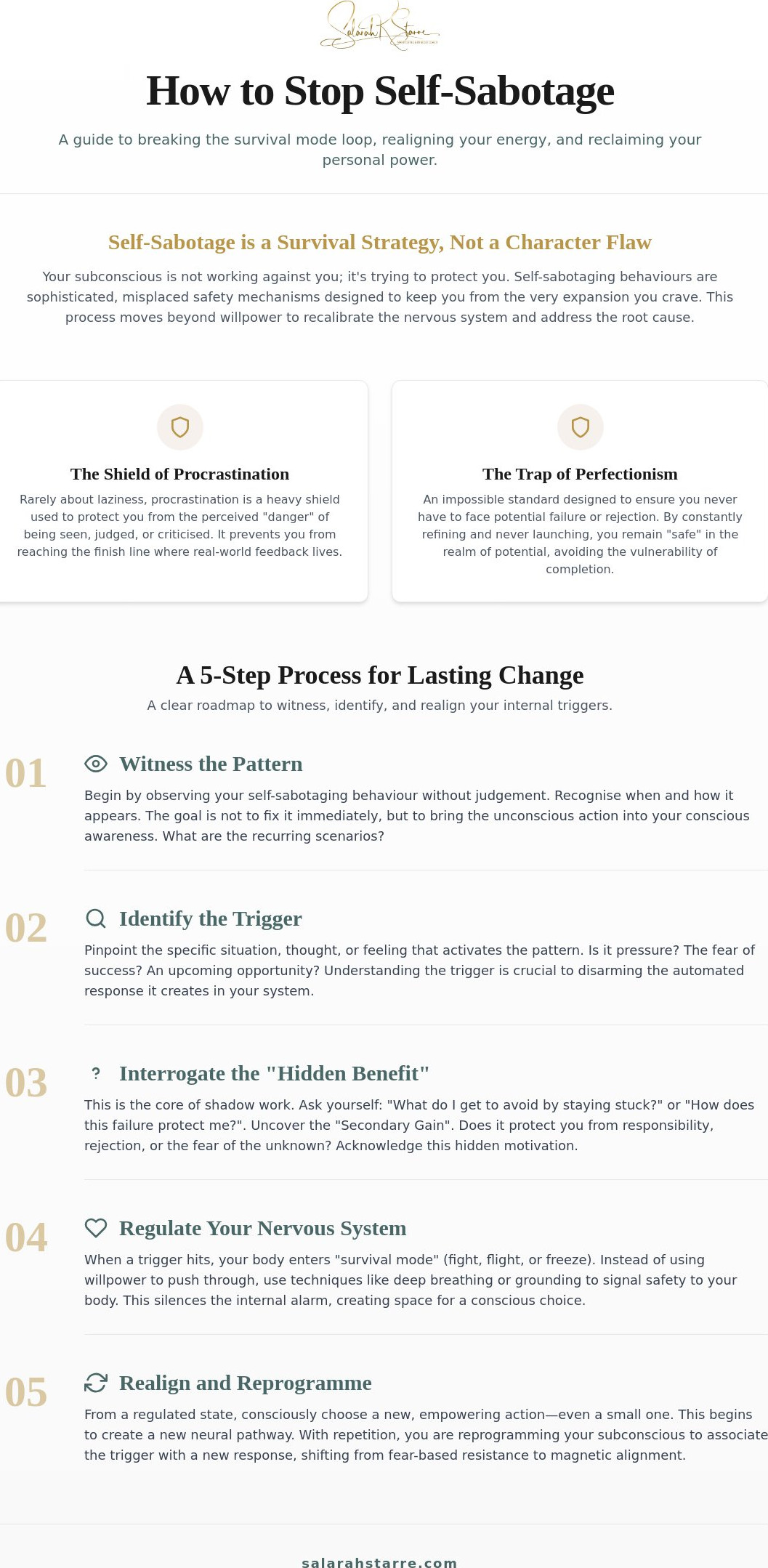
How to Stop Self-Sabotage: A 5-Step Process for Lasting Change
Theory alone won't liberate you. You've understood the anatomy, faced the shadow, and regulated your system; now, you must apply a surgical process to the moment of collision. Learning how to stop self-sabotage requires a transition from passive victimhood to active, conscious leadership of your own psyche. This is a visceral, five-step roadmap designed to dismantle the survival loops that have kept you stagnant. It isn't about soft affirmations. It's about structural realignment. It's about taking command, shifting frequency, and reclaiming power.
- Step 1: Witness the Pattern. Observe the behaviour as a neutral scientist. Don't judge, don't shame, and don't try to fix it immediately. Simply acknowledge the urge to sabotage as it arises.
- Step 2: Identify the Trigger. Trace the timeline backwards. What specific thought, email, or conversation preceded the urge to retreat? Pinpoint the exact moment the internal collision began.
- Step 3: Locate the Feeling. Resistance is somatic. Find where it lives in your body. Is it a knot in your stomach, a tightness in your throat, or a pressure in your chest?
- Step 4: Communicate with the Shadow. Approach the sabotaging part with fierce curiosity. Ask it: "What are you trying to protect me from right now?" Listen for the answer without dismissal.
- Step 5: Recalibrate the Response. Choose a new action from a state of regulated safety. Step 5 is not about forcing, but about initiating a new energetic frequency.
Step-by-Step: From Awareness to Action
Witnessing is your most potent weapon. When you observe your patterns without the heavy weight of a harsh critic, the behaviour loses its grip on your reality. Use a journal to track these internal collisions daily. Document the goal, the fear that rose to meet it, and the somatic response that followed. This creates a data-driven map of your subconscious landscape. If you're ready to accelerate this process, One to one Coaching provides the expert guidance needed to navigate these deep internal shifts with precision, depth, and speed.
Building Unshakeable Self-Trust
Sabotage erodes your relationship with yourself. To repair this, you must begin keeping small, non-negotiable promises to your soul. These aren't grand gestures; they are micro-wins that rewire the brain’s reward system and signal that you are a person who follows through. Celebrate these moments of alignment. Each time you choose regulation over reaction, you strengthen your internal authority. You are transitioning from needing a coach to becoming your own internal mentor. This is how to stop self-sabotage at the foundational level, ensuring your self-trust becomes unshakeable, magnetic, and permanent.
Reclaiming Your Power with Subconscious Reprogramming
Traditional cognitive-behavioural approaches or standard medical advice often stop at the surface. They treat the symptom whilst ignoring the energetic frequency that keeps the loop alive. To truly master how to stop self-sabotage, you must venture deeper than logic. You must clear the emotional debris that has calcified in your subconscious over decades. This is not about "thinking better" or forcing a positive outlook. It's about structural, internal shifts. When you clear the blocks, manifestation becomes a natural byproduct of your state rather than a desperate struggle of the ego. You move from the frantic static of survival mode into the clear, resonant frequency of authentic power.
The Magnetic Recalibration Framework
The Magnetic Recalibration is the surgical solution for deep-seated patterns that refuse to budge. This signature programme is designed to align your energetic state with your highest desires, ensuring your subconscious is no longer an anchor, but a sail. We go beyond the "positive thinking" trap that leaves so many high-achievers feeling like frauds. Instead, we focus on clearing the emotional debris—the old shame, the inherited fears, and the suppressed grief—that fuels the urge to sabotage. This is a premium path for those who demand depth, excellence, and visceral results. It’s about creating an internal environment where success feels safe, natural, and inevitable.
- Identify: Unmask the shadow motivations and hidden benefits of your current patterns.
- Heal: Release the somatic tension and emotional trauma stored within the nervous system.
- Align: Synchronise your conscious goals with your subconscious safety settings.
- Manifest: Create from a state of unshakeable self-trust and magnetic certainty.
Your Journey to Authentic Power
The path to liberation is clear: Identify, Heal, Align, Manifest. It requires a willingness to look beneath the surface and a refusal to settle for mediocre shifts. Often, the spark for this transformation begins with a catalyst who can see the patterns you've grown blind to. Engaging a transformational speaker UK can provide that initial, high-frequency jolt needed to break the inertia of a survival loop. It’s time to stop the internal collision that drains your energy and stalls your progress. Stop breaking your own heart by holding yourself back. Reclaim your authority, recalibrate your energy, and start claiming the destiny you were born to inhabit.
Step Into Your Magnetic Authority
You now possess the blueprint to dismantle the invisible barriers that have stalled your expansion. True mastery of how to stop self-sabotage isn't found in more discipline or harder work; it's found in surgical realignment, nervous system regulation, and shadow integration. You've learned to witness the pattern, interrogate the fear, and anchor yourself in safety. This is the path from survival to sovereignty. It's time to stop the internal collision and start manifesting from a state of unshakeable, magnetic certainty.
Salarah K Starre brings nearly twenty years of expertise in subconscious reprogramming to this transformative work. As a bestselling author and host of a leading manifestation podcast, she specialises in moving clients out of survival mode and into authentic power. Through bespoke healing retreats and deep emotional programmes, she provides the tools to realign, recalibrate, and reclaim. Ready to break the cycle? Discover The Magnetic Recalibration and reclaim your power today.
Your highest potential is not a distant dream; it's a frequency you're now ready to inhabit. Trust your depth, honour your journey, and claim the life you were always meant to lead.
Frequently Asked Questions
How do I know if I am self-sabotaging or just having a bad day?
Self-sabotage is a recurring, predictable pattern that emerges precisely when expansion feels imminent. A bad day is an external anomaly; sabotage is an internal collision. It's the "upper limit" problem in action. You'll notice it as a persistent behaviour that halts your momentum just as you're about to break through. If the resistance feels familiar, heavy, or rhythmic, it's a subconscious safety setting, not a random bout of bad luck.
Can self-sabotage be cured entirely, or is it a lifelong battle?
It's a recalibration, not a final destination. You don't "cure" a survival mechanism; you evolve it. Once you master how to stop self-sabotage, the frequency of these patterns diminishes until expansion becomes your natural baseline. You move from a state of constant internal war to one of unshakeable alignment. The goal is to build a nervous system that feels safe with your highest level of success, wealth, and visibility.
What is the fastest way to stop a self-sabotage loop when it starts?
Change your physiology to change your frequency. The fastest way to break the loop and learn how to stop self-sabotage in the moment is to ground, breathe, and realign. Press your feet into the floor, lengthen your exhale, and move your body. You cannot argue with a nervous system in survival mode. By shifting your physical state, you bypass the analytical mind and signal immediate safety to the subconscious.
Is self-sabotage the same as being lazy or having low motivation?
Absolutely not. Laziness is a passive state of low energy, whilst sabotage is an active, high-stakes protective strategy. It's an intense misdirection of power. Many people who struggle with these patterns are actually high-performers living in "high-functioning freeze." You're not lacking motivation; you're experiencing a subconscious conflict where your brain views your goals as a threat to your safety, belonging, or identity.
How does shadow work help with stopping self-sabotaging behaviour?
Shadow work unmasks the parts of you that benefit from failure. It forces you to look at the "Secondary Gain" of staying stuck, whether that's avoiding responsibility, escaping criticism, or maintaining a familiar identity. By identifying, interrogating, and integrating these hidden aspects, you stop the internal sabotage at its root. You no longer need to hide because the light of awareness has transformed the fear into fuel for your growth.
Why do I sabotage my relationships just when they become serious?
Intimacy is a powerful trigger for your internal safety settings. As a relationship deepens, the subconscious perceives a threat to your autonomy or a risk of devastating abandonment. You create distance, spark conflict, or withdraw to regain a sense of safety. It's a "flight" response disguised as a personality clash. You're trying to protect your heart by breaking the connection before it can break you, choosing familiar loneliness over dangerous vulnerability.
Can a mindset coach really help me stop these deep subconscious patterns?
Surface-level mindset shifts are rarely enough for deep-seated patterns. You need a mentor who operates at the level of the subconscious and the nervous system. This requires a surgical approach to emotional healing, not just better habits or "positive thinking" affirmations. A high-level coach helps you identify the energetic roots of your resistance and provides the framework to realign your power, shift your frequency, and reclaim your authority from the inside out.
What happens if I try to stop self-sabotaging but fail again?
You don't fail; you simply gather more data for your next recalibration. If you slip back into old behaviours, it's a sign that a deeper layer of the shadow is ready to be witnessed. Shame is the fuel for future sabotage, so choose fierce curiosity instead. Use the slip to identify the specific trigger you missed and recalibrate your response. Every internal collision is an opportunity for a more profound realignment and a stronger foundation of self-trust.


