

A childhood wound can shape adult choices long after the original experience. A father wound isn’t a clinical diagnosis; it describes lasting pain associated with a father who was absent, harsh, emotionally unavailable or unable to offer what a child needed. Healing the father wound exercises can help you recognise these patterns, question the critical voice they may have shaped and work through resentment without forcing forgiveness.
If you recognise people-pleasing, perfectionism, fear of failure or difficulty expressing your needs, the pattern deserves attention, not self-blame. These reactions may once have helped you cope, but they don’t have to dictate how you relate to yourself or others now.
This guide explains how childhood experiences can affect safety, self-worth and relationships, then offers practical exercises for grounding, journalling, reframing self-criticism and expressing boundaries. You’ll also learn why healing takes time, how to make room for grief and anger, and what releasing resentment can mean without excusing harm or reconciling before you’re ready. Each exercise is an invitation to build a steadier inner voice and choose what comes next.
Key Takeaways
- Notice where old reactions show up in your relationships, work and inner dialogue, then identify the need or fear beneath them.
- Use journalling and grounding to make space for childhood emotions without blaming yourself for what you couldn’t control.
- Challenge harsh self-talk by separating what happened from the meaning you attached to it, then choose a more balanced response.
- Explore boundaries and forgiveness at your own pace; healing doesn’t require excusing harm or forcing reconciliation.
- Build self-validation through small, consistent choices that strengthen your sense of worth, voice and personal authority.
What Is the Father Wound?
A father wound isn’t a clinical diagnosis. It describes emotional pain associated with a father who was absent, harsh, emotionally unavailable or unable to meet a child’s needs. Its effects may surface years later: a missed message at work can trigger fear of failure, or a partner’s silence can feel like rejection. These are learned patterns, not proof that you’re flawed.
To set boundaries with your father, decide what level of contact feels manageable and write down your limits around topics or behaviour. Practise a clear statement, such as, “I’m ending this call if you shout,” and follow through calmly.
Doing these exercises alone may bring up grief, anger or distress that feels difficult to contain. Pause if you feel overwhelmed, ground yourself in the present and seek support from someone you trust.
- Spot the learned belief. Write down one moment that still shapes your choices, such as being criticised for a mistake. Separate the event from the meaning you attached to it: “He called my work careless” is an event; “I’m never good enough” is a belief. This distinction creates room to question the old conclusion.
- Track self-criticism without obeying it. For one week, note when your inner voice becomes harsh. Record the situation, the exact thought and what you felt. If a delayed reply prompts, “They’re angry with me,” label it as a thought, not a fact. That small pause builds self-awareness instead of automatic self-blame.
- Challenge perfectionism with one imperfect action. Choose a low-stakes task, such as sending an email after one careful edit rather than checking it repeatedly. Afterwards, note what actually happened. Perfectionism can feel like protection from criticism, but repeated checking may keep your confidence waiting for approval that never arrives.
- Practise internal authority. Before seeking someone else’s approval, ask, “What do I think, need or value here?” Write a balanced response beside the critical belief: “I can make mistakes and still be worthy of respect.” Repeat it when a familiar trigger appears. Self-validation is built through these specific, credible choices, not forced positivity.
- Make space for joy and self-love. Choose one activity that feels meaningful rather than earned, such as listening to music, walking outdoors or creating something without judging the result. Notice the feeling in the moment. Healing the father wound exercises can help you recognise old patterns, but living beyond them also means building relationships and routines that make room for joy, choice and personal power.
Forgiveness and releasing resentment
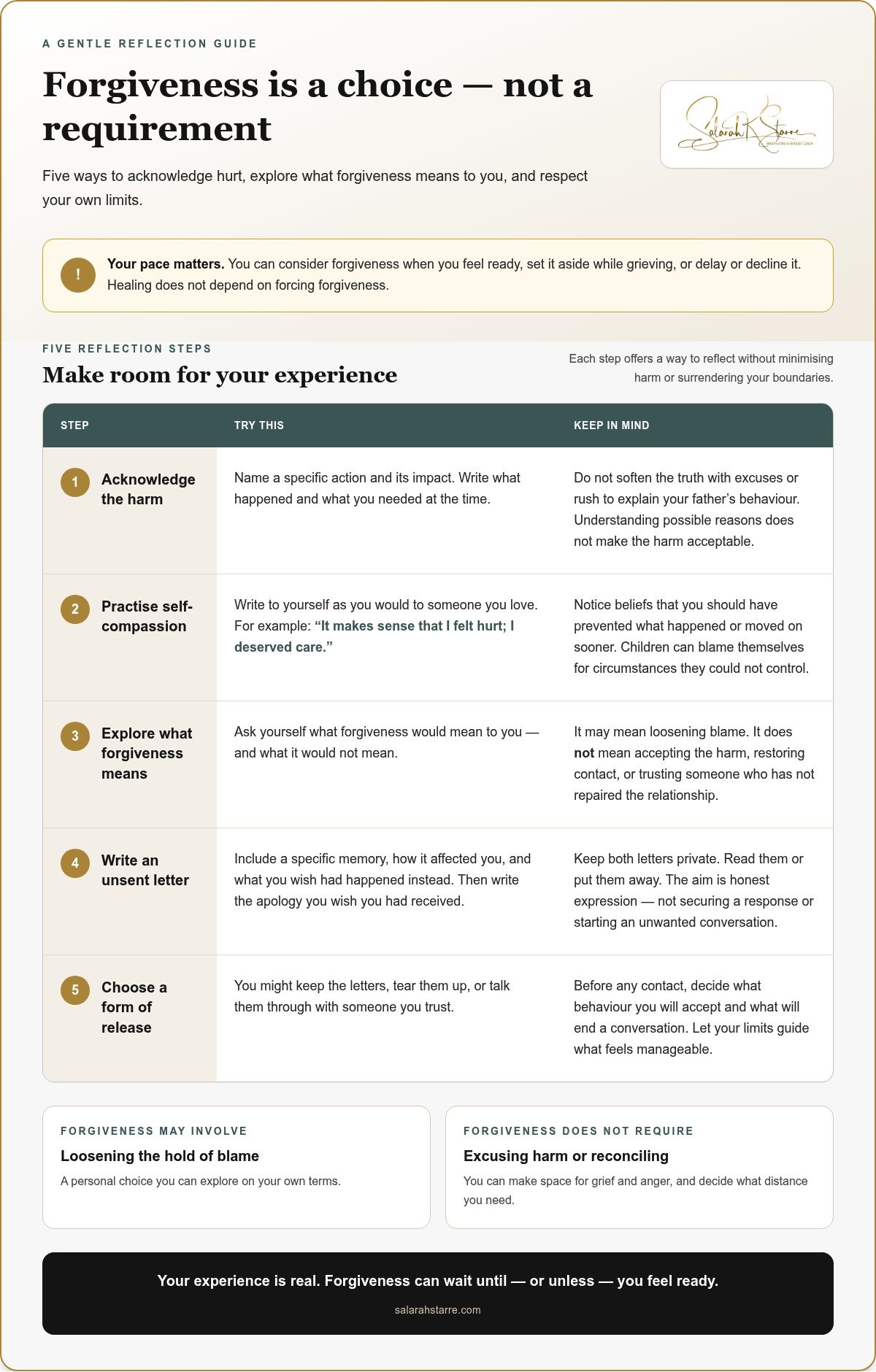
Forgiveness is a personal choice, not a requirement for healing. Use these steps to acknowledge painful experiences, practise compassion and decide what letting go means to you.
-
Acknowledge harm without minimising it
Name a specific action and its impact, such as a broken promise that left you feeling unimportant. Write what happened and what you needed at the time. Don’t soften the truth with excuses or rush to explain your father’s behaviour. Understanding possible reasons doesn’t make the harm acceptable. Let your experience be real before considering forgiveness.
-
Practise self-compassion in forgiveness
Write a short response to yourself as you would to someone you love. Try: “It makes sense that I felt hurt; I deserved care.” Notice any belief that you should have prevented the experience or moved on sooner. Children often blame themselves for circumstances they couldn’t control. Self-compassion challenges that unfair burden without asking you to deny anger, sadness or the need for distance.
-
Explore forgiveness as part of healing
Ask what forgiveness would mean to you, and what it wouldn’t mean. It may mean loosening the hold of blame; it doesn’t mean saying the harm was acceptable, restoring contact or trusting someone who hasn’t repaired the relationship. You can set forgiveness aside while grieving what you needed but didn’t receive. Healing can begin even if your father has died or never acknowledges the hurt.
- Write an unsent letter expressing what you never felt able to say. Include a specific memory, how it affected you and what you wish had happened instead. Then write the apology you wish you had received, without sending either letter. Read them privately or put them away. The aim is honest expression, not securing a response or starting a conversation you don’t want.
- Choose a form of release that respects your limits. You might keep the letters, tear them up, or talk through them with someone you trust. Before any contact, decide what behaviour you will accept and what will end a conversation. If you want structured space for reflection, Salarah K Starre’s Deep Healing Programs & Retreats offer a guided setting for personal work. Forgiveness remains yours to define, delay or decline.
Practices that foster forgiveness may help you release blame and reclaim personal power, but forgiveness is an option to consider only when you feel ready.
Father wound and childhood experiences
A father who was absent, harsh or emotionally unavailable can leave lasting pain around safety, trust and belonging. Exercises may include grounding, naming feelings, journalling and inner-child visualisation. Use them to explore what happened and what you needed at the time.
To journal about an emotionally absent or abusive father, describe a specific memory, your feelings and the need that went unmet. Keep the focus on your experience, rather than proving or excusing his behaviour.
-
Grieve unmet needs and childhood experiences
Name an unmet childhood need, such as comfort after a frightening moment or praise for an achievement. Write what happened, how you felt and what you needed from your father. Anger may sit alongside sadness or longing; record each feeling without judging it. Acknowledge the relationship you wanted, not only the one you had. Don’t force a quick lesson or forgiveness from a painful memory.
Then complete the sentence, “I needed…” For example: “I needed someone to listen when I was scared.” This gives grief a clear focus. A child may assume they caused a parent’s absence or anger, even when they had little control. Add, “That wasn’t mine to fix.” Read your words slowly, and stop if the memory feels too intense.
-
Use inner child visualisation
Choose a quiet place and picture yourself as a child in a familiar setting, such as a bedroom or school playground. Imagine warm golden light surrounding your younger self as a symbol of care and understanding. Ask what they’re feeling and what they need from you now. Keep the image simple; you don’t need to recover a perfect memory or create a vivid scene.
Offer one specific response, such as, “You didn’t deserve to feel alone.” Picture yourself sitting nearby, listening without correcting or rushing the child. If the visualisation brings up a broken or frightening image, open your eyes and name what you see in the room. Ground yourself by feeling your feet on the floor, then decide whether to continue or pause.
-
Journal about childhood experiences
Set up a page with three prompts: “What happened?”, “What did I feel?” and “What did I need?” Focus on one event at a time, such as being ignored after asking for help. Describe observable details first, then note your emotional response. This keeps the entry anchored in your experience, especially if your father was abusive or emotionally unavailable.
Finish by writing what you want to tell your younger self today. You might say, “You were a child; you weren’t responsible for his choices.” Keep the entry private if that helps you write honestly. Close the notebook, take a slow breath and return to an everyday task. The aim is to recognise the impact, not force a conclusion about the whole relationship.
Challenging an internalised critical voice
A critical thought can sound like truth, especially when it echoes an absent parent’s words. Use these steps to identify the belief, examine it and practise a more balanced response.
- Track triggers for one week. Each time self-criticism appears, note the situation, the exact words and your response. For example: “My manager asked for a change” may trigger, “I’m useless.” Record what happened next, such as avoiding the task or overworking it. This pattern shows where an old message may be shaping a present choice.
- Separate the event from its meaning. Write one difficult memory in two lines. First record the observable event: “Dad didn’t come to my school performance.” Then name the belief you formed: “I’m not important.” The event deserves acknowledgement, but the belief is an interpretation, not proof of your worth. Ask what else a child could have concluded from that moment.
- Rewrite the belief with credible words. Avoid affirmations that feel impossible, such as “I never doubt myself.” Choose a balanced statement you can believe: “I can feel uncertain and still take one useful step.” Test it against a current example, like sharing an idea at work despite nerves. Repeat the revised sentence when the old criticism returns, then take the action it supports.
- Notice how criticism sits in your body. Pause when a familiar thought arrives and observe one physical response, such as a tight jaw, shallow breathing or raised shoulders. Try placing both feet on the floor and lengthening your exhale. Somatic work uses awareness of bodily sensations; it may help you notice reactions connected with difficult experiences before they drive your behaviour.
- Explore the protective part behind the voice. Internal Family Systems, developed by Richard Schwartz, describes inner parts that can carry painful beliefs and protective roles. Instead of attacking the critic, ask what it fears might happen if it stopped pushing you. It might answer, “You’ll be rejected.” Acknowledge the concern, then explain what you can choose now. Work with a qualified practitioner when this exploration feels hard to manage alone.
Finally, notice which messages repeat across generations. A parent taught that mistakes bring shame may pass that rule on through criticism, even without intending harm. Naming the pattern can interrupt automatic repetition; it doesn’t define you or excuse hurtful behaviour. Choose a different response today, such as correcting a mistake without calling yourself a failure.
Recognising patterns linked to a father wound
A father wound may show up in present-day reactions, not just memories. Track what happens around trust, closeness and conflict to spot patterns and choose a response that serves you now.
- Notice your first reaction. For one week, record moments when you feel rejected, unsafe or compelled to please. Note the situation, your feeling and what you did next. For example, a friend cancelling plans might trigger panic, repeated messages or a decision to withdraw. This record offers insight into recurring reactions without labelling every difficult interaction as a wound.
- Look for patterns across relationships. Compare how you respond to a partner, colleague and friend. Do you hide your needs with each person, or find it difficult to trust men even when their behaviour is consistent? Look for repeated responses rather than one isolated incident. The pattern matters because it can reveal an old expectation operating in a new relationship.
- Separate chemistry from behaviour. Strong attraction can feel compelling, but it doesn’t show how someone handles care or conflict. Write down what the person actually does: do they listen when you say no, keep agreements and return to repair after disagreement? Compare those actions with your feelings of excitement or familiarity. This helps you assess the relationship using evidence, not chemistry alone.
- Identify your conflict pattern. After a disagreement, note whether you avoid the conversation, apologise automatically or become emotionally distant. Then ask whether repair is possible and what a respectful repair would look like, such as acknowledging harm and changing the behaviour. Healthy conflict includes repair, not just avoidance. Your response can change when you name the pattern and state one clear need.
- Practise a boundary in a low-stakes moment. Say no to a manageable request without listing several reasons. For example, “I can’t take that on today” is clear and complete. If contact with your father is involved, list topics you won’t discuss, behaviours that end a call and the amount of contact that feels manageable. Let repeated behaviour, rather than hope or fear, guide your choices.
Use these observations to choose one response to practise this week, such as pausing before replying or stating a need plainly. For support turning insight into deliberate change, explore your next step.
Possible signs of a father wound include harsh self-talk, difficulty trusting men, fear of abandonment and emotional distance. Notice when these experiences arise and whether they recur across relationships. You might record the words that come to mind, what you fear losing and whether you pull back from closeness. Treat these as possible signs, not proof of a single cause, and consider them alongside patterns you’ve already noticed.
Salarah K Starre: The Magnetic Recalibration
The Magnetic Recalibration is a next step if you want guided support alongside your own reflection. After noticing recurring reactions and practising new responses, you may want space to explore what feels difficult to shift alone. One to one Coaching offers a setting to focus on your personal reflections and intentions; Manifestation Workshops provide a group-based option for exploring change. Choose the format that feels relevant to the work you want to do, without treating any programme as a substitute for clinical psychotherapy when that is what you need.
If you’d like to explore this work with Salarah K Starre, visit salarahstarre.com.
Choose the next step that feels true to you
Let your next move come from self-respect, not pressure to heal on someone else’s timetable. Healing the father wound exercises can help you practise new responses, while lasting change also grows through everyday choices: what you accept, what you express and where you direct your energy.
To carry this inner work into a wider personal-growth journey, explore The Magnetic Recalibration, Speaking Engagements or Manifestation Workshops with Salarah K Starre. Choose the form of support that aligns with what you’re ready to explore. You don’t need every answer before taking a thoughtful step forward.
Contact Salarah K Starre to explore your next step. Keep choosing what strengthens your voice, self-trust and freedom.
Frequently Asked Questions
What is a father wound and how can it affect adult relationships and self-esteem?
A father wound is emotional pain associated with a father’s absence, harshness or emotional unavailability; it isn’t a clinical diagnosis. In adulthood, it may influence how someone interprets closeness, disagreement or reassurance. For example, a neutral request for space might feel like rejection. Self-esteem can also become tied to external approval, making ordinary mistakes feel like proof of personal failure.
What inner child exercises can help with father wound healing?
Try a brief dialogue between your adult self and a younger version of yourself. Write a question the child might ask, such as, “Will someone stay?” Then answer from your present perspective: “I can seek dependable people and choose relationships that respect me.” Focus on one concern. If imagining childhood feels too intense, use a present-day object or place to orient yourself.
Can therapy help heal a father wound, and which therapy approaches are used?
Therapy can provide structured support for exploring painful experiences and their effects on present-day behaviour. Internal Family Systems (IFS) and somatic work are approaches that can help people explore parts carrying father-wound pain and notice bodily responses. IFS was developed by Richard Schwartz. A therapist can help you decide how to approach this work and adjust the pace when difficult feelings arise.
How to practise self-compassion and reparenting exercises for a father wound?
Reparenting means responding to your needs with care and consistency in the present. Choose an everyday moment, such as feeling overwhelmed before a meeting, and ask what would help: a pause, preparation or a kind word. Offer yourself that response without demanding perfect performance first. You might say, “This is hard, and I can take it one step at a time.”
How long does it take to heal a father wound?
Healing is gradual, not a single conversation or weekend retreat. Its pace can shift as you encounter new relationships, memories or life pressures. Rather than setting a deadline, notice meaningful changes: recovering more quickly after conflict, expressing a need sooner or making choices with less fear of disapproval. A slower period doesn’t erase progress; it may mean you need rest, support or a different approach.


