

What if your chronic self sabotage in relationships isn't a sign of weakness, but a masterpiece of subconscious protection? You know the visceral sting of watching a beautiful connection crumble under the weight of your own hands. You've felt the suffocating fear of engulfment, the sharp terror of abandonment, and the exhausting urge to burn it all down just to feel in control again. It's a brutal cycle that leaves you feeling like a failure; however, your system is simply running an outdated survival script. You aren't failing at love; you are succeeding at staying safe in a way that no longer serves your growth.
This article will strip away the shame and reveal the hidden drivers behind your behaviour. You will discover how to recalibrate your internal frequency, realign your nervous system, and reclaim your power through the Magnetic Recalibration. We will dive deep into the shadow work necessary to dismantle these barriers; this is the path to stop pushing love away and start feeling truly secure in the heat of authentic intimacy. It's time to move beyond survival and step into a state of unshakeable connection and lasting power.
Key Takeaways
- Reframe self sabotage in relationships as a sophisticated subconscious protection mechanism designed to keep you safe from the perceived "danger" of deep intimacy.
- Uncover how your suppressed shadow self projects unhealed fears onto your partner, creating artificial conflict to maintain a familiar sense of distance.
- Learn to identify the visceral red flags of a dysregulated nervous system before they manifest as destructive or avoidant behaviour.
- Master somatic regulation techniques to expand your window of tolerance, allowing you to remain present, grounded, and secure during vulnerable moments.
- Understand how the Magnetic Recalibration allows you to shift your internal frequency from survival-based reactions to a state of authentic, magnetic connection.
Decoding Self-Sabotage in Relationships: A Subconscious Protection Mechanism
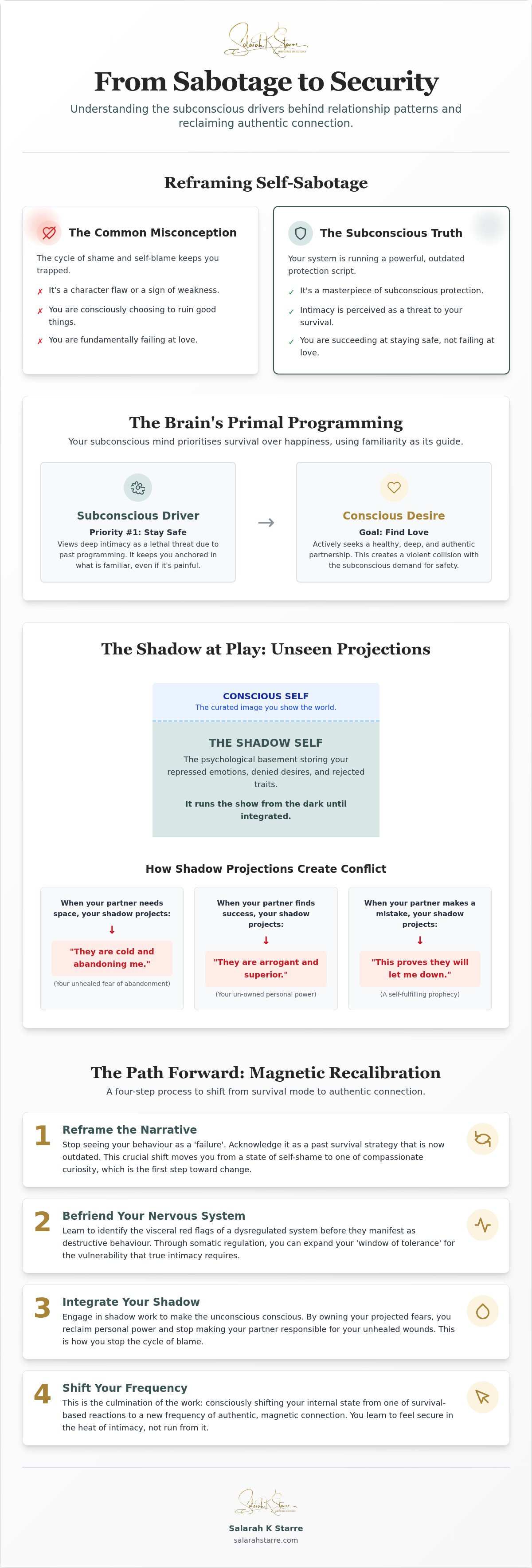
Self sabotage in relationships isn't a character flaw or a sign of weakness. It is a violent collision between your conscious desire for love and your subconscious demand for safety. Your brain is biologically wired to prioritise survival over happiness; consequently, it often perceives deep intimacy as a lethal threat. When a connection begins to feel "too real," your internal alarm sounds. You push, you pull, you burn. This self-destructive behavior serves a singular purpose; it keeps you anchored in the known and protected from the perceived danger of being seen.
Familiarity is the primary currency of the subconscious mind. Even if your current state is lonely, stagnant, or painful, it is predictable. To your primitive brain, predictable equals safe. These patterns usually calcify in early childhood as vital survival strategies. If love was conditional, volatile, or absent during your formative years, your system learned that closeness is a precursor to pain. You developed defences then that are now wrecking your adult connections. You aren't failing at love; you are succeeding at a survival script that is simply outdated.
Why Your Subconscious Mind Pushes Love Away
We all possess an internal thermostat for joy and success, often called the "Upper Limit" problem. When your relationship exceeds your internalised threshold for happiness, the ego panics. It triggers a rapid descent back to a "safe" level of dissatisfaction. Vulnerability feels like potential annihilation to a wounded nervous system. If you carry internalised beliefs that you are unworthy or that love is inherently dangerous, you will subconsciously engineer a crisis to prove yourself right. You protect. You defend. You retreat. It's a surgical strike against your own fulfilment, executed to maintain the status quo.
Intimacy as a Threat to the Ego
The ego thrives on the static and the certain. It hates change, even when that change is the very love you crave. Intimacy is a powerful catalyst; it demands you shed your armour, reveal your shadows, and evolve. To the ego, shedding armour feels like suicide. Self sabotage in relationships often acts as a pre-emptive strike. You hurt them before they can hurt you. You leave before you are left. You find "deal-breakers" where none exist. Recognise that your inner saboteur is actually a younger version of you. It's a child still trapped in a survival loop, trying desperately to keep you alive in the only way it knows how.
The Shadow at Play: Why We Undermine the Love We Crave
Your shadow is the silent architect of your relational misery. It is the psychological basement where you have stored every repressed emotion, denied desire, and rejected trait since childhood. Whilst you might consciously claim to want a healthy partnership, your shadow often has a different agenda. It seeks to confirm its old stories of rejection and unworthiness. This creates a violent internal collision between your curated self-image and your hidden patterns. Until you integrate these fractured parts, they will continue to run the show; they will continue to drive self sabotage in relationships from the dark.
Intimacy acts as a high-intensity spotlight. It shines directly into your basement, forcing your shadow into the open. Instead of facing the discomfort of your own unhealed wounds, it's easier to project them. You see your partner's need for space as "coldness" because you haven't healed your own fear of abandonment. You interpret their success as "arrogance" because you haven't embraced your own power. Understanding and Overcoming the Pattern of these projections is the only way to stop the cycle of destruction.
Shadow Projections in Intimate Partnerships
The cycle of blame is a sophisticated diversion tactic. It is far less painful to attack your partner's perceived flaws than to face the raw, unintegrated parts of your own psyche. You become a detective for disappointment, constantly searching for evidence that they will eventually let you down. This creates a self-fulfilling prophecy where you provoke the very behaviour you fear most. Shadow work is the process of making the unconscious conscious to regain personal power.
Healing the Hidden Patterns
Surface-level communication is a sticking plaster on a structural wound. To truly break the cycle, you must address the root energetic block. This is why shadow work for self-sabotage is the essential first step toward lasting change. You must identify your shadow's favourite weapons of mass destruction: excessive criticism, emotional withdrawal, or manufactured drama. By naming these patterns, you strip them of their authority. You begin to shift from a state of reactive survival into one of magnetic presence. If you are ready to dismantle these barriers, engaging in one to one coaching can provide the surgical precision needed for true transformation.
Recognising the Saboteur: Red Flags and Nervous System Responses
Self sabotage in relationships often masquerades as high standards or "gut instinct." In reality, it is a sophisticated defence system designed to maintain a safe distance. When intimacy threatens the ego's control, your mind begins to manufacture flaws in your partner. You become hyper-critical. You obsess over minor imperfections. You constantly scan for an exit strategy, ensuring you have one foot out the door before the relationship can truly deepen. This isn't intuition; it's a pre-emptive strike against potential pain. You constrict, you withdraw, you repel.
Your body is the primary battleground for these patterns. When a connection feels "too close," your nervous system enters survival mode. You might confuse the frantic energy of anxiety with a lack of chemistry or a warning sign from your intuition. However, true intuition is a calm, grounded knowing. Sabotage is loud, frantic, and physiological. It's an internal collision between your desire for closeness and your biological imperative to stay safe.
Physiological Signs of Relationship Sabotage
Intimacy can trigger a visceral sense of suffocation or tightness in the chest. This is your body's way of screaming "danger" at a safe person. You may experience a sudden, inexplicable loss of attraction just as things become serious. This isn't a change in your partner; it's a nervous system shutdown mechanism. Understanding the nervous system and manifestation is vital here. If your body doesn't feel safe receiving love, you will energetically repel it, regardless of your conscious desires. Your internal state dictates what you are capable of holding.
Common Sabotage Behaviours to Monitor
The saboteur uses a variety of survival strategies to keep love at arm's length. Recognising these behaviours is the first step toward dismantling them. Watch for these common patterns:
- The Situationship Trap: Choosing low-commitment loops to avoid the perceived "annihilation" of true vulnerability.
- Emotional Withdrawal (Freeze): Numbing out, becoming "busy," or disappearing when emotional depth is required.
- Provoking Arguments (Fight): Creating artificial conflict to generate space and distance when things feel too intimate.
- The Perfectionist Shield: Using excessive criticism to justify why a partner "isn't the one," thereby avoiding the risk of being known.
These responses are not choices; they are automated reactions. They are the "Flight" from intimacy, the "Fight" against connection, and the "Freeze" in the face of love. By identifying these triggers, you begin to move out of reactive survival and into a space where real intimacy becomes possible.
How to Stop Self-Sabotaging and Build Radical Self-Trust
Awareness is a sedative if it doesn't lead to structural change. You cannot simply think your way out of a physiological survival loop. To end self sabotage in relationships, you must move beyond intellectual understanding and begin the work of internal realignment. This process requires a visceral commitment to staying present when every fibre of your being is screaming at you to flee. It is about building the capacity to hold intimacy without shattering under the pressure of being seen.
The journey toward radical self-trust involves four definitive stages of recalibration:
- Step 1: Radical Awareness. You must catch the "urge" to sabotage in real-time. It often manifests as a sudden "ick," a desire to pick a fight, or a cold withdrawal. Note the sensation without judgement.
- Step 2: Somatic Regulation. When the alarm sounds, you must anchor your body. Calm your nervous system so you can remain in the "window of tolerance" instead of spiralling into fight or flight.
- Step 3: Subconscious Interrogation. Ask yourself: "What am I trying to protect myself from right now?" This strips the saboteur of its power by exposing its hidden agenda.
- Step 4: Reprogramming. You must consciously replace survival-based scripts with high-frequency beliefs. Shift from "Love is a trap" to "I am safe to be known."
Regulating the Nervous System for Intimacy
Intimacy is a high-voltage energy. If your internal wiring is damaged, you will blow a fuse every time love flows toward you. Breathwork and grounding techniques are not merely "wellness" trends; they are essential tools to keep you present during conflict. When your inner child feels unsafe, you must step in as the grounded, authoritative parent. You must prove to your system that you can handle the heat of connection. This is how you transition from a state of survival into a state of magnetic connection.
Breaking the Cycle of Toxic Patterns
Building self-respect is the foundation of secure attachment. This begins with establishing non negotiables in a relationship that protect your energy and honour your worth. Sometimes, growth looks like staying when every instinct tells you to run. Other times, it looks like leaving a loop that no longer serves your evolution. You are building the "muscle" of receiving. You are learning to let love land without deflecting it through drama or distance. To accelerate this shift and dismantle these barriers permanently, consider joining The Magnetic Recalibration to realign your internal state for lasting intimacy.
Recalibrating for Intimacy: From Survival Mode to Magnetic Connection
Healing isn't about fixing a broken version of yourself. It is about realigning with your authentic power. You've spent years honing a survival identity, but that armour has eventually become a cage. The self sabotage in relationships you’ve experienced is simply the friction between who you were and who you are becoming. By engaging in the Magnetic Recalibration, you shift from fear-based manifesting to heart-centred attraction. You stop fighting the current; you become the current. This journey is about reclaiming your sovereignty and allowing yourself to be truly, deeply met.
True transformation requires you to look beneath the surface of your "problems" and address the energetic root. You aren't just changing a habit; you are realigning your entire internal state. This shift moves you away from the frantic energy of survival and into the grounded certainty of your own worth. It is a process of shedding, realigning, and rising. You are no longer a victim of your subconscious scripts; you are the intentional architect of your relational reality.
The Power of Subconscious Reprogramming
Your internal frequency dictates your external results. If you carry the vibration of lack or unworthiness, you will subconsciously engineer lack in your connections. Subconscious reprogramming allows you to realign your energetic blueprint, ensuring your external relationships reflect your internal power. This is where the surgical precision of One to one Coaching becomes invaluable. A specialist identifies the blind spots your ego desperately hides, allowing you to break through, shift, and realign. You move from a state of constant collision to a state of unshakeable magnetism. You stop repelling the very love you crave and start holding it with ease.
Your Next Steps to Lasting Love
Generic advice will not break specific sabotage loops. You need a bespoke approach that addresses your unique nervous system responses and shadow patterns. Immersive experiences, such as Deep Healing Programs & Retreats, offer the depth required for a total system reset. These programs provide the space to fully recalibrate your nervous system, allowing you to move beyond the "survival" identity and into an "abundant" one. This isn't just about finding a partner; it's about becoming the version of you that can sustain and enjoy a high-frequency connection. You are ready to stop pushing love away. You are ready to stand in your power. Begin your journey to magnetic relationships with Salarah K Starre.
Master Your Internal Frequency for Lasting Intimacy
Self sabotage in relationships is a sophisticated shield; however, it is one you no longer need to carry. You have unmasked the subconscious drivers, identified the nervous system triggers, and recognised the shadow's influence. You now understand that intimacy isn't the enemy; your outdated survival script is. True transformation requires more than just insight; it demands a radical realignment of your internal state. You are ready to move beyond the cycle of pushing love away and finally step into a space of secure connection.
With nearly two decades of expertise in subconscious reprogramming, Salarah K Starre provides the surgical precision needed for deep nervous system healing. Through bespoke high-level coaching and specialist shadow work, you can dismantle the barriers to authentic connection. It's time to shift from reactive survival to unshakeable, heart-centred power. You have the strength to stay, the capacity to receive, and the magnetism to attract the love you deserve.
Reclaim your power and break the cycle with The Magnetic Recalibration. Your future of authentic, secure intimacy is waiting to be claimed. Step into your sovereignty and let yourself be seen.
Frequently Asked Questions
Why do I self-sabotage when things are going well in my relationship?
You sabotage when things are going well because your internal thermostat has reached its "Upper Limit." When happiness exceeds your familiar level of dissatisfaction, your subconscious triggers a crisis to bring you back to safety. It's a protective strike against the perceived danger of deep intimacy. Your brain prioritises survival over joy; therefore, it views a "perfect" connection as a threat to the known status quo.
Can self-sabotage be intentional or is it always subconscious?
Self-sabotage is almost exclusively a subconscious protection mechanism rather than an intentional choice. You don't consciously decide to ruin your happiness. Instead, your nervous system reacts to the threat of vulnerability by activating survival scripts. These automated responses, such as withdrawal or criticism, are designed to keep you safe from potential pain. It is a biological imperative, not a character defect or a lack of willpower.
How do I know if I am self-sabotaging or if the relationship is just wrong?
Distinguishing between self sabotage in relationships and a genuine lack of compatibility requires radical self-honesty. Sabotage feels frantic, loud, and physiological; it usually happens just as closeness increases. A "wrong" relationship feels like a calm, persistent misalignment of values or character. If you find yourself finding deal-breakers in every partner the moment they get close, you are likely running a protection script rather than exercising intuition.
Is it possible to stop self-sabotaging without professional help?
Whilst awareness is a powerful catalyst, stopping deep-seated patterns without professional guidance is incredibly difficult. Your ego is designed to hide your blind spots from you. A specialist in subconscious reprogramming can provide the surgical precision needed to identify and realign these hidden drivers. Expert support ensures you aren't just managing symptoms but are actually dismantling the root energetic blocks that keep you trapped in survival mode.
What are the most common signs of self-sabotage in women versus men?
Whilst every individual is unique, patterns of self sabotage in relationships often manifest differently based on socialisation. Women frequently exhibit "fawning" behaviours or hyper-vigilance, seeking safety through control or constant reassurance. Men often lean toward "flight" or "freeze" responses, using emotional withdrawal or manufactured distance to protect their autonomy. Both are simply different masks for the same underlying fear of being engulfed or abandoned by a partner.
How does my childhood affect my tendency to sabotage my current relationships?
Your childhood is the blueprint for your adult connections. If your early environment was volatile, conditional, or neglectful, your system learned that love equals danger. You developed survival strategies then that have now become destructive sabotage loops. You are essentially a child in an adult's body, trying to protect yourself from old wounds that haven't yet been integrated through deep shadow work and nervous system awareness.
Can a relationship survive self-sabotage once it has occurred?
A relationship can certainly survive sabotage; however, it requires both partners to move beyond blame and into radical responsibility. Once the saboteur acknowledges their behaviour as a protection mechanism, the connection can become a container for deep healing. It requires transparency, somatic regulation, and a commitment to staying present when the urge to run arises. Recovery is possible when you choose to prioritise authentic connection over subconscious safety.
How long does it take to reprogram the subconscious mind for healthy love?
Reprogramming the subconscious mind isn't an overnight event; it is a process of consistent internal realignment. Whilst you can experience significant energetic shifts within weeks of starting a program like The Magnetic Recalibration, fully integrating new patterns usually takes several months of dedicated practice. The goal is to move your nervous system out of a permanent state of survival and into a baseline of unshakeable self-trust and magnetic power.


