
Your relentless terror of being exposed isn't proof of incompetence; it is an energetic collision between your outward achievements and your subconscious safety thresholds. When you repeatedly find yourself asking, "why do I feel like a fraud?" every time you succeed, you know the physical toll intimately. You run on the fumes of obsessive perfectionism, brace against the paralysing dread of making a visible mistake, and reflexively deflect genuine praise because your nervous system cannot register it as safe.
You cannot rationalise this pattern away with surface-level positive thinking. Real transformation demands addressing the somatic and psychological blueprints that keep you trapped in hyper-vigilance. In this guide, you will discover the subconscious drivers behind feeling like a fraud and learn how to recalibrate your identity at the deepest level. We will examine the precise shifts needed to quieten your persistent inner critic permanently, regulate your nervous system out of survival mode, and finally ground yourself in the power you have already built.
Key Takeaways
- Understand the energetic split between external success and internal safety to answer why do I feel like a fraud once and for all.
- Uncover how early childhood conditioning and subconscious safety contracts covertly wire you for chronic self-doubt.
- Identify whether your nervous system defaults to hyper-vigilant overcompensation or strategic withdrawal when visibility peaks.
- Master practical somatic release techniques designed to shift your body out of survival mode and physically hold your accomplishments.
- Reclaim authentic sovereignty by anchoring unshakeable self-trust that replaces performative perfection with grounded authority.
The Anatomy of Fraudulence: Why High Achievers Feel Like Imposters
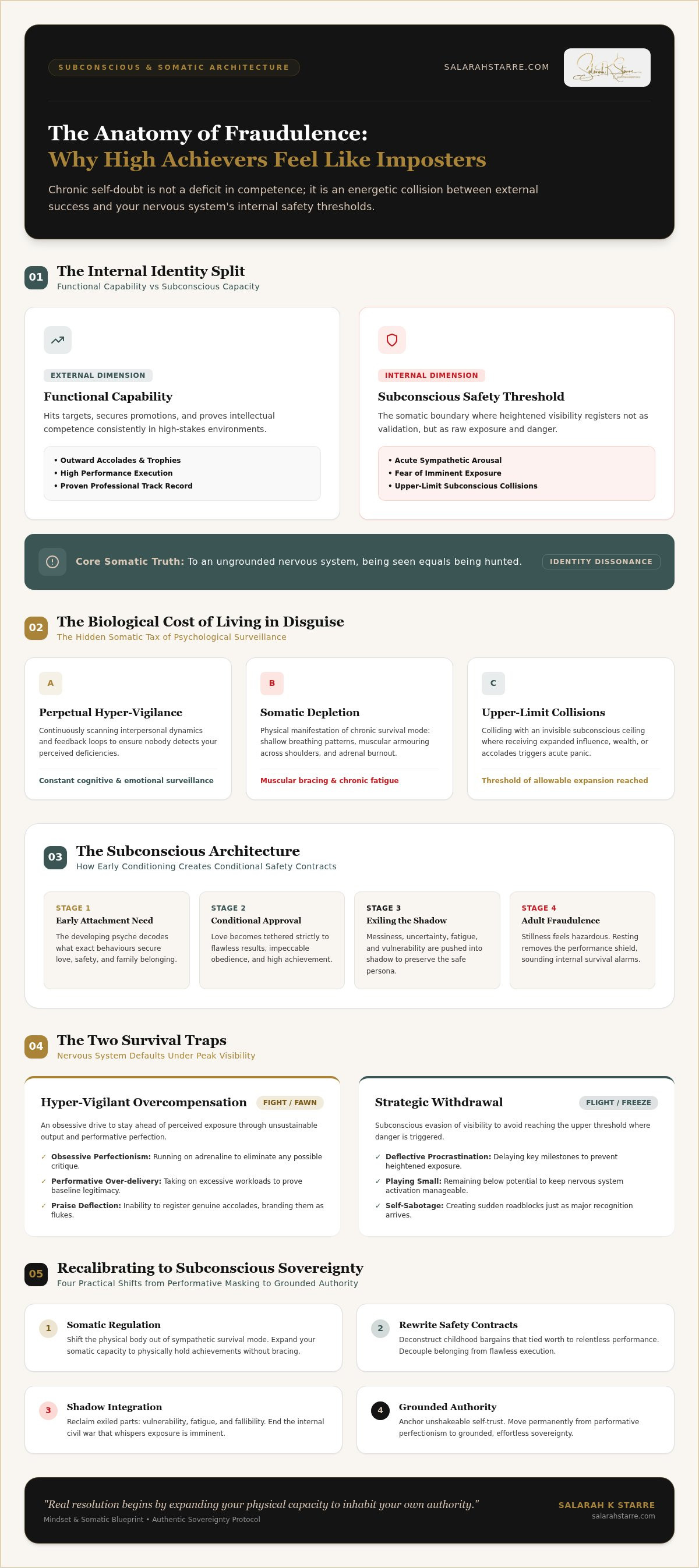
You hit the target, receive the accolades, and secure the promotion. Yet within hours, a suffocating dread sets in. Instead of feeling grounded, you wonder: why do I feel like a fraud after proving my competence? This internal identity rift happens when your functional capability surges ahead of your nervous system's capacity to receive recognition. Traditional clinical definitions of impostor syndrome often dismiss this as mere cognitive distortion, but high performers recognise it as a full-bodied energetic dissonance. Healthy humility acknowledges limits whilst trusting capability; chronic fraudulence, by contrast, interprets every milestone as an imminent trap.
Your nervous system interprets heightened visibility not as validation, but as raw exposure. To an ungrounded system, being seen equals being hunted.
The Paradox of Success and Heightened Exposure
Every professional triumph raises the stakes. When external validation pours in, high achievers experience an acute surge of sympathetic arousal. Your mind intellectually registers the achievement, yet your emotional memory refuses to integrate it. The win remains untethered, rejected as a fluke or systemic oversight. Intellectual competence cannot compensate for visceral emotional safety. Without internal alignment, a higher title simply creates a taller pedestal from which you fear you will inevitably plummet.
The Biological Cost of Living in Disguise
Masking internal insecurity requires massive energetic expenditure. Running this psychological surveillance programme day after day burns through your mental reserves, draining focus and somatic vitality. Consider how this hidden tax exhausts your system:
- Perpetual hyper-vigilance: Continuously scanning interactions to ensure no one detects your perceived flaws.
- Somatic depletion: Shallow breathing, muscular armoring across the shoulders, and chronic adrenal fatigue.
- Upper-limit collisions: Hitting an invisible subconscious ceiling where receiving expanded influence, wealth, or praise registers as unsafe.
When you constantly ask, "why do I feel like a fraud?", you aren't diagnosing a deficit in skill. You are encountering your nervous system's upper threshold for holding power. Real resolution begins not by acquiring another credential, but by expanding your physical capacity to inhabit your own authority.
The Subconscious Architecture: How Early Conditioning Shapes Chronic Self-Doubt
Your conscious mind chases excellence, but your subconscious runs on ancient safety contracts. Early in life, you quickly decoded what behaviour earned connection, safety, and validation. If love felt tied strictly to flawless report cards or impeccable obedience, your developing psyche drew a severe conclusion: belonging is conditional. This foundational programming creates an ongoing internal split. In a comprehensive systematic review of impostor syndrome prevalence, researchers observed how pervasive these chronic self-worth deficits are across high-performing demographics. You aren't fundamentally broken; your early wiring simply prioritised survival over authenticity.
When you sit in boardrooms or lead high-stakes projects and silently ask, "why do I feel like a fraud?", you are replaying an outdated psychological bargain. You learned to trade your authentic, messy humanity for performance-driven acceptance.
Conditional Worth and the Good Child Syndrome
Growing up under conditional approval creates hyper-attuned adults. As a child, you learned that being messy, uncertain, or fallible threatened your emotional attachment. So you chose the mask of the reliable achiever. Resting now feels hazardous because stillness removes the performance shield. Without relentless output, the subconscious sounds an alarm, insisting that you have ceased to earn your right to belong.
Shadow Work: The Exiled Parts Driving the Mask
Every time you concealed exhaustion or faked certainty to maintain an image, you pushed genuine parts of yourself into the psychological shadow. You exiled vulnerability, fear, and fatigue. Yet what you bury does not dissolve; it festers beneath the surface, whispering that exposure is right around the corner. If you find yourself perpetually dodging self-created roadblocks, engaging in intentional shadow work for self-sabotage allows you to integrate these rejected traits rather than letting them dictate your career.
Uncovering this fragmented subconscious identity requires sharp, uncompromising self-inquiry:
- What unacceptable flaw do I believe others will discover if I drop my guard?
- Whose voice am I actually hearing when I dismiss my own hard-won expertise?
- What perceived catastrophe occurs in my body if I publicly admit, "I don't know"?
Persistent self-doubt is not a flaw you need to despise. Treat it instead as a direct invitation for shadow integration and subconscious realignment. When you bring your unedited truth into the light, the phantom need to maintain a spotless façade vanishes. To explore structured modalities for shifting these deep-rooted patterns, discover the transformational pathways available at salarahstarre.com.
The Survival Traps: Comparing Overcompensation Against Withdrawal
When the fear of exposure strikes, your ego deploys one of two polar defence strategies. You either redouble your efforts to outrun detection, or you pull back entirely to avoid scrutiny. Both paths look radically different on the surface, yet both stem from the exact same existential terror: the belief that your authentic self is fundamentally inadequate. As highlighted in the American Psychological Association's guidance on overcoming feeling like a fraud, these compulsive behaviours form a closed loop that keeps professionals locked in defensive patterns. Overcompensation and withdrawal are not personality quirks. They are somatic survival reflexes.
Neither extreme solves your internal crisis. Instead, both reinforce the very phoniness you dread.
The Overachiever: Perfectionism and Hyper-Independence
Hyper-functioning acts as a frantic shield. You obsessively research every variable, pull late nights, and triple-check basic deliverables to manufacture an illusion of total control. Delegating tasks feels out of the question because asking for support registers as exposing weakness. When success arrives, you credit your exhaustion rather than your natural talent. You tell yourself, "I only survived because I worked twice as hard as everyone else." This unsustainable baseline guarantees burnout whilst leaving the spirit starved.
The Under-Earner: Procrastination, Hiding, and Playing Small
Withdrawal sits at the opposite pole of the exact same panic. Instead of burning out, you procrastinate on key initiatives, turn down career advancements, or keep your rates artificially low. By deliberately orchestrating your own limitations, your subconscious mind achieves a powerful secondary payoff: absolute safety from criticism. If you never step onto the main stage, no one can throw stones. You protect your delicate self-worth at the direct expense of your true potential.
Notice how these two patterns sustain the identical cycle of self-doubt:
- The Overachiever's loop: Manic over-preparation leads to success, which convinces the mind that only perfection prevents disaster.
- The Under-Earner's loop: Intentional avoidance preserves safety, which reinforces the belief that you lack what it takes to perform.
These reactive traps clarify the root problem when you wonder, "why do I feel like a fraud?" The exhaustion comes not from your work, but from the relentless management of these two survival strategies. Breaking free requires unhooking your identity from both frantic striving and defensive invisibility.
Recalibrating the Nervous System: Practical Shifts to Dissolve Internal Fraudulence
Affirmations and intellectual pep talks inevitably collapse in the face of somatic panic. When your body registers visibility as mortal peril, repeating positive slogans in the mirror feels like an insult to your survival instincts. True relief requires shifting your physiology before rewiring your psychology. When you understand the profound link between the nervous system and manifestation, you realise that you cannot sustain external expansion without internal biological safety. Regulation is the non-negotiable foundation for genuine self-trust.
Step 1 and 2: Physiological Safety and Somatic Release
Interrupting somatic threat activation requires working directly with the body in real time:
- Identify the physical cue: Catch the exact moment your body braces during high-stakes encounters. Track the throat constriction, the frozen diaphragm, and the abdominal tension. Name the state without judgment: "My system feels exposed."
- Execute a vagal reset: Drop your shoulders, unclench your jaw, and lengthen your exhalation so it lasts twice as long as your inhalation. This simple shift signals safety directly to the brainstem.
- Hold praise somatically: When someone commends your work, resist the urge to deflect, minimise, or over-explain. Soften your posture, take a full breath, and allow your nervous system to physically register the validation.
Step 3 and 4: Cognitive Interception and Identity Recalibration
Once your physiology stabilises, stop debating the inner prosecutor. Trying to out-argue subconscious panic only fuels it. Instead, acknowledge the phantom accusation, recognise it as an outdated survival pattern, and refuse to adjust your actions to appease it. Replace frantic over-functioning with uncompromising boundaries: decline unpaid scope creep, cease apologising for reasonable timelines, and make decisions without seeking compulsive reassurance.
Rewiring these deeply embedded somatic loops dissolves the compulsive urge to ask, "why do I feel like a fraud?" It replaces exhausting performance with grounded presence. If you are ready to permanently dismantle survival habits and expand your internal capacity for visibility, explore The Magnetic Recalibration to realign your subconscious architecture with authentic authority.
Reclaiming Authentic Authority: Moving from Fraudulence to Subconscious Sovereignty
Mainstream advice insists you must merely "tolerate" imposter syndrome, treating it as an unavoidable tax on ambition. That perspective is flawed. Authentic authority does not mean performing confidence until you trick yourself into feeling secure. It is the uncompromising alignment between your internal self-trust and your outer execution. When you dismantle the subconscious belief that your worth depends on flawless delivery, the relentless question of "why do I feel like a fraud?" loses its grip on your identity. True authority requires no armour.
Liberation arrives when you stop policing your every word, decision, and gesture. You shift from defensive survival into rooted sovereignty.
Cultivating Unshakeable Inner Congruence
Exceptional leaders are not immune to uncertainty. The difference lies in their relationship to the unknown. Performative leaders mask doubt with rigidity, terrified that asking a question exposes ignorance. Grounded leaders, conversely, treat uncertainty as creative space. Vulnerability dissolves the illusion of fraudulence instantly. When you stop hiding your humanity, exposure ceases to be a threat. Anchor this sovereignty daily:
- Audit external dependency: Notice when you seek external praise to quell internal anxiety, and redirect that validation inward.
- Normalise fallibility: Treat minor missteps as operational feedback rather than indictments of your character.
- Ground your physical presence: Speak at an unhurried tempo, maintain eye contact, and inhabit your physical space without apology.
Deep Transformational Mentorship
Intellectual comprehension alone cannot rewrite decades of somatic conditioning. Shifting deeply rooted survival contracts requires intentional subconscious reprogramming and skilled guidance. Navigating this internal territory alongside an experienced mentor accelerates identity elevation, moving you beyond the survival strategies explored earlier. Immersive experiences like an energetic alignment workshop UK give you the structured framework needed to integrate your shadow, expand your capacity for visible impact, and anchor permanent self-trust.
Moving beyond asking "why do I feel like a fraud?" is an act of deep internal reclamation. It demands that you claim your seat at the table with clean, quiet certainty. When your subconscious architecture aligns with your conscious ambition, performing ends. Sovereignty begins.
Dismantle the Mask and Inhabit Your Full Power
Living under the constant interrogation of "why do I feel like a fraud?" is an exhausting waste of your brilliance. True liberation occurs when you recognise that perceived fraudulence is not an intellectual defect. It is a somatic survival response; an unresolved collision between early conditional approval and your present-day visibility. By regulating your nervous system out of threat mode, integrating your exiled shadow, and halting the frantic pendulum of overcompensation and hiding, you anchor genuine, unshakeable self-trust.
You don't need to earn your right to occupy rooms you have already entered. Backed by nearly two decades guiding high achievers through deep subconscious recalibration, this specialised framework unites shadow work, nervous system regulation, and energetic mastery to permanently collapse outdated survival loops. Stop managing the exhausting surveillance programme of who you think you should be. To ground your achievements and step into embodied authority, explore transformative subconscious reprogramming and coaching with Salarah K Starre today.
Frequently Asked Questions
Is feeling like a fraud the same thing as having imposter syndrome?
Yes, feeling like a fraud is the central somatic and emotional reality of what psychologists call the impostor phenomenon. While "imposter syndrome" is the popular label, it is not a formal medical diagnosis or psychiatric illness. It is a protective, fear-based cognitive pattern. High performers experience it when external success outpaces internal self-worth, generating a visceral panic that their competence will suddenly be unmasked as sheer luck.
Can high achievers ever completely stop feeling like an imposter?
Yes, you can permanently dismantle chronic imposter feelings by addressing the subconscious architecture holding them in place. High performers often believe self-doubt is the permanent price of ambition, but that is simply an unintegrated survival mechanism. By aligning your subconscious safety thresholds with your conscious capability, external visibility ceases to feel dangerous. You shift from defensive performance to rooted sovereignty, allowing genuine self-trust to become your default baseline.
Why do my accomplishments make me feel more like a fake instead of confident?
External accomplishments heighten feelings of phoniness because each milestone raises the stakes of potential failure. When your subconscious mind equates visibility with danger, a promotion or accolade does not feel like validation; it feels like an exposed ledge. You find yourself asking, "why do I feel like a fraud?" precisely because your nervous system cannot yet hold the energetic weight of your expanded authority without triggering biological panic.
How does childhood trauma or family expectations cause adult feelings of fraudulence?
Early environments that reward performance rather than authenticity program your subconscious to treat imperfection as a threat to connection. If praise was tied to flawless grades, sporting victories, or playing the family mediator, you learned that love is conditional. As an adult, you unconsciously maintain this exhausting contract. You believe that dropping the mask of absolute competence will result in catastrophic rejection from colleagues, clients, or peers.
What happens if I ignore persistent feelings of being a fraud at work?
Ignoring persistent feelings of fraudulence inevitably leads to severe adrenal fatigue, chronic burnout, and self-sabotaging career moves. High achievers who suppress these emotions tend to swing wildly between exhausting over-preparation and panic-driven procrastination. Over time, this unresolved internal tension erodes health, stifles creative decision-making, and limits leadership capacity, trapping brilliant professionals in survival mode rather than allowing them to thrive in authentic power.
Can nervous system regulation help relieve the anxiety of being exposed?
Nervous system regulation is the absolute foundation for dissolving the dread of exposure. The terror of being discovered as an imposter is a physiological fight-or-flight trigger, not an intellectual failing. Somatic resets signal safety directly to your vagal system, slowing your pulse and relaxing muscular tension. Once your body recognises that being seen does not equal being harmed, chronic anxiety evaporates and authentic confidence takes root.
Why does positive thinking fail to cure my persistent imposter syndrome?
Positive thinking fails because intellectual affirmations cannot override visceral subconscious survival programming. When an inner voice screams, "why do I feel like a fraud?", forced positivity merely layers mental denial over genuine somatic dread. Lasting transformation requires shadow work, nervous system regulation, and deep subconscious recalibration. You must address the root identity contract beneath the fear rather than attempting to recite surface-level platitudes to an alarmed body.


