

What if feeling drained after a conversation isn’t a sign that you’re too sensitive, but a signal that a personal limit needs attention? You may be asking, what are energetic boundaries, and why do some interactions leave you carrying feelings or responsibilities that aren’t yours? The answer isn’t about shutting people out. It starts with noticing what’s happening within you.
If saying no brings guilt, or protecting your space feels like rejecting someone, you’re not alone in that tension. Energetic boundaries are limits you set for yourself. They help you choose what you give, what you take on and how you respond. They don’t control another person’s behaviour. In this guide, you’ll learn what they mean in practical terms and how to approach them with greater self-trust.
We’ll look at signs your limits may need attention, how boundaries differ from avoidance or control, and simple ways to communicate them clearly. The aim isn’t to become harder or less caring. It’s to stay connected to yourself, act with self-respect and make room for more balanced relationships.
Key Takeaways
- Understand what are energetic boundaries and how they relate to your attention, emotional capacity, time and participation.
- Notice your own responses as clues about where a limit may help, not as proof of someone else’s intentions.
- Separate self-protection from punishment, avoidance or attempts to control another person’s behaviour.
- Use a four-step process to recognise a limit, name your need, communicate clearly and follow through.
- Review your boundaries as your circumstances and capacity change, using reflection to strengthen self-trust.
What Are Energetic Boundaries? A Clear, Grounded Definition
The phrase can sound mysterious, as though it describes an invisible force you’re meant to sense perfectly. It doesn’t have to. If you’re wondering what are energetic boundaries, think of them as personal limits around your attention, emotional capacity, time and participation. They help you recognise what you can genuinely offer and choose how to respond when you’re reaching your limit.
Energetic boundaries are limits you set around your attention, time and emotional involvement. They guide your choices without dictating someone else’s. That distinction matters. You might end a conversation, take time before replying or decline to take on a problem. You’re deciding what you will do, not telling someone else what to feel, think or do.
What does energy mean in this context?
Here, energy is plain-language shorthand for your felt capacity: whether you feel settled, engaged, strained or depleted. It isn’t a measurable force or a clinical diagnosis, and spiritual interpretations shouldn’t be treated as established scientific fact. The useful information is your own experience.
After an intense conversation, for example, you may notice that you’re tense and need quiet before moving on with your day. That doesn’t prove the other person has done something wrong. It tells you something about your current capacity. You might pause, get some space or choose a different time to continue.
How are energetic boundaries different from personal boundaries?
The terms often overlap in personal-growth conversations. Personal boundaries is the broader, established concept: limits that help define what feels acceptable in how you spend your time, relate to others and take part in situations. “Energetic boundaries” places particular emphasis on how an interaction affects your attention and emotional capacity.
In practice, the limit might concern how long you stay, how often you’re in contact, which subjects you’re willing to discuss or how much emotional support you can offer. You can care about a friend and still say, “I can listen for a few minutes, but I can’t talk this through tonight.” The limit doesn’t erase your care. It makes your participation clear and sustainable.
That’s the grounded starting point: notice your experience, identify the limit and keep your choices in your own hands. An uncomfortable feeling can prompt you to pay attention, but it isn’t a verdict on another person or the relationship.
How Energetic Boundaries Work in Everyday Relationships
Boundaries become clearer when you notice what happens in you during ordinary interactions. Perhaps your shoulders tighten when a conversation turns to a subject you’ve asked to avoid. Perhaps you feel resentful after agreeing to another favour, or relieved when a visit ends. These responses can point to a possible limit. They aren’t a diagnosis, and they don’t automatically prove that someone else has acted wrongly.
Notice the response, then get curious
Pause and ask: What was happening? What do I need right now? Is this a familiar pattern, or am I tired, distracted or under pressure for another reason? The same conversation can feel manageable one day and overwhelming the next. Treat your response as information to explore, not a verdict about the other person.
Body-based awareness can help you spot these shifts. A clenched jaw, restlessness or the urge to withdraw may prompt you to check in with yourself. These observations don’t prove a particular spiritual or psychological explanation. Exploring nervous-system awareness alongside manifestation can offer another lens for reflecting on how inner patterns shape your choices.
Make the boundary about your own actions
A personal limit names what you will do; a demand tells someone else what they must do. You can’t control whether another person agrees with your boundary. You can choose how much time, contact or emotional involvement you offer, and what you’ll do if a conversation no longer feels workable.
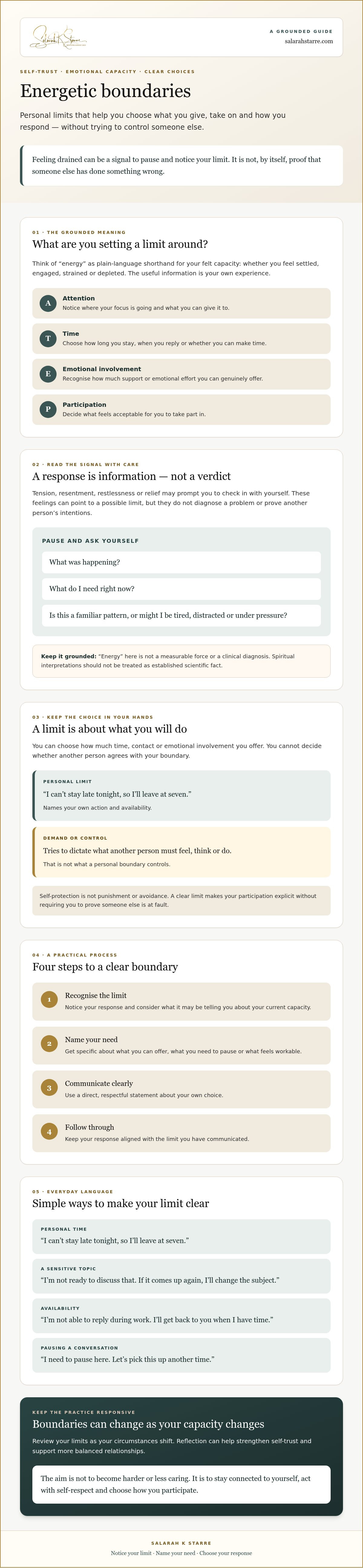
- Personal time: “I can’t stay late tonight, so I’ll leave at seven.”
- A sensitive topic: “I’m not ready to discuss that. If it comes up again, I’ll change the subject.”
- Availability: “I’m not able to reply during work. I’ll get back to you when I have time.”
- Ending a conversation: “I need to pause here. Let’s pick this up another time.”
Clear limits aren’t punishments. They make your participation explicit without requiring you to prove that the other person is at fault. If you notice a pattern of overextending yourself or feeling unable to speak up, reflecting on breaking toxic relationship patterns may help you identify what keeps repeating. Start with one small, realistic choice, then notice what it’s like to follow through.
If you’d like support exploring recurring patterns and strengthening self-trust, learn more about Salarah’s coaching and transformational work.
Are Energetic Boundaries Selfish? Misconceptions to Leave Behind
No. Having a limit doesn’t automatically make you selfish. It means recognising what you can offer and choosing how to take part. If you’ve been asking what are energetic boundaries, this distinction matters: protecting your capacity isn’t the same as rejecting someone or making them responsible for your feelings.
A boundary can be uncomfortable for another person, particularly if they’re used to a different arrangement. They may disagree, feel disappointed or need time to adjust. That reaction doesn’t, by itself, prove your limit is unfair. Equally, calling something a boundary doesn’t make every response reasonable. Communicate your limit with care, proportion and respect, whilst still taking your needs seriously.
Boundary or control: how can you tell the difference?
A request asks for someone’s cooperation; a boundary states what you’ll do; control tries to dictate what the other person must do. The key difference is whose choices you’re defining.
Imagine you need a quieter evening. “Could we keep tonight low-key?” is a request. “If the noise gets too much, I’ll head home” is a boundary. “You’re not allowed to invite anyone over” tries to direct another person’s choices, unless you’re setting an agreement for a shared space together.
Boundaries can include follow-through, but follow-through isn’t a threat. It’s the action you’ve chosen to honour your limit. State it plainly, without insults or punishment: “I’m not comfortable discussing this. If it continues, I’ll end the conversation.” Then act consistently. You don’t need to force agreement for your choice to be clear.
Why guilt and other people’s reactions can complicate boundaries
Guilt may appear when you change a familiar pattern, such as always being available or agreeing before checking your capacity. Notice it, but don’t treat it as a verdict. Ask whether you’ve acted against your values or are simply experiencing the discomfort of doing something differently.
People respond in their own ways. Someone might respect your limit, question it or feel upset. You can listen and reconsider if you’ve been unclear or unfair, but their reaction doesn’t erase your needs. A healthy boundary leaves room for conversation without making your wellbeing conditional on everyone’s approval.
If a relationship feels unsafe, or conversations about boundaries leave you overwhelmed or afraid, you don’t have to manage that alone. Consider speaking with a suitably qualified professional or support service. The priority isn’t winning an argument. It’s finding a way to protect your wellbeing and make informed choices.
How to Set Energetic Boundaries: A Practical Four-Step Process
Knowing you need a limit is one thing. Stating it clearly, without blame or a long defence, is another. If you’ve been exploring what are energetic boundaries, this four-step process turns the idea into choices you can use with family, friends, colleagues and in everyday social situations.
- Notice the limit. Identify what feels difficult. Is the conversation running late, is a topic uncomfortable, or are you being asked to take on more than you can manage? Start with what you can observe, not a conclusion about someone else’s motives.
- Name the need. Ask what would make the situation manageable. You might need more time, a pause, a change of subject or less frequent contact. Choose one specific limit to address first, rather than trying to resolve every tension at once.
- Communicate clearly. Use direct, respectful language and speak from your own perspective. You don’t need to over-explain or build a case against the other person.
- Choose your follow-through. Decide what action you’ll take if the limit isn’t respected. Follow-through means choosing your own next move, not forcing someone else to agree.
Keep the words simple and the action clear
A useful script is: “I can’t talk about this tonight. If it comes up again, I’m going to end the call, and we can try another time.” At work, you might say, “I can take this on next week, but I can’t add it to today’s workload.” With a friend, try, “I’m not available this evening, but I’d be glad to arrange another time.”
If someone challenges your limit, repeat it calmly rather than escalating into an argument: “I understand you’d like to continue, but I’m going to stop here for now.” You can listen, clarify and adjust if needed. You don’t have to keep defending a reasonable choice until the other person approves.
Before speaking, separate the facts from the story you’re telling yourself. “They asked me to stay late twice this week” is observable. “They don’t respect my time” is an interpretation. This distinction can help you address the actual issue clearly, without accusation.
For further reflection, consider how energetic alignment relates to the choices you make and the limits you communicate. If you want support exploring recurring patterns and building self-trust, explore one-to-one coaching with Salarah.
How to Maintain Energetic Boundaries and Build Self-Trust
A boundary isn’t a rule you set once and must defend forever. Your capacity, responsibilities and relationships can shift. A limit that worked during a busy period may need revisiting when circumstances change. That doesn’t mean you’ve failed or abandoned yourself. It means you’re responding to what’s true now.
Reviewing a boundary without abandoning yourself
Every so often, check whether your boundary is still clear, proportionate and within your control. Ask yourself: Does this limit address what I need? Can I follow through on the action I’ve chosen? Is there new information that calls for different wording or timing?
For instance, you might have said you can’t discuss a difficult subject by message, but later realise a planned phone call would feel manageable. You can adjust the format without dismissing your underlying need for care and space. If your first attempt came out sharply or wasn’t clear, repair the communication: “I’m sorry I was abrupt. I still need us to leave that topic for another time.” Repair the delivery whilst holding on to what matters.
Reflection isn’t a test you have to pass after every interaction. Look for useful patterns over time. Did you communicate what you meant? Did your chosen response support your capacity? What might you do differently next time? Small, honest adjustments build self-trust more reliably than demanding perfect words or outcomes.
When deeper reflection or support may help
If you repeatedly struggle to express your needs, feel compelled to agree despite not having the capacity, or aren’t sure which limits feel like your own, that can be a prompt for further reflection. It isn’t a diagnosis. Noticing a recurring pattern gives you a place to explore what influences your choices and how you want to respond.
One-to-one coaching or The Magnetic Recalibration may offer optional transformational support as you reflect on mindset, recurring patterns and energetic alignment. Coaching is not clinical psychotherapy or crisis support. If you need clinical or urgent help, contact an appropriate qualified professional or support service.
Boundaries are practised through choices, communication and follow-through. If you’d like to explore that work further, explore Salarah’s coaching approach.
Start Honouring Your Limits with Clarity
Understanding what are energetic boundaries gives you a grounded place to begin: they’re personal limits around your time, attention and emotional involvement, not rules for controlling someone else. Your responses can help you recognise where a limit may be needed, but they aren’t automatic proof that another person has acted wrongly.
Practise by noticing what feels difficult, naming what you need, communicating it clearly and choosing how you’ll follow through. You don’t have to get every interaction right. Review what’s working, adjust when life changes and let each honest choice strengthen your self-trust.
If you’d like space to explore recurring patterns and decide on your next steps, Salarah K Starre brings nearly two decades of experience in mindset and manifestation coaching to her work as a bestselling author and podcast host. Explore Salarah’s coaching approach and consider whether it feels right for you.
Start with one clear limit. Honour it with care, and keep building relationships without abandoning yourself.
Frequently Asked Questions
What are energetic boundaries, in simple terms?
Energetic boundaries are personal limits around your time, attention, emotional capacity and involvement. The phrase describes how you experience your capacity, not a measurable force or diagnosis. For example, you might notice that you need quiet after a demanding day and choose not to take a call. The boundary is the choice you make about your participation, not an attempt to control what another person does.
What are examples of energetic boundaries in everyday life?
Examples include turning off work notifications during personal time, choosing not to discuss a private subject or leaving a social event when you’re ready to go. You might also decide how much time you can give to a friend who needs support, rather than agreeing to more than you can manage. You could express the limit as your own choice: “I can talk for ten minutes, then I need to go.”
How do you set energetic boundaries with someone you care about?
Start by identifying what feels difficult and what you need. Then explain your limit clearly, without blaming or over-explaining. You could say, “I care about you, but I can’t talk about this tonight. Let’s choose another time.” If the conversation continues, calmly repeat your limit and choose an action you can take, such as ending the call. Caring about someone doesn’t require ignoring your capacity.
Are energetic boundaries the same as personal boundaries?
They overlap, and people often use the terms interchangeably in personal-growth conversations. Personal boundaries broadly describe limits in how you relate, spend time and take part in situations. “Energetic boundaries” tends to focus on how interactions affect your attention and emotional capacity. Either way, the practical question is similar: what feels manageable, and what choice can you make to honour that limit?
Can setting boundaries change a relationship?
Yes. A boundary can change how often you meet, what you discuss or how you share responsibilities. It may lead to clearer expectations and more balanced contact, though you can’t determine how another person will respond. Disagreement or disappointment doesn’t automatically mean the limit is wrong. Notice how the relationship develops over time, and consider whether your communication and follow-through reflect the kind of connection you want.
Are energetic boundaries selfish or unkind?
No. A limit isn’t automatically selfish or unkind. It can help you offer care honestly, rather than agreeing to something you can’t sustain and growing resentful. Tone and context matter, so aim to be direct and respectful. A request invites another person’s cooperation; a boundary states what you’ll do. You can acknowledge someone’s feelings without giving up your needs or making them responsible for your choices.


