
What if the behaviour you’re worried about isn’t proof that you’re “too needy” or incapable of intimacy, but a pattern asking to be understood? The signs of an unhealthy attachment style can include repeatedly seeking reassurance, pulling away when closeness grows, or people-pleasing to avoid conflict. One reaction, especially in a difficult relationship, doesn’t define you.
If you keep cycling through anxiety about rejection, distance and reassurance, it can be exhausting. You may also wonder whether what you’re noticing is an attachment pattern, a clinical diagnosis or a response to how someone is treating you. That distinction matters. Attachment language can help you notice what’s happening; it shouldn’t become a label used to blame or excuse harmful behaviour.
This article will help you recognise recurring patterns without turning them into a verdict on yourself or anyone else. You’ll learn what to look for, how relationship dynamics can shape your reactions, and how to identify grounded next steps, including when to seek professional support. Awareness isn’t a diagnosis. It’s a starting point for building safer, more secure ways of relating.
Key Takeaways
- Spot signs of an unhealthy attachment style by looking for recurring patterns, not isolated reactions.
- Consider how earlier experiences may shape expectations around closeness and trust without defining your future relationships.
- Assess whether a cycle is causing sustained distress by noticing its frequency, intensity and impact on your autonomy.
- Use a simple reflection sequence: notice a trigger, name the feeling, identify the need and choose your next response.
- Know when clinical or NHS support may be appropriate, and how coaching differs from clinical assessment or psychotherapy.
What are the signs of an unhealthy attachment style in a relationship?
Attachment patterns are ways of responding to closeness, trust and the possibility of rejection or disconnection. They can influence how you seek reassurance, handle conflict or respond when someone needs space. Attachment theory offers a framework for understanding these responses, but it isn’t a tool for diagnosing yourself or a partner.
An attachment pattern is a recurring way of responding to closeness and perceived relationship threat, not a mental health diagnosis or a fixed identity. One difficult conversation, a request for reassurance or a need for time alone doesn’t prove that a pattern is unhealthy. Ask whether the response keeps repeating, causes distress, disrupts the relationship or makes it harder for either person to act with choice and independence.
Look at what happens over time, rather than judging a single moment. Are you regularly unable to feel settled without reassurance? Do you withdraw whenever vulnerability enters the conversation? Is there room to discuss needs, respect boundaries and repair after conflict? The signs of an unhealthy attachment style become more concerning when reactions are persistent, limit autonomy or leave both people feeling stuck.
Which behaviours may signal an anxious attachment pattern?
A recurring fear of rejection can make a delayed reply or change in plans feel like evidence that the relationship is at risk. You might seek reassurance repeatedly, check messages or ask whether everything is all right, then struggle to tolerate uncertainty even after receiving an answer. This can leave you on edge and the other person feeling under pressure.
Context matters. Some people prefer more frequent communication, and a partner’s inconsistency or unexplained distance may be genuinely unsettling. Notice whether your response fits what’s happening and whether you can discuss your needs openly. A request for connection, by itself, isn’t a sign that something is wrong.
Which behaviours may signal an avoidant or disorganised pattern?
A repeated tendency to pull away when closeness deepens may make it hard to share vulnerability, ask for support or stay present during emotional conversations. Someone might minimise their needs, change the subject or become distant after conflict. These behaviours can reduce discomfort in the moment, yet leave important issues unresolved.
Some people move between urgently seeking closeness and abruptly withdrawing from it. That push-pull cycle can feel confusing for both people, but it doesn’t establish a diagnosis or define someone’s whole personality. Focus on what happens, how often it happens and whether both people can acknowledge the impact and work towards repair.
How do attachment patterns develop and shape relationship behaviour?
Attachment theory offers a way to understand the expectations people carry into close relationships: whether connection feels reliable, whether it feels safe to express a need, and what distance might mean. Early relationships can help shape those expectations, but they don’t write an unchangeable script for adult life. Later experiences, personal circumstances and the dynamics of a particular relationship can all affect how someone responds. The University of Illinois resource How attachment patterns develop explores how attachment is studied in adults.
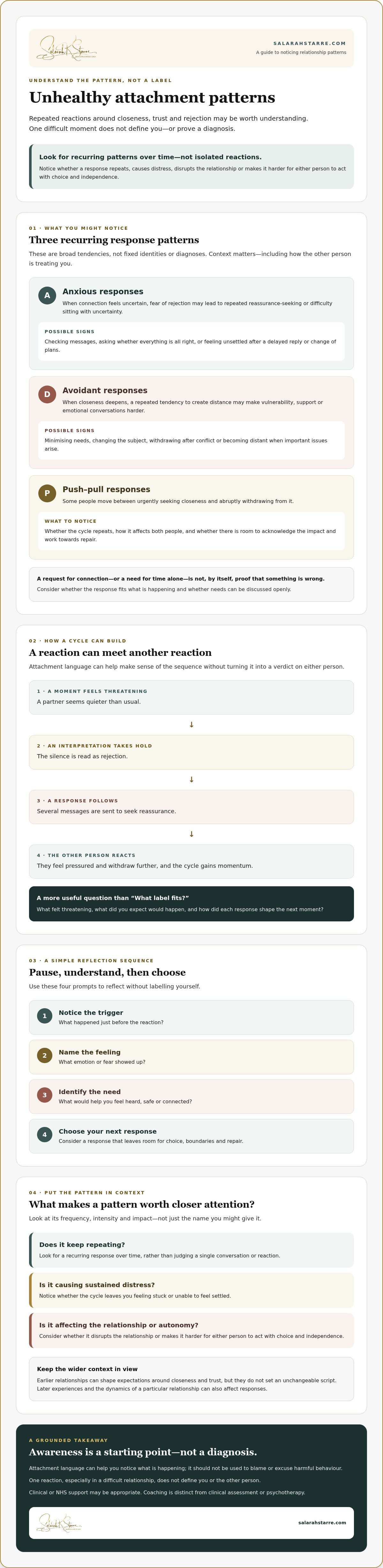
A familiar reaction can unfold quickly. A partner seems quieter than usual; you interpret the silence as rejection and send several messages to seek reassurance. They feel pressured and withdraw further. Or you sense tension, assume asking for support will make things worse, and shut down; your partner reads that silence as indifference. One reaction meets the next, and the cycle gains momentum.
That sequence doesn’t prove either person has a particular attachment style. It gives you something more useful to examine: what felt threatening, what you expected would happen, and how each response shaped the next moment. The signs of an unhealthy attachment style make more sense when you see them as patterns between feelings, interpretations and actions, rather than a verdict on someone’s character.
What is the difference between anxious, avoidant and secure attachment?
These terms describe broad tendencies, not exhaustive personality types. An anxious response may involve seeking reassurance when connection feels uncertain. An avoidant response may involve creating distance or keeping vulnerability private. A more secure response often makes it easier to communicate needs, tolerate some uncertainty and reconnect after a disagreement. None of these descriptions can diagnose you or someone else.
People may respond differently across relationships and circumstances. A person who usually feels comfortable with closeness may become guarded in a relationship marked by repeated conflict. Someone who seeks reassurance may feel more settled when communication is consistent. Pay attention to what’s happening between you, not just which label seems to fit.
Can attachment patterns change over time?
Attachment patterns can change, and they are not mental health diagnoses. Noticing a familiar reaction can create a pause between the trigger and your next move. Supportive relationships, honest communication and appropriate professional help may also support new ways of responding. There’s no guaranteed outcome or fixed timeline, and one approach won’t suit everyone.
If you’d like reflective personal-development support to explore recurring relationship reactions, you can learn more about Salarah’s coaching approach. Coaching isn’t clinical assessment or psychotherapy. Consider a qualified mental health professional or appropriate NHS service for clinical support.
When do attachment signs point to harmful patterns?
Every relationship has moments of strain. A disagreement or upset reaction on its own doesn’t establish a harmful attachment pattern. Look instead at what happens over time: how often the cycle repeats, how intense it becomes, how it affects each person’s wellbeing and autonomy, and whether both people are willing to listen and repair.
For example, a delayed reply might cause worry one day, then be resolved through a calm conversation. Concern grows if similar moments repeatedly lead to distress, monitoring, escalating conflict or pressure to give up ordinary independence. The signs of an unhealthy attachment style need to be considered alongside the relationship’s circumstances, not counted like items on a checklist.
| What you notice | What it may look like |
|---|---|
| Situational response | An occasional upset after a disagreement or delayed reply, followed by space to talk and reconnect. |
| Repeated pattern | A familiar cycle of trigger, reaction and fallout that repeatedly causes distress or restricts one person’s choices. |
| Immediate safety concern | Threats, intimidation, coercion or controlling behaviour that makes someone fear for their safety or feel unable to say no. |
How can you tell a recurring cycle from a one-off reaction?
Trace the sequence without deciding in advance who’s at fault: what happened, what did you feel or assume, how did you respond, how did the other person respond, and what followed? A disagreement about plans, for instance, may end with each person explaining their needs and agreeing how to handle similar situations. If the same conflict keeps returning and neither person can speak freely or make repairs, the impact deserves attention.
Notice whether communication becomes more respectful over time, and whether apologies lead to changed behaviour. Repair doesn’t mean pretending nothing happened. It means acknowledging impact, respecting boundaries and making a genuine effort to respond differently.
Are unhealthy attachment signs the same as abuse?
No. Attachment styles can’t establish whether abuse is present or absent, and they never excuse coercion, intimidation or abuse. Controlling who someone sees, monitoring their movements, making threats or using fear to restrict their choices are safety concerns, not simply relationship patterns to work through together.
If you feel unsafe, consider contacting a trusted person, your GP or a relevant domestic abuse support service. If there’s immediate danger in the UK, call 999. You don’t need to settle on an attachment label before seeking help, and you don’t have to manage a safety concern alone.
How can you reflect on unhealthy attachment signs without labelling yourself?
Use curiosity, not a verdict. The aim isn’t to decide which attachment category you belong to; it’s to understand what happens in a difficult moment and create more choice in how you respond. The signs of an unhealthy attachment style are more useful as prompts for reflection than as labels to pin on yourself or someone else.
What questions can help you identify your own pattern?
Start with a recent situation that felt emotionally charged. Ask yourself:
- What happened, and what did I notice in my body or thoughts?
- Did I feel afraid, want to withdraw, or feel an urge to seek reassurance?
- What might that response have been trying to protect me from?
- What did I need, and did my reaction fit my values and boundaries?
There may be more than one explanation. A reaction could connect with past experiences, present relationship dynamics, stress or unmet needs. You don’t have to uncover a single root cause to learn from the pattern.
Journalling can help you notice recurring situations. Keep notes brief and private: what triggered you, what you felt, what you did and what happened next. Stop or pause if writing feels overwhelming. You’re gathering information, not putting yourself on trial. For broader reflection, read about breaking toxic relationship patterns.
What small steps can support a more secure response?
Try a manageable experiment rather than making a sweeping ultimatum. Pause before replying to a triggering message, name the feeling and make one clear request, such as, “I feel unsettled when plans change. Could you let me know when you can?” Then notice whether both people can respond with respect.
A more secure response isn’t about one person doing all the emotional work. It involves expressing needs, listening to the other person and respecting each other’s boundaries. If you feel activated, a short pause may help you notice what’s happening before choosing what to say. You might also write down what you want the other person to understand, then turn it into a clear, specific request.
If you want support exploring recurring reactions as personal-development work, find out about one-to-one coaching. Coaching isn’t clinical assessment or psychotherapy, and isn’t a substitute for mental health care.
What support can help when attachment patterns keep affecting your relationships?
Recognising recurring reactions can be useful, but you don’t have to work everything out alone. If relationship distress is persistent, escalating or interfering with sleep, work, daily routines or your sense of safety, consider speaking with your GP or a qualified mental health professional. They can help you explore what support may be appropriate. An NHS service may also be a suitable route, depending on where you live and what you need.
When should you consider professional mental health support?
Seek qualified support if anxiety, low mood or relationship difficulties are becoming hard to manage, or if your usual ways of coping aren’t helping. You don’t need to prove that your experience fits a particular label. A clinician can assess your needs; attachment language alone can’t diagnose an attachment disorder or determine what treatment is right for you.
If you’re experiencing abuse, threats or immediate risk of harm, prioritise safety rather than trying to resolve the situation as an attachment pattern. Contact someone you trust and seek help from an appropriate support service. If there’s immediate danger in the UK, call 999 or go to A&E. For urgent mental health help that isn’t an immediate emergency, contact your GP or the relevant NHS urgent mental health service in your area.
How can coaching support personal reflection without replacing therapy?
Coaching can offer space for personal-development reflection, such as noticing recurring reactions, exploring subconscious patterns and strengthening self-trust. Salarah K Starre’s coaching work draws on shadow work and nervous system awareness. It isn’t clinical psychotherapy, diagnosis or crisis care, and it shouldn’t replace assessment or treatment from a qualified health professional when those are needed.
Choose support according to the need in front of you. If you’re unsure whether coaching or clinical help is more suitable, consider discussing your concerns with your GP or a qualified mental health professional first. No single route can promise a particular outcome, but the right support can help you make sense of what’s happening and consider realistic next steps.
If you’re reflecting on patterns that may be connected with self-sabotage, you can read more about shadow work for self-sabotage. To learn about Salarah’s personal-development work, explore her approach to subconscious patterns.
Choose one grounded step towards more secure relationships
Attachment patterns can help explain recurring reactions, but they aren’t fixed identities or diagnoses. The signs of an unhealthy attachment style matter most when a cycle repeatedly causes distress, restricts autonomy or makes it difficult to communicate and repair. Notice what triggers the response, what you need, and whether the relationship allows both people to act with respect and choice.
Change doesn’t begin with blaming yourself. It begins with awareness, honest reflection and one practical response you can try. If distress is persistent or affecting daily life, consider speaking with your GP or a qualified mental health professional. Coaching can support personal development, but it isn’t clinical care.
Salarah K Starre brings nearly two decades of experience to work exploring subconscious patterns and self-trust through personalised coaching and transformational programmes. If you’d like to explore this kind of reflective support, explore Salarah’s approach to subconscious patterns.
Your patterns can be understood, and your next response can be different. Start with one honest step.
Frequently Asked Questions
What are the most common signs of an unhealthy attachment style?
Common signs include recurring fear of rejection, repeated reassurance-seeking, withdrawing from closeness, difficulty asking for support or feeling unable to be alone. Jealousy, people-pleasing or conflict that repeatedly disrupts the relationship may also be worth noticing. These behaviours don’t prove a particular attachment style. Look at how often they occur, their impact on your wellbeing and autonomy, and whether you and your partner can discuss and repair the pattern.
Can you have an unhealthy attachment style and still have a healthy relationship?
Yes. Attachment-related reactions don’t automatically prevent a healthy relationship. What matters is whether both people can communicate honestly, respect boundaries, take responsibility for their behaviour and work through difficulties without fear or coercion. You may notice a familiar response and still choose how to act. A supportive relationship can make room for reflection and change, but it shouldn’t require one person to carry all the emotional work or give up their independence.
How do I know if I have anxious attachment or simply need reassurance?
A need for reassurance can be understandable, especially if communication is inconsistent or a relationship feels uncertain. Consider whether the worry is tied to a specific situation or keeps returning despite discussion and reassurance. Notice how much it affects your day, whether checking or asking repeatedly brings lasting relief, and whether you can talk openly about what you need. These observations can guide reflection, but they can’t diagnose an attachment style.
Can an unhealthy attachment style be changed?
Attachment patterns can shift; they aren’t fixed identities. Recognising a recurring trigger may help you pause, name what you feel and choose a response that better reflects your needs and values. Supportive relationships, honest communication and appropriate professional help may also help you practise new ways of relating. Change isn’t guaranteed to follow a set timeline, and no single technique works for everyone. Focus on workable steps rather than expecting instant transformation.
Is avoidant attachment the same as not loving someone?
No. Pulling back from vulnerability or finding it hard to ask for support doesn’t, by itself, reveal whether someone loves their partner. People may distance themselves for different reasons, and behaviour alone can’t confirm what another person feels. Look at the wider relationship: can you discuss the distance, understand each other’s needs and agree on boundaries? A label shouldn’t replace an honest conversation about how the behaviour affects you.
What is the difference between an attachment issue and emotional abuse?
Attachment language describes possible relationship responses; it doesn’t determine whether abuse is happening or excuse harmful behaviour. Coercion, threats, intimidation or controlling someone’s choices are safety concerns, not simply attachment patterns. If you feel unsafe or at risk of harm, contact someone you trust or an appropriate support service. In immediate danger in the UK, call 999. You don’t need to identify a pattern or label before seeking help.
Should I see a therapist or an attachment coach?
Consider a GP, qualified mental health professional or appropriate NHS service if distress is persistent, escalating or interfering with daily life, or if you need clinical assessment or treatment. Coaching may suit personal-development reflection, such as exploring self-trust or recurring patterns, but it isn’t psychotherapy, diagnosis or crisis care. Check what a provider offers and their scope of practice. If you’re unsure which route fits, a GP can help you consider suitable support.


