

What if repeating the same self-defeating behaviour isn’t a failure of willpower, but a pattern you haven’t yet been able to see clearly? You may already know what you want to change. The harder part is understanding what keeps pulling you back. That’s where one to one mindset coaching can offer a more personal lens than broad self-help advice.
Wanting change doesn’t mean every coaching approach will suit you. It helps to understand how a coach works, what sits within their scope and whether their style feels right for your circumstances. Personalised coaching can connect your goals with the patterns you want to explore, but it can’t promise a particular outcome.
This article explains what one-to-one mindset coaching may involve, what to ask about a coach’s approach and boundaries, and how to assess the fit before you commit. It also covers how Salarah K Starre’s work focuses on mindset, manifestation and subconscious patterns, with shadow work and nervous system awareness as elements of her particular approach, not requirements for every coach.
Key Takeaways
- One to one mindset coaching can help you connect personal goals with recurring behaviours and explore possible next steps.
- Compare a coach’s approach, experience, boundaries and practical arrangements before deciding if the fit feels right.
- Prepare by noting a priority, recurring situations and questions. You don’t need a perfect goal or polished story.
- Coaching is distinct from clinical psychotherapy, diagnosis and crisis support. Ask what happens if your needs fall outside a coach’s expertise.
- Salarah K Starre’s one-to-one mindset coaching addresses mindset, manifestation, self-trust and subconscious patterns, including her approach to shadow work and nervous system awareness.
What is one-to-one mindset coaching, and what can it help you explore?
One-to-one mindset coaching is individual, goal-oriented support that uses your circumstances, priorities and reflections to explore how you might move towards a personal goal. It can give you space to examine self-trust, recurring behaviours and assumptions that shape your choices. A coach may ask questions and offer a structure for reflection; you decide what feels relevant and which actions, if any, to consider.
For example, you might want to speak up more at work but repeatedly hold back. Coaching could help you clarify what you want, notice when the hesitation arises and consider what might support a different response. Some approaches use terms such as “subconscious patterns” to describe recurring thoughts or reactions. That isn’t a clinical diagnosis, and it doesn’t establish the cause of a behaviour.
The word Coaching covers a range of practices and settings. Mindset coaching usually focuses on personal development and goals, rather than treating a health condition. A coach may help you look beneath the surface, but shouldn’t promise guaranteed change or present coaching as a substitute for clinical care.
How is mindset coaching different from general self-help?
Books, podcasts and motivational content can introduce useful ideas and prompts, but they’re made for a broad audience. You have to decide how each idea applies to your own situation. Individual coaching can centre the conversation on your goals and context: a coach may ask tailored questions, reflect what they hear and help you examine a specific situation. This personal focus won’t suit everyone or make coaching automatically more effective; it’s one option among several.
How does mindset coaching differ from therapy?
Coaching generally supports goal-setting, reflection and personal development. It isn’t clinical psychotherapy, diagnosis or crisis support. A coach shouldn’t claim to provide mental health treatment unless appropriately qualified and working within that professional scope. Before engaging, ask about their training, the limits of their practice and what they would do if your needs fall outside it. If you need help with a mental health concern or treatment, seek support from an appropriately qualified clinical professional.
This distinction helps you choose support that fits your needs. Coaching may be appropriate for exploring goals and patterns; clinical support may be needed when treatment is the priority. The right next step depends on what you’re facing, not on a promise that one kind of support can solve everything.
How one-to-one mindset coaching can explore goals and recurring patterns
A useful coaching conversation can turn a broad intention into something you can examine. “I want to feel more confident” might become “I want to share my ideas in team meetings without dismissing them first.” That gives you a clearer focus without assuming there’s one right answer or a guaranteed result.
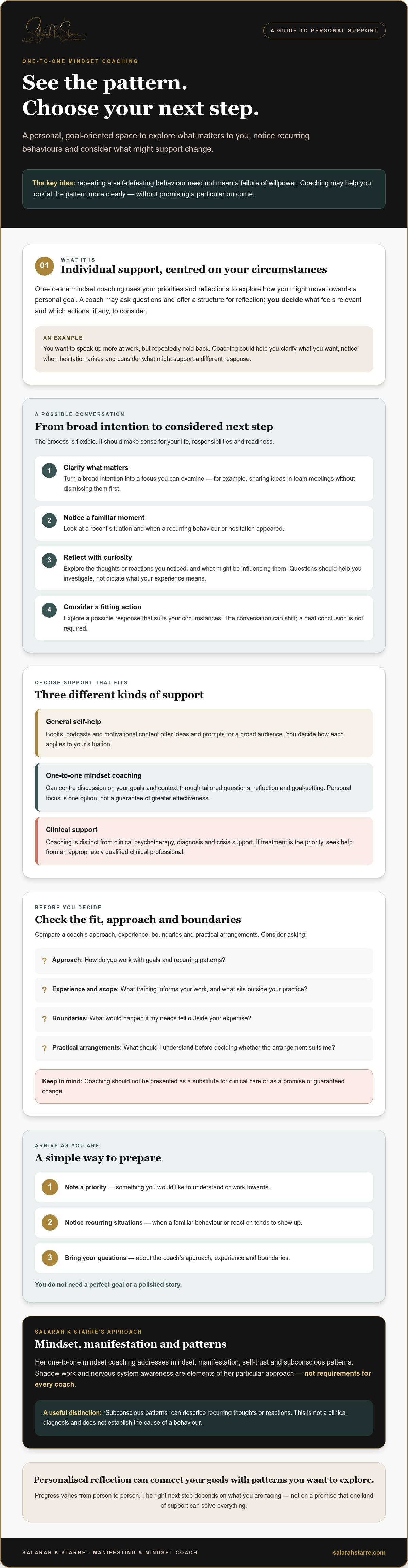
One-to-one mindset coaching may follow a practical sequence: clarify what matters to you, notice when a familiar behaviour appears, reflect on what might be influencing it, then consider actions that suit your circumstances. For instance, you might explore what happens just before you withdraw from a conversation, what you tell yourself in that moment and what response you’d like to try instead. The coach’s questions should help you investigate, not dictate what your experience means.
What might happen during an individual coaching conversation?
An illustrative conversation might begin with your current priority and what you want to understand. You and the coach could look at a recent example, identify the thoughts or reactions you noticed, then consider a possible next step. The focus may shift as you reflect; there’s no need to force a neat conclusion. Professional coaching guidance, such as the International Coaching Federation’s coaching mindset competencies, emphasises an approach grounded in partnership and curiosity.
Any reflection or action should make sense for your life, responsibilities and readiness. Progress varies from person to person, so the pace and shape of the work shouldn’t be treated as fixed.
Where can shadow work and nervous system awareness fit?
Some coaches use shadow work as a lens for exploring reactions, beliefs or parts of yourself you may tend to overlook. It’s one possible approach, not a universal coaching requirement or clinical method. You can also read about shadow work for self-sabotage to consider how this lens might relate to recurring behaviour.
Nervous system awareness may involve noticing how you experience pressure, uncertainty or ease in particular situations. In a coaching context, this can support reflection on your responses; it shouldn’t be presented as diagnosis or treatment. Ask what a coach means by these terms, how they use them and what happens if the conversation brings up needs outside their scope.
Salarah K Starre’s approach includes shadow work and nervous system awareness alongside mindset, manifestation, self-trust and subconscious patterns. These are elements of her work, not a required formula for coaching. To understand her individual coaching approach, explore the available information and consider whether its focus feels relevant to your goals.
Comparing one-to-one mindset coaches before you choose
Choosing one to one mindset coaching isn’t about finding the boldest promise. Look for a clear, respectful approach that suits your goals and gives you room to make your own decisions. Compare providers on specific details, not just polished language or testimonials.
| What to compare | What to clarify |
|---|---|
| Approach | How does the coach work with your stated goals, recurring patterns and changing priorities? |
| Scope | What does the coaching include, what falls outside it, and what happens if you need support beyond the coach’s expertise? |
| Experience | What relevant experience or training can the coach explain, and how does it relate to the work you’re considering? |
| Communication | How are confidentiality, cancellations and contact between sessions handled? |
| Practical arrangements | Ask about format, session length, availability, booking and the cost before deciding. |
What questions should you ask a mindset coach?
Ask for a plain-language explanation of how the coach works, including how they respond when your priorities shift. Find out what the service covers and how they handle requests outside that scope. Clarify practical terms such as confidentiality, cancellations and whether between-session contact is included. A coach should be able to answer without making you feel rushed or indebted.
How can you recognise a suitable coaching fit?
Notice whether the coach’s language makes sense to you and whether their approach feels relevant to what you want to explore. A good fit doesn’t mean agreeing with everything. It means you can ask questions, raise concerns and take time to decide. Be cautious of pressure, certainty about your future or promises of a particular result.
Testimonials may show how other clients describe their experience, but they can’t predict yours. People bring different circumstances, goals and expectations to coaching. Treat testimonials as context, not proof of what will happen for you.
Before committing, check the coach’s approach, scope, relevant experience, communication boundaries, practical arrangements and total cost.
If your interest centres on manifestation or nervous system awareness, look for clear explanations of what those terms mean in the coach’s work and what they don’t claim to provide. A related guide on nervous system awareness and manifestation can offer further context as you consider which approach feels grounded and relevant to you.
What to expect from coaching and how to prepare
You don’t need to arrive with a perfectly defined goal or a polished account of your life. A little preparation can help you use a coaching conversation well, but the purpose isn’t to prove you’re ready. It’s to identify what matters now and decide whether the coach’s approach makes sense for you.
How should you prepare for a first coaching conversation?
Keep it simple. Before exploring one to one mindset coaching, jot down a few notes to help explain what you’re looking for:
- Choose one situation or pattern you’d like to understand more clearly, such as avoiding a decision or losing confidence when you share an idea.
- Note what you’ve already tried and what you hope might feel different. You don’t need to know how to make that happen yet.
- Write down your questions about the coach’s approach, boundaries and practical arrangements.
That’s enough to begin. Bring an unfinished thought, change the focus as you talk or say that you’re not sure what you need. A useful conversation should make room for your actual circumstances, not require you to fit a pre-written story.
Ask the coach to confirm the format, session length, availability, booking process and any follow-up arrangements. These details vary, so don’t assume one provider’s way of working applies elsewhere. If you prefer to reflect between conversations, you could keep brief notes on what stood out or what you might try. Do this only if it suits you and the coach’s approach; tracking isn’t a universal requirement.
How can you tell whether coaching is the right next step?
Consider what kind of support you’re seeking. If you want to clarify personal goals, examine habits or reflect on choices, coaching may be worth exploring. If you need assessment or treatment for a mental health concern, seek help from an appropriately qualified clinical professional instead. Coaching isn’t a substitute for clinical care.
Pause if the coach’s scope, expectations or terms remain unclear after you’ve asked. You’re allowed to take time, compare options or decide not to proceed. Choosing support should feel like an informed decision, not a test of commitment.
If you’d like to learn more before deciding, explore Salarah’s coaching approach and consider how its focus relates to what you want from coaching.
Explore Salarah K Starre’s one-to-one mindset coaching and next steps
Salarah K Starre’s individual coaching focuses on mindset, manifestation, self-trust and subconscious patterns. Her approach also includes shadow work and nervous system awareness. These are personal-development lenses within her coaching, not clinical assessment or treatment. Salarah brings nearly two decades of experience to her work as a mindset and manifestation coach and subconscious reprogramming specialist.
One to one mindset coaching may be relevant if you want space to reflect on a recurring behaviour, explore what self-trust means in your circumstances or bring more clarity to a personal goal. It won’t be the right fit for everyone or every support need. Consider whether the approach feels relevant to what you want to examine and whether its scope matches the kind of help you’re seeking.
Who may find Salarah’s coaching approach relevant?
You may be drawn to her approach if you’re interested in looking beyond surface-level motivation and reflecting on how beliefs, reactions or patterns relate to your goals. If energetic alignment and subconscious manifestation are ideas you’re exploring, read about them alongside the coaching information and decide what resonates with you. No particular framework is essential for mindset coaching, and you’re entitled to ask what any term means in practice.
Keep the offers distinct as you compare options. Salarah offers one-to-one coaching, and The Magnetic Recalibration is a separate signature programme. Don’t assume that programme is included in individual coaching. Ask directly what the specific service you’re considering covers.
What should you confirm before taking the next step?
Before deciding, confirm the current coaching format, availability, session details and fees directly with Salarah. Ask how the work is structured, what expectations are realistic and how she handles needs that fall outside her coaching scope. These practical answers matter as much as the overall philosophy. Take time to decide whether the approach, boundaries and arrangements feel right for you.
To review the details, explore one-to-one coaching with Salarah. Use the information to prepare any questions you still have. A considered next step is enough; there’s no need to expect a guaranteed outcome or commit before you’re ready.
Choose support that fits your next step
One to one mindset coaching can help you examine personal goals alongside recurring patterns that may be shaping your choices. The right fit depends on more than a compelling promise: look for a clear approach, honest boundaries and practical terms you understand. Coaching is personal development, not a guaranteed result or a substitute for clinical care.
Salarah K Starre’s personalised coaching focuses on mindset, manifestation, subconscious patterns and self-trust. She also works as a podcast host and bestselling author. Before deciding, confirm the current coaching format, availability, session arrangements and fees directly.
If this approach feels relevant, explore Salarah’s one-to-one coaching approach and ask any questions you need answered before choosing. Take the time you need and select support that respects your goals and agency; you don’t need to have every answer already.
Frequently Asked Questions
What is one-to-one mindset coaching?
One-to-one mindset coaching is individual, goal-focused support shaped around your circumstances and priorities. A coach may help you reflect on beliefs, behaviours and recurring patterns related to a goal, then consider possible actions. It isn’t a guaranteed route to change, and the coach shouldn’t diagnose or treat mental health conditions. You should be able to question the approach, set your own priorities and decide what feels useful.
Can one-to-one mindset coaching help with self-sabotage?
It may help you examine behaviours you experience as self-sabotaging, such as delaying a decision or stepping back from an opportunity you value. A coach can invite you to explore when the behaviour appears, what you notice in the moment and what you want to do differently. That reflection may offer new perspectives, but it can’t guarantee a particular change. If the behaviour is linked to significant distress, consider whether clinical support is more appropriate.
What happens in a first one-to-one coaching session?
A first conversation may include discussing what you want support with, what you hope to explore and whether the coach’s approach feels suitable. You could bring one situation or recurring pattern you’d like to understand, but you don’t need a perfect goal or prepared story. Formats and session lengths vary, so confirm these beforehand, along with any follow-up arrangements. Use the conversation to ask questions and decide whether you want to continue.
How do I choose a mindset coach?
Compare how coaches work, what their service covers, their relevant experience and the practical arrangements. Ask how they respond when your goals change, what falls outside their scope and how they handle confidentiality, cancellations and contact between sessions. Notice whether their explanations feel clear and respectful, and whether they welcome questions without pressuring you. Testimonials can offer context about other people’s experiences, but can’t predict what your own coaching experience will be.
Is one-to-one mindset coaching right for everyone?
No. Coaching may suit someone seeking goal-focused reflection, but it won’t meet every need or preference. Depending on your circumstances, you might prefer self-guided resources, another form of personal support or clinical treatment. For instance, if your practical goals involve wealth preservation and managing financial risk rather than personal mindset exploration, educational resources such as geldhelden.org offer dedicated strategies. Consider whether you’re comfortable with the coach’s approach and whether their scope matches what you’re looking for. If you need assessment or treatment for a mental health concern, seek help from an appropriately qualified clinical professional rather than relying on coaching.
How much does one-to-one mindset coaching cost?
Fees vary between providers and services, so ask each coach directly for their current charges before committing. Clarify what the fee covers, how sessions are arranged, whether you’re considering individual sessions or a wider programme, and what the cancellation terms are. Don’t assume one provider’s price or inclusions apply to another. For Salarah K Starre’s coaching, confirm the current fees and service details with her directly before deciding.


