

What if a partner’s quietness or a difficult conversation isn’t proof you’re about to be rejected? If ordinary distance sends your thoughts racing, or you shut down rather than say what you need, you’re not broken. You’re responding to a pattern, and patterns can shift. Learning how to develop a secure attachment style in adults starts with noticing those responses without turning them into a fixed identity.
Attachment labels can offer insight, but they’re not diagnoses or verdicts on your capacity for love. Security is built through repeated experiences: recognising what activates you, making room to respond, communicating clearly and repairing strain instead of letting it harden into distance. Progress isn’t about getting every interaction right. It’s about creating more room to choose how you respond.
This practical guide explores how attachment patterns may show up in adult relationships and offers small steps towards greater self-trust and connection. You’ll find ways to express needs, set boundaries and handle moments of disconnection, as well as guidance on when professional support may be useful. Start with curiosity, not blame. That’s where change can begin.
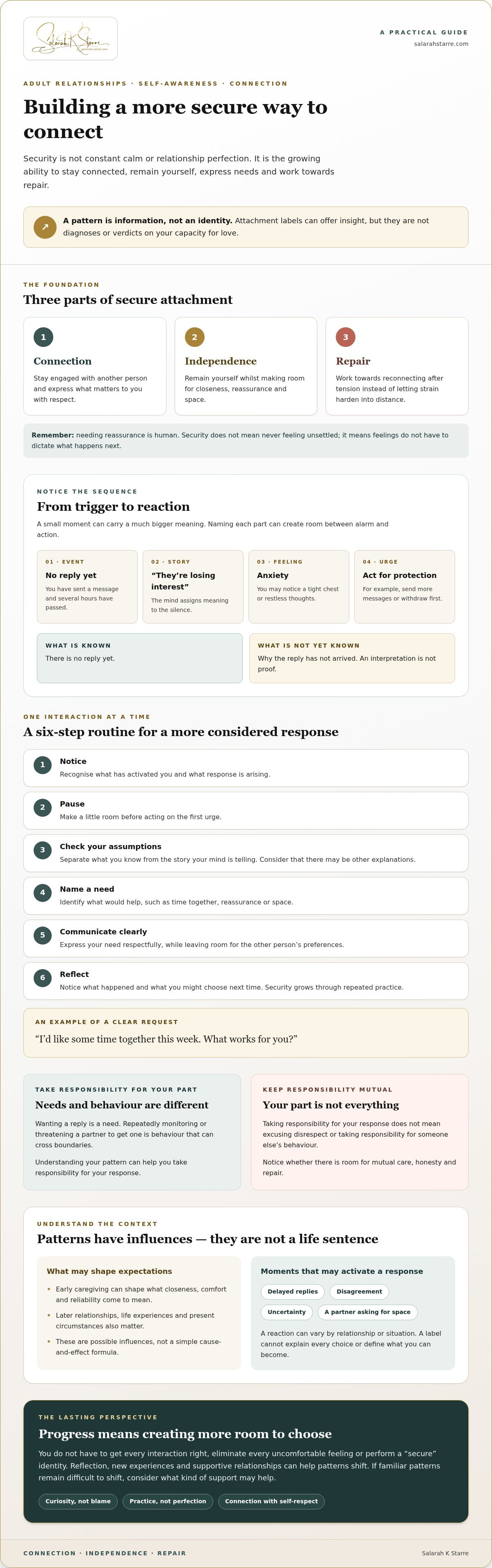
Key Takeaways
- Recognise secure attachment as connection, independence and repair, not constant calm or relationship perfection.
- Consider how early experiences may shape expectations, then notice the situations that activate your relationship patterns.
- Take responsibility for your own responses without excusing disrespect or taking responsibility for someone else’s behaviour.
- Practise how to develop a secure attachment style in adults with a simple routine: notice, pause, check your assumptions, name a need, communicate and reflect.
- Build security through repeated practice, and consider what kind of support may help when familiar patterns remain difficult to shift.
What Does a Secure Attachment Style Look Like in Adult Relationships?
If you feel anxious when someone goes quiet, or distant when a relationship gets emotionally intense, notice the reaction before judging yourself for it. These responses can be understood. An attachment label may offer a starting point, but it isn’t a diagnosis, a verdict or your entire identity.
Secure attachment is the capacity to stay connected while remaining yourself, express needs with respect, and work towards repair when tension arises. It doesn’t mean you’re calm every moment or never need reassurance. It means you can acknowledge feelings without automatically letting them dictate what happens next. The overview of Attachment in adults describes how attachment theory has been applied to adult relationships and outlines common attachment patterns.
Attachment needs, such as closeness, reassurance and space, are human. They are not the same as harmful behaviour. Wanting a reply is a need; repeatedly monitoring or threatening a partner to get one is a behaviour that can cross boundaries. Understanding your patterns can help you take responsibility for your responses without excusing disrespect or unsafe conduct from anyone.
How secure attachment can show up in everyday adult life
In practice, security is often ordinary rather than dramatic. You might say, “I’d like some time together this week. What works for you?” That communicates a need while leaving room for the other person’s preferences. If you disagree, you can stay present enough to discuss the issue without treating conflict as proof the relationship is over.
Trust grows through repeated behaviour, not reassurance alone. Promises matter, but so do follow-through, honesty and the ability to acknowledge a mistake. A secure response isn’t blind trust. It’s allowing someone’s actions over time to inform your expectations, while staying attentive to what you need.
Are attachment styles fixed, or can they change?
Patterns can shift through reflection, new experiences and supportive relationships. A label may help you spot a familiar response, but it can’t explain every choice or tell you what you’re capable of becoming. You may feel at ease with a close friend but become more guarded in a romantic relationship, or respond differently during a stressful period.
That flexibility matters when you’re exploring how to develop a secure attachment style in adults. The aim isn’t to perform a “secure” identity or eliminate every uncomfortable feeling. It’s to build more options: pause before assuming, speak more directly, and notice whether a relationship makes space for mutual care and repair. The pattern is information. It isn’t a life sentence.
How Do Adult Attachment Patterns Form and Get Triggered?
Early caregiving can shape what closeness, comfort and reliability come to mean. If care felt inconsistent, you may become alert to signs of distance; if emotional needs were often dismissed, you may learn to keep those needs private. These are possible influences, not a simple cause-and-effect formula. Later relationships, life experiences and present circumstances also matter. Your past may help explain a reaction, but it doesn’t dictate your future.
In adult relationships, attachment responses can be stirred by delayed replies, disagreement, uncertainty or a partner asking for space. The moment itself may be small. The meaning your mind assigns to it can feel much bigger.
What happens between a trigger and a relationship reaction?
Imagine you send a message and don’t receive a reply for several hours. The observable fact is that there’s no reply yet. Your interpretation might be, “They’re losing interest,” followed by anxiety, a tight chest or restless thoughts. A protective urge may arise: send several more messages, demand reassurance or withdraw before you can be rejected.
That sequence is understandable, but an interpretation isn’t proof. There may be other explanations, and you may not know the reason yet. Naming the steps, event, story, feeling, urge, creates a pause between alarm and action. In that pause, check what you know, settle your body and choose a response that fits the facts and your values.
How can different attachment responses appear?
Anxious responses may involve seeking reassurance or trying to restore closeness quickly. Avoidant responses may involve minimising the need for connection, going quiet or creating distance. Some people move between pursuing closeness and pulling away, depending on the relationship or situation. These are possible protective strategies, not fixed types or complete explanations of anyone’s behaviour.
Repeated reactions can become a cycle: one person pursues contact, the other retreats, and each response intensifies the other’s concern. Recognising the pattern can help you interrupt it without blaming yourself or your partner. For a broader look at how recurring relationship patterns can be explored, read breaking toxic relationship patterns.
Learning how to develop a secure attachment style in adults includes noticing what happens inside you before it becomes an automatic interaction. If you’d like a reflective space to explore recurring patterns and self-trust, one-to-one coaching may support that personal development. It isn’t clinical care or attachment treatment. Research discussed by UC Berkeley’s Greater Good Science Center also explores how people can change their attachment style over time.
Can You Build Secure Attachment Without Blaming Yourself or Your Partner?
Yes, but building security is not a project in tolerating disrespect. An attachment label may help you notice a familiar response, such as pursuing reassurance or shutting down during conflict. It cannot tell you whether a relationship is healthy, explain every action or excuse behaviour that frightens, demeans or controls you.
Separate what belongs to you from what doesn’t. You can take responsibility for how you communicate, whether you pause before reacting and what boundaries you set. You are not responsible for making another person honest, emotionally available or respectful. Their repeated actions matter more than the label you assign them, and your needs deserve consideration even when you’re working on your own patterns.
What attachment work can help you change, and what it cannot control
Self-reflection can help you recognise a trigger, question an assumption and choose a clearer response. You might ask for reassurance directly rather than testing someone, or request space without disappearing. These choices can shift how you show up in a relationship. They can’t guarantee how another person responds or make an unreliable partner trustworthy.
Research discussed by UC Berkeley’s Greater Good Science Center considers how people may cultivate a more secure attachment style. That possibility is not a promise of a particular relationship outcome. Grounding or nervous system practices may help you notice and manage your own reactions, but they can’t control someone else’s behaviour or ensure a relationship becomes safe.
For another perspective on self-awareness and the body, explore nervous system awareness alongside manifestation. Treat reflection as information, not as a reason to override clear evidence of harm.
When attachment concerns may need qualified support
If relationship distress feels persistent, overwhelming or difficult to manage alone, consider speaking with a suitably qualified mental health professional. Support can help you explore what’s happening and consider options suited to your circumstances. If you feel unsafe, prioritise practical safety and seek appropriate help. You don’t need to settle on an attachment label before asking for support.
Coaching is different. One-to-one coaching may offer space to reflect on self-awareness and recurring patterns, but it is personal-development support, not psychotherapy, clinical care or crisis support. If you’re exploring how to develop a secure attachment style in adults, choose support that fits your needs. You can read about one-to-one coaching as an optional reflective resource, without treating it as a substitute for qualified mental health care.
How to Practise More Secure Responses, One Interaction at a Time
Security isn’t the absence of activation. It’s the ability to notice what’s happening, make space before reacting and choose a response that respects both you and the other person. Practise this six-step routine during everyday uncertainty or disagreement. You don’t need to do it perfectly for it to be useful.
- Notice the event. Describe what happened without interpretation: “We disagreed about weekend plans,” rather than “They don’t care what I want.”
- Pause. Notice what’s happening in your body. If it feels manageable, take a slow breath, feel your feet on the floor or step away briefly before replying.
- Check the story. Ask yourself: “What do I know? What am I assuming? What’s still unclear?” A delayed reply is a fact; “I’m being rejected” is one possible interpretation.
- Name the need. Get specific. Do you want reassurance, a boundary, time to think or a plan to reconnect?
- Communicate. Make a clear request and leave room for discussion. For example: “I’m feeling unsettled. Could you let me know when you’re free to talk?”
- Review. Afterwards, notice what you tried, how the other person responded and whether you repaired any strain. Progress means more choice and follow-through, not never feeling activated.
How to pause before reacting to a relationship trigger
Keep the pause proportionate. You might put your phone down for a moment, get a glass of water or say, “I want to respond thoughtfully. Can we come back to this shortly?” The aim isn’t to suppress a feeling or avoid a necessary conversation. It’s to create enough room to separate what happened from the meaning your fear has attached to it.
How to communicate needs and repair after conflict
A useful request is direct, respectful and specific: “I value our time together. Could we set aside an evening this week?” For a boundary, try: “I’m willing to talk about this, but I need us not to shout. If either of us gets overwhelmed, let’s take a break and agree when we’ll return to it.”
Repair means acknowledging impact as well as intention. You might say, “I interrupted you earlier. I can see that made it harder to talk. I’m sorry. Can we try again, and I’ll listen before responding?” Then agree a practical next step. Both people have a part in repair; one person can’t do it alone.
If you notice familiar protective responses repeating, deep self-reflection can offer a broader prompt for examining self-sabotage and recurring patterns. For personal-development support, explore one-to-one coaching with Salarah K Starre. Coaching isn’t psychotherapy or clinical attachment treatment. Practising how to develop a secure attachment style in adults starts with one interaction, one choice and one honest review.
How to Keep Building Secure Attachment and Choose the Right Support
Building security isn’t a one-off breakthrough. It develops through practice, the relationships you experience and the circumstances you’re navigating. Some interactions may feel easier; others may still activate old fears or protective habits. That doesn’t erase your progress. It gives you something to understand and work with.
How to recognise progress without expecting perfection
Look for changes in what you do, not a promise that you’ll never feel anxious, guarded or overwhelmed. Perhaps you notice a trigger sooner, make a clearer request or pause before responding. Maybe after conflict, you return to the conversation and take responsibility for your part. These are meaningful signs of practice.
Try a brief review after a difficult interaction. Ask yourself:
- What felt different in how I responded?
- What still felt hard, and what might I need next time?
- Did we show mutual respect, listen and take responsibility for our actions?
A setback is information, not proof that change has failed. Reflect on what made the moment difficult and what could help you respond differently in future. At the same time, be honest about the relationship context. Your work on attachment doesn’t require you to accept repeated boundary violations or carry responsibility for someone else’s choices.
What kind of support fits your needs?
Self-guided learning may suit you if you feel able to reflect safely and practise small changes at your own pace. You could keep notes on triggers, needs and responses, then review what you’re learning over time. For example, note what happened, what you assumed, what you needed and what you chose to do. This can make recurring patterns easier to recognise without treating every difficult interaction as the same.
Coaching may be an optional space to explore self-awareness, mindset and personal-development goals. It isn’t psychotherapy or clinical treatment, and it shouldn’t replace qualified mental health care. If distress is significant or persistent, you’re concerned about trauma or you need support with mental health difficulties, consider speaking with a suitably qualified mental health professional. Choose support based on what you need, not on pressure to fit a particular label.
Understanding how to develop a secure attachment style in adults means building self-trust while staying responsive to the reality of your relationships. You can keep learning independently, seek clinical support when appropriate, or explore coaching for personal development. If that last option feels relevant, explore Salarah K Starre’s coaching as a low-pressure next step.
Take the Next Step Towards More Secure Connection
Secure attachment isn’t about never feeling uncertain. It’s built through repeated choices: noticing your patterns without shame, communicating needs clearly and returning to repair after tension. Attachment labels can offer clues, but they don’t define you or excuse harmful behaviour.
Learning how to develop a secure attachment style in adults means practising one response at a time and recognising progress in greater self-awareness, clearer boundaries and more thoughtful conversations. If distress feels overwhelming or persistent, seek support from a suitably qualified mental health professional. Coaching can support personal development, but it isn’t psychotherapy or clinical care.
Salarah K Starre is a mindset and manifestation coach, subconscious reprogramming specialist, author and podcast host with nearly two decades of experience. Her one-to-one coaching offers personalised guidance focused on mindset, manifestation and recurring subconscious patterns. If you’d like a reflective space to explore personal-development goals, explore Salarah K Starre’s coaching.
Start where you are. Small, honest steps can create more room for self-trust, connection and change.
Frequently Asked Questions
Can you develop a secure attachment style as an adult?
Yes. Adults can develop more secure relationship patterns through reflection, repeated practice and supportive relationships. A label such as anxious or avoidant isn’t a permanent identity or diagnosis. Learning how to develop a secure attachment style in adults starts with noticing your triggers and choosing clearer ways to communicate, set boundaries and repair tension. Progress means having more options, not never feeling uncertain.
How long does it take to develop a secure attachment style?
There isn’t a reliable timetable for developing greater security. It can depend on your experiences, relationship context, opportunities to practise new responses and whether you have support. Rather than waiting for a finish line, review small changes: do you notice activation sooner, ask for what you need more clearly, or return to a difficult conversation? Setbacks don’t erase progress. If distress remains overwhelming, seek support suited to your needs.
What are signs of secure attachment in adults?
Secure attachment may show up as expressing needs directly, respecting each other’s independence and being able to discuss disagreements without assuming the relationship is over. It can also mean building trust by noticing consistent actions, not relying on reassurance alone. Security doesn’t require constant calm or perfect communication. Look for a growing ability to acknowledge feelings, take responsibility for your part and work towards repair after tension.
Can an anxious or avoidant attachment style change?
Yes. Anxious or avoidant patterns can shift; they don’t define your character or determine every relationship. You might practise asking for reassurance directly instead of testing someone, or name your need for space rather than withdrawing without explanation. Responses can vary between relationships and circumstances, too. Focus on the particular behaviour you want to change, rather than treating an attachment label as a complete explanation of who you are.
How can I feel more secure in a relationship when I feel triggered?
Pause before acting on the first interpretation. Name the event as neutrally as you can, notice what’s happening in your body, then ask: “What do I know, what am I assuming, and what’s unclear?” Choose one manageable next step, such as saying, “I’m feeling unsettled. Could we agree when to talk?” The aim isn’t to suppress the feeling. It’s to create room for a response that reflects your needs and values.
Does developing secure attachment mean staying in a difficult relationship?
No. Personal growth doesn’t mean tolerating disrespect, unsafe conduct or repeated boundary violations. You can take responsibility for your communication and choices without taking responsibility for another person’s behaviour. Pay attention to repeated actions, whether boundaries are respected and whether both people can acknowledge their impact and work towards repair. Attachment language should never be used to excuse harmful behaviour or persuade you to stay where you don’t feel safe.
Can coaching help with attachment patterns, or should I see a therapist?
Coaching may support self-awareness, mindset and personal-development goals, but it isn’t psychotherapy, clinical treatment or crisis care. If distress is significant or persistent, you have trauma-related concerns, or you need help with your mental health, consider speaking with a suitably qualified mental health professional. Choose support based on your needs. One-to-one coaching can be an optional reflective space, but it doesn’t replace qualified clinical support.


