

What if another round of reassurance isn’t what will help you feel secure? A delayed reply, a pause in conversation or a shift in your partner’s behaviour can send your thoughts racing. Overcoming relationship anxiety isn’t about silencing those feelings or assuming everything is fine. It’s about slowing the spiral enough to see what’s happening clearly.
You may recognise the cycle: you overthink a message, fear rejection or abandonment, then seek reassurance. It brings relief, but the calm doesn’t last. That doesn’t mean your concerns are unfounded. It means anxiety and genuine relationship issues need to be considered separately, without assuming one explains away the other.
This article explores what may be fuelling relationship anxiety and offers practical ways to pause before reacting, build self-trust and communicate your needs without relying on repeated reassurance. You’ll learn to distinguish anxious predictions from observable behaviour, so you can respond with greater clarity while still taking real concerns seriously.
Key Takeaways
- Relationship anxiety can affect connection without proving that you or your relationship are broken.
- Trace the pattern from trigger to interpretation and response to spot what may be keeping anxiety in motion.
- Separate feared predictions from specific, repeated behaviours, while allowing that anxiety and genuine concerns can coexist.
- Practise overcoming relationship anxiety by pausing, settling your body and checking what you know before choosing how to respond.
- Build self-trust through considered choices, clear boundaries and noticing progress, even when anxious thoughts still arise.
What relationship anxiety can feel like, and how it affects connection
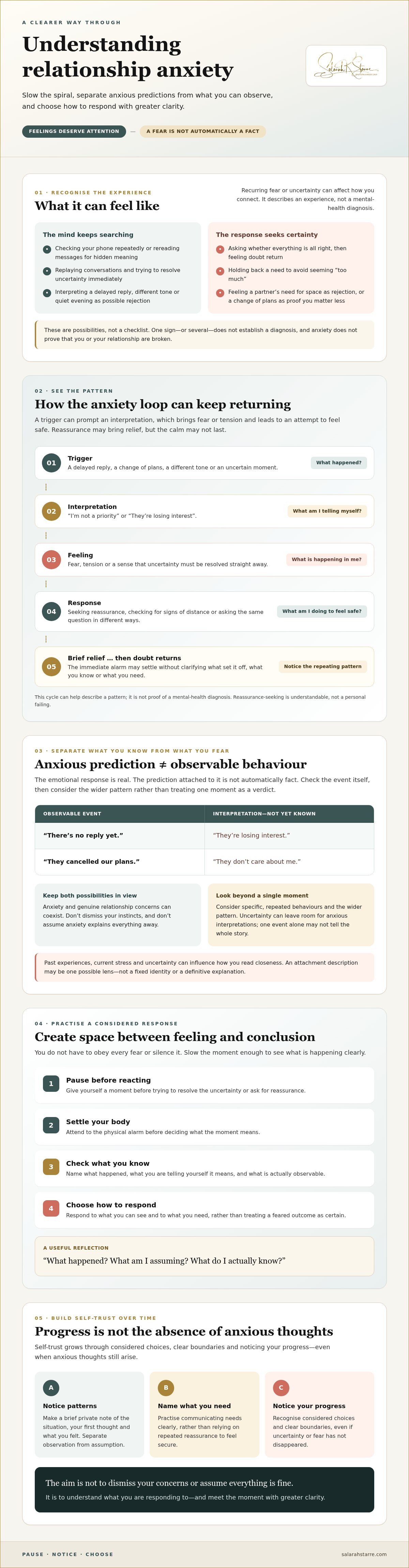
It can be exhausting to care about someone and still feel caught in a loop of doubt. A delayed reply, a different tone or an unusually quiet evening may spark fears that you’re being rejected or that something has changed. Those feelings deserve attention, but they don’t automatically mean you or your relationship are unhealthy.
Relationship anxiety is recurring fear or uncertainty about a close relationship that affects how you connect; the phrase describes an experience, not a mental-health diagnosis. It can show up without a clear sign of trouble, and it can also coexist with genuine concerns. The aim isn’t to dismiss your instincts. It’s to understand what you’re responding to.
Common signs of relationship anxiety
You might check your phone repeatedly, reread messages for hidden meaning or replay a conversation long after it’s ended. Perhaps you ask your partner whether everything is all right, feel briefly reassured, then find the doubt returning. Ordinary uncertainty can start to feel intolerable, as if you must resolve it immediately.
Fear can also shape how you communicate and seek closeness. You may hold back a need to avoid seeming “too much”, or ask the same question in different ways to try to feel secure. A partner’s need for space might feel like rejection; a change in plans might become proof, in your mind, that you matter less. These are possibilities, not a checklist. One sign, or several, doesn’t establish a diagnosis.
Why anxiety can feel convincing
The emotional response is real. The prediction attached to it isn’t automatically fact. Anxiety can make an uncertain moment feel like a certain outcome, especially when the stakes feel personal.
For example, your partner hasn’t replied for a few hours. The observable event is that there’s no reply yet. “They’re losing interest” is an interpretation, not something you know from that fact alone. There may be other explanations, and the wider pattern of behaviour matters more than one moment.
Past experiences, current stress and uncertainty can all influence how you read closeness. Some people recognise themselves in descriptions of an anxious-preoccupied attachment style, which can include fear of abandonment and a desire for reassurance. Treat this as one possible lens, not a fixed identity or definitive explanation. Labels can offer language, but they can’t tell the whole story of you or your relationship.
Overcoming relationship anxiety begins with making room between the feeling and the conclusion. You don’t have to obey every fear or silence it. First, notice what happened, what you’re telling yourself it means, and what you actually know.
Why relationship anxiety keeps returning: triggers, thoughts and learned patterns
A recurring anxiety loop can make the same fear feel new each time. It may begin with a trigger, such as a change of plans. Your mind assigns it meaning: “I’m not a priority.” That interpretation brings fear or tension, which prompts an action, perhaps asking for reassurance or checking for signs of distance. Relief may follow, but if it’s brief, the underlying fear can return.
A repeating anxiety cycle can help describe a pattern, but it isn’t proof of a mental-health diagnosis. The causes and signs of relationship anxiety may involve a mix of influences rather than one explanation. Past experiences can shape what feels threatening; current stress can make uncertainty harder to bear; and unclear situations can leave more room for anxious interpretations.
Seeking reassurance isn’t a personal failing. It can be an understandable attempt to feel safe when fear is loud. But reassurance may settle the immediate alarm without helping you examine what set it off, what you know or what you need. The goal isn’t to shame yourself for wanting comfort. It’s to notice whether the same question keeps returning and what the cycle might be asking you to understand.
Notice the trigger without judging yourself
Try making a brief, private note when anxiety rises. Record the situation, your first thought and what you felt. Then separate what you observed from what you assumed about your partner’s intentions. For example, “They cancelled our plans” is observable; “They don’t care about me” is an interpretation. Look for patterns across different moments rather than treating one difficult day as a verdict.
Explore past patterns without treating them as destiny
Earlier relationships and experiences may influence how you respond to closeness, conflict or distance. They can offer context, not a fixed identity or an inevitable future. Exploring your history is useful when it gives you more choice, not when it assigns blame to you or someone else. A related guide, Breaking Toxic Relationship Patterns: A Subconscious Guide to Radical Freedom, can be a prompt for reflection. Keep your own experience at the centre of that exploration.
Overcoming relationship anxiety involves more than trying to stop a thought. It means recognising the sequence and creating room to choose your next move. If recurring patterns feel difficult to untangle alone, one-to-one coaching with Salarah K Starre may offer space to explore them and strengthen self-trust. Coaching is not clinical psychotherapy.
Anxiety or a genuine relationship concern? How to assess what is happening
Anxiety and a real relationship problem can exist at the same time. You don’t have to decide that every fear is “just anxiety” or that every unsettling moment proves something is wrong. Ask what you can observe, what you’re predicting, and whether behaviour is respectful and safe.
Try this distinction:
Anxious prediction: “They took longer than usual to reply, so they must be losing interest.” This centres on a feared meaning that one event alone can’t confirm.
Observable concern: They repeatedly break agreed plans without explanation, dismiss you when you raise it, or ignore a clearly stated boundary. Look at specific actions and patterns, not guesses about someone’s motives.
This isn’t a test for deciding whether a partner is “good” or “bad”. It’s a way to bring more precision to your judgement. Healthy connection makes room for respect, consent, honesty and emotional safety. Self-regulation can help you think clearly, but it must never become a reason to excuse coercion, intimidation or harm.
Separate facts, fears and unanswered questions
Write down three things: what happened, what you fear it means, and what you don’t yet know. For instance, “They ended the call quickly” is an observation; “They’re angry with me” is a fear; “I don’t know why they had to go” is an unanswered question. This separation can help you respond to what you know rather than treating a prediction as settled fact.
If you feel safe doing so, ask a calm, direct question and listen to the response. The purpose is to understand, not to test, monitor or interrogate your partner. Notice whether their words and actions align over time. A single conversation may clarify something; repeated behaviour offers more context.
When concern is about safety or repeated harmful behaviour
Threats, coercion, intimidation and persistent boundary violations are serious concerns. You don’t need to prove that your fear is “valid” before seeking help. If you feel unsafe or unsure about your safety, consider speaking with someone you trust or contacting a suitable professional support service. If there’s immediate danger, contact emergency services.
Don’t rely on calming exercises to make harmful behaviour easier to tolerate. And don’t treat couples communication or coaching as a substitute for safety planning. Overcoming relationship anxiety should help you trust your judgement, not train you to override it. Pause, assess the pattern and prioritise safety.
Responding to relationship anxiety: practical steps
When anxiety surges, you don’t have to solve the whole relationship in that moment. Create space between the feeling and your next action. This sequence is flexible, not a formula for guaranteed calm. Use what feels manageable, and skip or stop any exercise that increases your distress.
- Pause. If it’s appropriate, wait before sending a message or asking a question.
- Settle. Try one slow exhale, notice your feet on the floor, or name a few things you can see and hear. Body awareness can help you notice what’s happening inside; explore this further in The Nervous System and Manifestation: Why Your Body is the Key to Abundance.
- Name the fear. Try, “I’m afraid this silence means I’m being rejected.” Naming a thought doesn’t make it true or make it disappear.
- Check the facts. What happened? What are you assuming? What do you still need to ask or understand?
- Choose a response. Decide whether to wait, raise a concern or make a clear request.
Pause before acting on the first fear
You’re not trying to suppress the feeling or scold yourself for having it. You’re giving yourself time to notice it without letting it make the decision. A slow exhale, a sensory grounding exercise or briefly stepping away from your phone may help you reflect. Keep it simple. If focusing on your body or surroundings feels uncomfortable, stop and choose another way to pause.
Communicate a need without making anxiety the other person’s responsibility
Asking for connection is different from repeatedly asking someone to prove that nothing is wrong. A clear request describes your experience and invites a response without demanding instant certainty. For example: “I’ve been feeling a little disconnected since we changed our plans. Could we find a time to talk and arrange another evening together?”
Use first-person language: say what you feel, give brief context and make a specific request. Then listen. Your partner may not respond exactly as you hope, but their willingness to hear you and discuss what works for both of you matters. Consider whether your needs and boundaries are treated with respect, not just whether the immediate anxiety has eased.
Overcoming relationship anxiety is a practice of pausing, noticing and choosing, not a demand to stay calm at all costs. If you’d like support exploring recurring patterns and strengthening self-trust, explore one-to-one coaching with Salarah K Starre. Coaching is not clinical psychotherapy.
Building lasting self-trust, and knowing when to seek support
Progress doesn’t mean never feeling anxious again. It may mean noticing a familiar pattern sooner, pausing before acting on it, or making a considered choice while uncertainty is still present. Self-trust isn’t certainty. It’s meeting your feelings with curiosity, respecting your boundaries and choosing a response that reflects what matters to you.
Small practices that reinforce self-trust
Build trust through small, repeatable actions. Keep a promise you make to yourself, such as taking time to think before replying, then reflect on how it felt. If you don’t follow through, notice why without turning it into proof that you can’t rely on yourself. Aim for honest reflection, not perfection.
It can also help to identify what you need beyond your relationship: time alone, connection with friends, rest or support with a challenge in another part of life. Boundaries aren’t punishments. They help you recognise what feels acceptable and decide what you’ll do if a boundary isn’t respected. If you’re exploring recurring responses, Shadow Work for Self-Sabotage: Recalibrating the Subconscious Shadow may offer a prompt for reflection. Let that exploration create more choice, not another reason to criticise yourself.
Choosing the right kind of support
If distress feels persistent, overwhelming or significantly affects daily life, consider speaking with your GP or a qualified mental-health professional. They can discuss appropriate assessment or mental-health support. You don’t need to wait until you’ve reached a breaking point to ask for help.
Coaching has a different purpose. It can support personal development and reflection on recurring subconscious patterns, but it isn’t clinical assessment, mental-health treatment or psychotherapy. Choose the type of support that fits what you’re experiencing, and check a provider’s approach and scope before deciding.
Overcoming relationship anxiety is not about forcing yourself to feel calm or handling everything alone. It’s about growing your capacity to notice, reflect and choose, while taking your needs seriously. If you’d like to explore recurring patterns through a personal-development lens, you can learn about Salarah K Starre’s one-to-one coaching. This is an optional space for reflection, not therapy, and no particular outcome is promised.
Take the next step towards trust and calm
Overcoming relationship anxiety doesn’t mean silencing every fear or demanding certainty from yourself. It means learning to pause, separate what you know from what you’re predicting, and choose a response that respects both your feelings and your boundaries.
Anxiety and genuine relationship concerns can coexist. Look for specific patterns, communicate your needs clearly where it feels safe, and seek appropriate support if distress feels overwhelming or affects daily life. Progress may mean noticing the spiral sooner, not never feeling anxious again.
Self-trust grows through considered choices, honest reflection and small commitments you keep to yourself. You don’t have to make every shift alone. Salarah K Starre brings nearly two decades of experience to her personalised one-to-one coaching and transformational programmes, which offer space to explore recurring patterns and strengthen self-trust. Coaching is not clinical psychotherapy.
If this kind of personal-development support feels right for you, explore Salarah’s coaching and transformational work. Start where you are. One grounded choice at a time can open the way to a steadier, more connected relationship with yourself and others.
Frequently Asked Questions
Is relationship anxiety normal?
It’s common to feel uncertainty or fear in a close relationship, particularly during change or conflict. That doesn’t mean you’re broken or that the relationship is necessarily unhealthy. If worry keeps returning, affects how you communicate or makes everyday uncertainty hard to tolerate, it may help to notice the pattern and consider what support you need. The phrase “relationship anxiety” describes an experience, not a diagnosis.
How can I stop overthinking in a relationship?
You may not be able to switch off every thought, but you can create space before acting on it. Pause, take a slow exhale, then write down what happened, what you fear it means and what remains unknown. For example, a short reply is observable; “they’re losing interest” is an interpretation. Check facts where you can, and choose one considered response rather than repeatedly checking or seeking certainty. Overcoming relationship anxiety is a practice, not an instant fix.
Can relationship anxiety ruin a relationship?
Relationship anxiety can strain connection if fear repeatedly drives checking, conflict, withdrawal or requests for reassurance that never feel settled. But anxiety doesn’t automatically ruin a relationship, and it doesn’t make you solely responsible for its difficulties. Both people’s behaviour matters. Noticing the pattern, communicating needs clearly and addressing genuine concerns can support healthier choices. If the relationship involves coercion, intimidation or harm, prioritise safety and seek appropriate outside support.
What causes relationship anxiety?
There isn’t one cause that applies to everyone. Past experiences, present-day stress, uncertainty and learned ways of responding to closeness may all contribute. A delayed reply, for instance, might trigger fear if you’ve experienced rejection before, but that history doesn’t prove what your partner intends now. Explore possible influences with curiosity rather than treating an attachment label or one difficult experience as a definitive explanation.
How do I know whether it is anxiety or a red flag?
Look at specific behaviour over time, not only the intensity of a fear or one ambiguous moment. Separate what you observed from what you think it means, then consider whether there’s a repeated pattern of dishonesty, disrespect or ignored boundaries. Anxiety and real concerns can coexist. Coercion, threats, intimidation or persistent boundary violations deserve attention and outside support. Don’t use calming techniques to excuse behaviour that makes you feel unsafe.
Should I seek therapy for relationship anxiety?
Consider speaking with your GP or a qualified mental-health professional if distress feels unmanageable or significantly affects daily life, sleep or relationships. They can discuss suitable assessment or mental-health support. Coaching is different: it can support personal development and reflection on recurring patterns, but it isn’t clinical assessment, psychotherapy or mental-health treatment. Choose support according to your needs, and check that a provider’s role and approach are clear.
How can I ask my partner for reassurance without becoming dependent on it?
Make a clear, specific request for connection rather than asking your partner to repeatedly prove that everything is all right. You could say, “I’ve been feeling unsettled since our plans changed. Could we talk tonight and choose another time to meet?” Then listen to their response and notice whether your needs are treated with care. Reassurance can be part of connection; building self-trust also means making room for uncertainty and considering the wider pattern.


