

What if the aim isn’t to find perfect words, but to make your needs clear without turning the conversation into a contest? Learning how to communicate needs without conflict starts with that shift. You can be direct and considerate at the same time.
If you’ve softened a request, stayed quiet or told yourself it wasn’t worth bringing up, you may know what happens next: frustration builds, then the conversation comes out more forcefully than you intended. And when past talks have ended in defensiveness, withdrawal or blame, speaking up can feel risky. A clear request isn’t criticism or control. It gives the other person a chance to understand what matters to you, while leaving them room to respond.
This guide will help you name a need without apologising for having it, make a specific and realistic request, and listen without losing sight of yourself. You’ll find practical ways to start the conversation, recognise when tension is rising, and pause or reset if the discussion stops being productive. No script can guarantee agreement. The aim is steadier, more honest communication, even when the outcome isn’t what you hoped for.
Key Takeaways
- Learn how to communicate needs without conflict by separating what happened from the meaning you’ve attached to it.
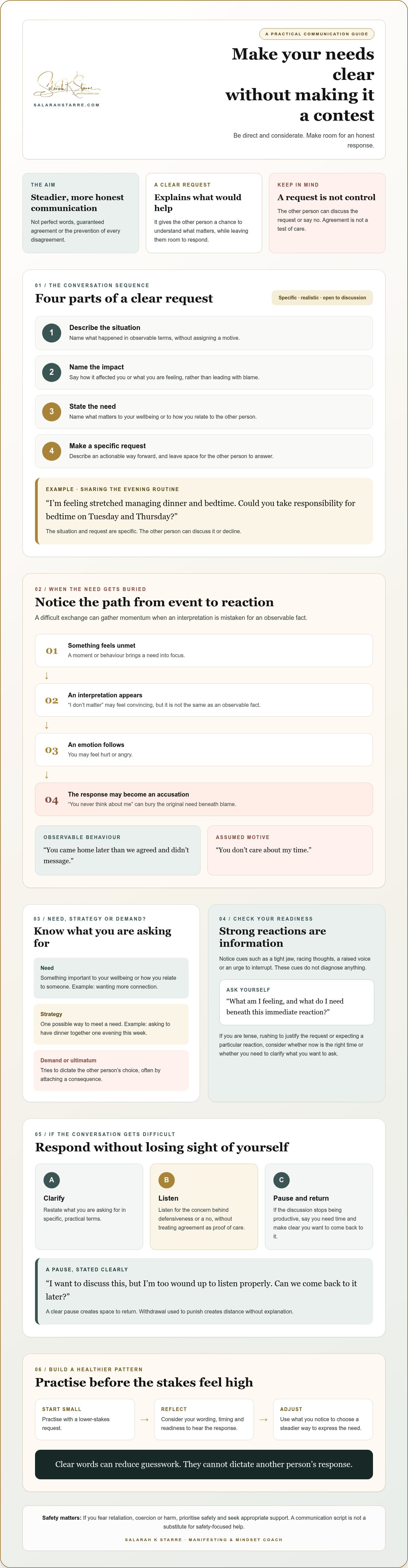
- Use a clear sequence: describe the situation, name its impact, state your need and make a specific request.
- Make requests actionable and open to discussion, rather than treating agreement as a test of care.
- If the other person becomes defensive or says no, clarify, listen for their concern, or pause and return to the conversation later.
- Practise with a lower-stakes request and reflect on your wording, timing and readiness to hear the response.
Why communicating your needs without conflict can feel so difficult
You want to be honest, but you may also be bracing for an eye-roll, an argument or silence. That tension can make even a reasonable request feel loaded. You might rehearse it, dilute it with apologies or decide to say nothing. The difficulty doesn’t prove that your need is unreasonable. It may reflect what you’ve learnt to expect from difficult conversations.
Keeping quiet can feel easier in the moment. Over time, what remains unsaid may surface as resentment, withdrawal or an indirect comment that leaves the other person guessing. Clear words can reduce guesswork, but they can’t dictate someone else’s response. Respectful communication makes room for dialogue; it doesn’t guarantee agreement or prevent every disagreement.
What does it mean to communicate a need clearly?
A need names something important to your wellbeing or how you relate to someone. A strategy is one possible way to meet it; a preference is what you’d like, but may be flexible. A demand or ultimatum tries to dictate the other person’s choice, often by attaching a consequence. For example, wanting more connection is a need; asking to have dinner together one evening this week is a possible strategy. The other person can discuss or decline the request.
“I need more support” may be sincere, but it leaves the other person to guess what support means. If you’re carrying the evening routine alone, you might say, “I’m feeling stretched managing dinner and bedtime. Could you take responsibility for bedtime on Tuesday and Thursday?” That gives the request a situation, an action and room for a response. The Nonviolent Communication framework also distinguishes observations, feelings, needs and requests.
A request names what would help and leaves the other person free to answer; control tries to decide their answer for them.
Why can asking feel risky, selfish or unsafe?
Fear of rejection, memories of being criticised or a habit of keeping the peace can all make speaking plainly feel risky. If you’ve been praised for being “easy-going” or self-sufficient, asking for help may seem like letting someone down. That pattern can be learnt; it isn’t a diagnosis or proof that you’re asking too much.
Before a conversation, notice what’s happening for you. Are you tense, rushing to justify the request or already expecting a particular reaction? This awareness can help you choose whether to speak now, find a calmer moment or clarify what you want to ask. It won’t control the outcome, but it can help you act deliberately rather than burying the need until it comes out sideways.
There’s an important distinction: if you fear retaliation, coercion or harm, prioritise safety and seek appropriate support. A communication script isn’t a substitute for safety-focused help. The aim isn’t to find magic words. It’s to recognise what you need and choose a response that respects your wellbeing.
How emotions and assumptions can turn a need into an argument
A difficult exchange can gather momentum before either person has said what they actually need. One simple sequence helps make sense of it: something feels unmet, you interpret what happened, an emotion follows, then you choose how to respond. For instance, your partner forgets to let you know they’ll be late. You may interpret that as “I don’t matter”, feel hurt or angry, then open with “You never think about me.” The original need for consideration is now buried beneath a sweeping accusation.
The interpretation may feel convincing, but it isn’t the same as an observable fact. “You came home later than we agreed and didn’t message” describes behaviour. “You don’t care about my time” assigns a motive. That distinction matters. You can name the impact without claiming to know what the other person intended.
How to notice when you are activated before speaking
Before deciding how to communicate needs without conflict, notice whether you’re ready to talk. A tight jaw, racing thoughts, a raised voice or an urge to interrupt can be signs that the exchange is stirring a strong reaction. These cues don’t diagnose anything; they’re information. Take a moment to ask yourself: “What am I feeling, and what do I need beneath this immediate reaction?”
A pause creates space to return; withdrawal used to punish creates distance without explanation. If you need time, say so plainly: “I want to discuss this, but I’m too wound up to listen properly. Can we come back to it later?” This makes the pause clear rather than leaving the other person to guess whether you’ve ended the conversation.
How assumptions and blame shift the conversation off course
Words such as “always” and “never” can turn one moment into a case against someone’s character. Accumulated grievances add even more weight: a request about one missed message becomes a review of every disappointment. Try narrowing it back to one example and its effect: “When I didn’t hear you’d be late, I felt worried. Could you send me a message next time?”
Both people may experience the same exchange differently. You might remember a sharp tone; the other person might remember feeling interrupted. Listening to their account doesn’t require you to dismiss your own. It lets you compare perspectives and return to the issue at hand. Noticing your own reactions can help you decide when to pause or clarify, although it can’t guarantee a calm response from someone else.
If these patterns keep pulling you away from what you mean to say, you can explore Salarah K Starre’s mindset coaching as an optional space to reflect on learned responses and practise expressing yourself more clearly.
A simple framework for expressing needs without escalating tension
A clear structure can help you stay focused when the conversation matters. It isn’t a script to recite perfectly or a way to control the response. Think of it as four moves: describe what happened, name its impact, state what you need, then make one request.
- Describe the situation: Name a specific, observable event.
- Name the impact: Explain what you felt or what became difficult for you.
- State the need: Identify what matters or would help.
- Make a request: Ask for one realistic action, with room to discuss it.
Describe the moment, explain its impact, name what matters, then ask for one specific action. That’s the framework in brief. It can help you communicate needs without conflict, while recognising that no sequence can guarantee agreement.
How to turn an unmet need into a specific request
Start with what you could both observe, not a verdict such as “you never listen”. For example, at work: “In yesterday’s meeting, I wasn’t able to finish explaining my proposal. I felt frustrated because I want my ideas considered. Could you let me finish before responding next time?” This names the behaviour and its impact without claiming to know the other person’s intentions. In professional environments, mastering this form of composed dialogue is a key leadership capability, often developed through executive coaching providers such as Simon Lead LLC.
Keep the request specific, actionable and feasible. “Take me seriously” may express a real need, but it doesn’t show what action would help. One clear behaviour gives the other person something concrete to respond to. A request isn’t a test of whether they care. They may agree, offer an alternative or say they can’t do it. Leave space for that conversation.
What can you say when you feel nervous?
You don’t need a flawless opening. Try a line that feels natural: “I want to talk about something important to me,” or “I’d like to raise something and hear your perspective too.” If the timing is poor, ask, “Could we choose a time when we can both give this our attention?” That shows care for the conversation without apologising for having a need.
Repeated dynamics can make a straightforward request feel unusually difficult. If the same patterns keep surfacing, reflecting on breaking toxic relationship patterns may help you recognise what’s shaping the exchange. For now, keep the next step small: choose one situation, identify one need and make one request. Clear, not perfect.
What to do when the other person gets defensive or says no
A clear request can still meet discomfort, disagreement or an imperfect first response. That doesn’t automatically mean you asked badly. The other person may need time to understand what you mean, or they may have a different view of what’s workable. Focus on what happens next: can you both clarify, listen and consider options?
If they seem defensive, try asking, “What did you hear me asking for?” or “Is there a part of this that feels difficult?” Listen for their concern without abandoning your own point. You can clarify your intention, but you don’t have to keep rephrasing until they agree. Communicating needs without conflict also means accepting that a respectful conversation may still end in a no.
Compromise means looking for an arrangement that respects both people. It doesn’t mean erasing a core need to keep the peace. You get to decide what you can accept and what you’ll do if the need remains unmet.
How to pause and return to a difficult conversation
If the discussion is becoming heated or neither of you can listen, name the pause and, where possible, agree when to return. You might say, “I want us to work this through, but I need a break. Could we pick this up after dinner?” A pause works best when it’s clear you’re stepping back to steady the conversation, not using silence to punish or abandon the other person.
Before resuming, each of you can consider the original request and what felt difficult about it. Return to that point rather than reopening every past disagreement. If you can’t agree on the proposed action, ask whether there’s another option that addresses the same need.
When is a boundary more useful than another request?
A request asks another person to take an action. A boundary states what you will do to protect your limits; it isn’t a rule that forces them to behave differently. For example: “If we start insulting each other, I’ll end this conversation and leave the room. We can try again when we’re both ready to speak respectfully.” This is about your next step, not a threat designed to secure agreement.
Repeated dismissal, intimidation or retaliation isn’t solved by polishing your wording. If you feel unsafe or controlled, prioritise safety and seek appropriate qualified support. Consider safety planning with someone equipped to help; don’t rely on a conversation script to manage a potentially unsafe situation.
If you’d like support reflecting on recurring communication patterns and practising how to express your needs, explore one-to-one coaching with Salarah K Starre.
How to practise communicating needs and build a healthier pattern
Start with a lower-stakes conversation: ask a friend to confirm plans by a certain time, or ask a colleague to share updates in a particular way. For neurodivergent individuals who find direct conversations particularly daunting, interactive resources such as The ADHD Field Guide offer simulations and self-assessment tools to help explore communication styles in a low-pressure environment. Practising doesn’t mean rehearsing until you can control the outcome. It means getting more familiar with naming what matters and making a request you can stand behind.
Afterwards, notice what happened. Was your request specific? Did the timing leave room for the other person to listen and respond? What felt clear, and where did you start to soften, over-explain or lose your point? These observations give you something practical to adjust next time.
How to reflect after you have expressed a need
Try asking yourself three questions: What did I want? What did I actually ask for? What did I learn from the response? Keep the other person’s answer separate from your worth. A refusal or a different perspective doesn’t prove that your need was unreasonable. It tells you something about what they can or will offer in that moment.
You can refine your wording or choose a better time next time. You’re responsible for expressing yourself as clearly and respectfully as you can, not for managing another person’s behaviour or guaranteeing a particular response. Progress may look like saying what you mean sooner, hearing an honest answer or recognising when the conversation needs a pause. It doesn’t require every discussion to be conflict-free.
When can outside support help you change a repeated pattern?
If fear, shutting down or recurring conflict makes honest conversations hard to begin or sustain, support from an appropriately qualified professional may help you explore what’s happening and consider next steps. Choose support suited to your needs, especially if you feel unsafe. Coaching can offer a different kind of reflective space, but it isn’t clinical psychotherapy.
Salarah K Starre’s work focuses on mindset and transformational coaching, including reflection on learned patterns. If you’d like to explore that kind of support, consider whether her one-to-one coaching feels like a useful next step. The aim isn’t to find perfect words. It’s to practise how to communicate needs without conflict with more clarity, self-respect and room for an honest response.
Take one clear step towards more honest conversations
Learning how to communicate needs without conflict isn’t about finding magic words or guaranteeing agreement. It’s about naming what happened, explaining its impact, stating what matters and making a specific request. Then you can listen, clarify or pause without losing sight of your own needs.
Start small. Practise with a lower-stakes request and notice what felt clear, what felt difficult and whether the timing left room for a response. Progress isn’t measured by whether every conversation stays comfortable. It’s the growing ability to speak honestly, hear the answer and choose your next step with self-respect.
If you’d like space to explore the patterns shaping how you communicate, Salarah K Starre brings nearly two decades of experience to personalised coaching and transformational programmes. Coaching is an optional path for reflection, not a requirement for expressing yourself more clearly. Explore Salarah K Starre’s coaching and transformational work if it feels like a useful next step.
You don’t need perfect words to begin. You need one honest sentence, spoken with clarity and care.
Frequently Asked Questions
How do you communicate your needs without starting an argument?
Describe one specific situation, explain how it affected you and make a clear request without assuming the other person’s intentions. For example: “When plans change without a message, I feel unsettled. Could you let me know if you’ll be late?” Choose a time when you can both pay attention. This can reduce blame and guesswork, but it can’t guarantee the other person won’t disagree or feel uncomfortable.
What is the best way to express your needs in a relationship?
The best approach is clear, specific and open to discussion. Say what happened, name its impact on you, explain what matters and ask for one action that could help. For instance, replace “I need you to care more” with “I miss having time together. Would you be open to setting aside an evening this week?” Make the request in your own words, and leave space for your partner to share their perspective.
Can you ask for what you need without sounding demanding?
Yes. Make a request rather than issuing an instruction: ask for a specific action, then allow the other person to answer, suggest another option or decline. “Would you be able to pick up the shopping on your way home?” is clearer and less controlling than “You need to do this.” You don’t have to apologise for having a need. Respecting someone else’s choice doesn’t mean pretending your own need doesn’t matter.
How do you tell someone how you feel without blaming them?
Describe the behaviour you observed and its impact, rather than labelling the person or claiming to know their motives. For example, “When I wasn’t included in the planning discussion, I felt left out” is more precise than “You never respect me.” Then explain what would help, such as asking to be included next time. First-person language can make your experience easier to understand, but it doesn’t require you to minimise it.
What should you do if someone gets defensive when you express a need?
Stay with the specific issue and check what they understood: “I’m not trying to blame you. What did you hear me asking for?” Listen for their concern, then clarify your request without arguing over their character. If either of you can’t listen calmly, suggest a pause and agree when to return if possible. A defensive response doesn’t automatically mean you expressed yourself badly, and you don’t need to keep rewording until they agree.
Is communicating your needs the same as setting a boundary?
No. A need is something important to your wellbeing or relationships; a request asks another person to take a particular action. A boundary describes what you will do to protect your limits. For example, you might ask someone to speak respectfully, then set a boundary by saying, “If the insults continue, I’ll end this conversation.” A boundary guides your own choices. It isn’t a way to force someone else to behave as you wish.
How do you communicate a need when you are afraid of conflict?
Start with a lower-stakes request and prepare one sentence about what you need. You could open with, “I’d like to talk about something important to me. Is now a good time?” If fear comes from past criticism, notice that pattern without judging yourself. If you fear retaliation, coercion or harm, prioritise safety and seek appropriate qualified support instead of relying on a communication script. Learning how to communicate needs without conflict takes practice, not perfect wording.


