
What if confidence isn’t something you need to fake before you can manifest, but what emerges when your inner world feels safe enough to move? If you’re repeating affirmations whilst a voice inside calls you a fraud, you’re not failing at how to manifest with confidence. You may be trying to think your way past subconscious doubt while your nervous system remains braced for disappointment.
That tension is exhausting. You want to trust your vision, yet overthinking stalls your momentum and survival mode can leave you frozen. The answer isn’t to force bigger beliefs or pretend fear has vanished. It’s to build grounded self-trust: notice the patterns beneath the doubt, then choose actions that fit the direction you want to take.
In this article, you’ll discover how to move beyond “fake it till you make it”, work with the “not enough” wound, and shift from wanting your desire to embodying a steadier sense of “done”. We’ll explore why nervous system awareness and shadow work matter, what confidence as Energetic Alignment can look like, and how The Magnetic Recalibration can help bridge the gap between desire and reality. Manifestation isn’t a substitute for action. It begins with a more honest, embodied way to take it.
Key Takeaways
- Learn why forcing confidence can amplify doubt, and how to recognise when affirmations feel disconnected from your deeper beliefs.
- Explore how acknowledging hidden feelings such as shame or guilt can support greater self-trust and personal authority.
- Recognise the difference between survival mode and a more grounded state from which you can make considered choices.
- Discover practical ways to notice where your words and body disagree, then prioritise a sense of safety before repeating affirmations.
- Find out how to manifest with confidence by building Energetic Alignment, and how The Magnetic Recalibration can help bridge the gap between desire and reality.
The Confidence Paradox: Why Positive Thinking Alone Fails
You want the new role, relationship or opportunity. You repeat, “I’m completely confident,” but your stomach tightens and your mind starts listing everything that could go wrong. That’s the Confidence Paradox: trying to force confidence can make its absence feel even louder. The more you insist you’re certain, the more sharply you may notice the part of you that isn’t.
This isn’t proof that you’re bad at manifesting. It’s a signal to look beneath the words. Fear-based manifesting tries to secure an outcome from urgency, self-doubt or fear of being disappointed. Aligned manifesting brings your intention, inner beliefs and choices into greater coherence. It doesn’t mean you never feel fear. It means fear isn’t the only force directing your next move.
The Internal Collision of Desires and Beliefs
Your conscious mind might want to be visible, successful or loved, whilst a quieter belief says visibility invites judgement, success is unsafe or love must be earned. That clash can act like an internal brake: you push towards the goal, then hesitate, overthink or retreat. Forcing positivity over distress may add pressure and keep the body’s stress response active. It doesn’t reliably create confidence, and effects vary from person to person.
Manifestation confidence is subconscious safety: the felt sense that you can move towards a desire without abandoning or overriding yourself.
“Fake it till you make it” can be useful when it means practising a new behaviour before it feels familiar. But pretending you feel unshakeable whilst dismissing genuine fear can create internal conflict, not magnetism. A more grounded approach is to take one honest step that fits the belief you’re ready to build, then let experience strengthen your trust in yourself.
Why Affirmations Can Backfire
Say “I am worthy of success” whilst believing you always fall short, and your inner “BS detector” may fire. That’s not a literal brain mechanism; it’s a familiar way to describe the resistance that can arise when a statement contradicts your current self-image. Repeating it louder may become mental chatter: words cycling through your head without changing what feels true to you.
There’s a useful difference between wishing you can act and building self-efficacy, the belief in your ability to pursue a goal. Confidence becomes more grounded when your actions give that belief something to stand on. Try a statement that feels credible today, such as, “I can take one step, even if I’m uncertain.”
That’s a beginning, not the whole recalibration. Learning how to manifest with confidence means listening to the belief beneath the affirmation, rather than trying to overpower it. The deeper work is to understand what the doubt may be protecting, so your words, nervous system and choices can start moving in the same direction.
Deconstructing the Subconscious: How Shadow Work Builds Authority
Confidence can falter not because you lack ambition, but because part of you is trying to stay safe. In shadow work, the “Shadow Self” describes feelings, needs and traits you’ve learned to hide or reject. Shame about being seen, guilt about wanting more, or anger you’ve pushed aside can quietly shape your choices. The aim isn’t to label these parts as bad. It’s to recognise their influence and understand what they may be trying to protect.
This kind of inner exploration is not a guaranteed way to manifest an outcome. It can, however, help you notice patterns that affirmations alone may not reach. For a general grounding in how the body’s command system works, see the Cleveland Clinic’s overview of the nervous system. Emotional responses and bodily states are connected, but shadow work should not be confused with a clinical diagnosis or treatment.
Identifying the Saboteur Beneath the Surface
The “not enough” wound can sound like, “I’m not ready,” “Who am I to ask for that?” or “If I succeed, people will resent me.” You may delay sending the proposal, minimise your achievements or withdraw just as an opportunity appears. It can feel like sabotage. Another way to understand it is that a learned belief may be trying to protect you from judgement, rejection or unfamiliar change, even when that protection now limits your choices.
Bring the pattern into view without turning it into another reason to criticise yourself. Try asking:
- What do I fear could happen if I get what I want?
- What do I do when I’m close to taking a meaningful step?
- Whose judgement or expectations might I still be carrying?
Write down the first honest answer, not the most polished one. For a deeper exploration of how hidden patterns can feed self-sabotage, read shadow work for self-sabotage.
Integrating the Shadow for Total Alignment
Integration means making room for disowned parts of yourself, then choosing how to respond rather than letting them steer from the background. Assertiveness, ambition and anger aren’t automatically harmful; acknowledged and directed with care, they may help you set boundaries, name what you want and act with conviction. That’s a move from inner fragmentation towards greater wholeness, not a promise of instant transformation.
True authority comes from owning every part of your story, including the parts you once felt compelled to hide. As those parts become easier to recognise, your intention and behaviour can begin to align. If you’d like guidance with this deeper work, explore Salarah K Starre’s approach to subconscious reprogramming.
Nervous System Regulation: The Biological Foundation of Certainty
Confidence isn’t a frequency you can force your body to hold. Think of “frequency” as a metaphor for your prevailing state: when you feel steadier, it may be easier to think clearly, make choices and follow through. Under prolonged stress, attention can narrow towards threat and uncertainty. A meaningful goal may start to feel less like a possibility and more like another demand you have to survive.
This is the difference between survival mode and what we might call creation mode. The latter isn’t a formal biological state; it describes having enough capacity to imagine options, stay present and take purposeful action. Learning how to manifest with confidence includes noticing what state you’re in, rather than treating every pause as a failure of belief.
Breaking Free from Survival Mode
Survival responses don’t look the same for everyone. Flight may show up as restless over-planning, frantic research or constantly changing the goal. A frozen response might feel like blankness, procrastination or being unable to choose a first step. These experiences aren’t proof that you’re incapable. They can be cues to slow down and attend to what’s happening in your body.
Start small. Feel your feet against the floor, look around and name a few things you can see, or lengthen your exhale if that feels comfortable. Then ask, “What is one manageable action I can take now?” These practices aren’t a switch that guarantees safety or an outcome. They can help bring your attention back to the present whilst you keep your desire in view. For more on the connection between the body and manifestation, explore the nervous system and manifestation.
Embodying the Frequency of “It Is Done”
Wanting often directs attention towards what’s missing: “I’ll feel secure when this happens.” “Knowing”, in this context, doesn’t mean pretending the outcome is guaranteed. It means relating to your desire with enough steadiness to act today, without demanding certainty about tomorrow. Let the imagined future become a direction, not a test you must pass.
The vagus nerve is part of the communication network involved in regulating body functions, including aspects of the parasympathetic response. It isn’t a manifestation switch. Gentle movement, a comfortable breath and supportive routines may help you practise returning to a more settled state, though responses differ. Build capacity in ordinary moments: picture one specific next step, notice what arises, then take action at a pace you can sustain. That’s grounded authority in motion.
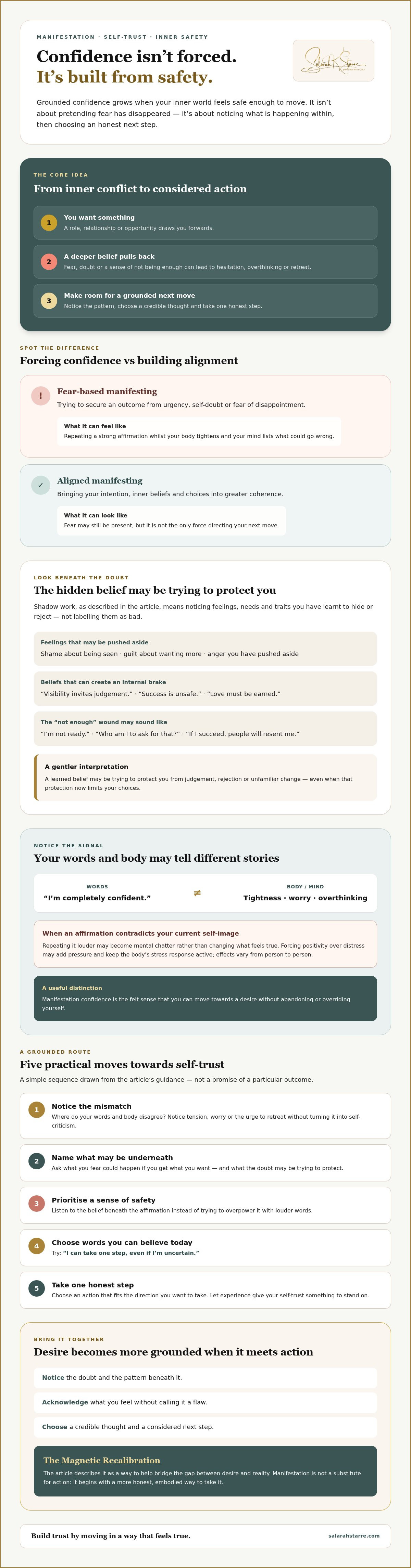
5 Steps to Organise Your Energetic State for Absolute Confidence
Energetic Alignment isn’t a mood you have to maintain perfectly. It’s the practice of bringing your intention, inner state and behaviour into closer agreement. Use these five steps as a working sequence, not another standard to judge yourself against. Pause, notice what’s true, then choose a next move you can stand behind.
Audit and Regulate Your Vessel
1. Audit the collision. Write down what you say you want, then note what you feel when you picture taking a step towards it. Do you claim you’re ready to be seen whilst avoiding the conversation that would make you visible? That gap is an energetic “leakage”: a place where attention and confidence may be drained by conflicting expectations. Treat it as information, not failure.
2. Regulate before you affirm. If you feel overwhelmed, stop trying to force a powerful statement. Press your feet into the floor, look around and name what you see, or take a comfortable, unhurried breath. Choose what feels manageable. A moment of quiet can be more useful than piling positivity on top of a system that’s asking you to slow down.
Integrate, Recalibrate and Act
3. Integrate the doubt. Ask what the hesitation might be trying to prevent: criticism, rejection, responsibility or change. You don’t need to obey that fear or banish it. Acknowledge the concern, consider what support or boundary would help, and redirect the energy spent fighting yourself.
4. Recalibrate your identity. Move from “seeker”, waiting for permission or proof, towards “owner”, someone willing to make choices in alignment with what matters. In areas such as financial growth, networks like The Real Estate InvestHER embody this shift by helping women ground ambitious goals in practical knowledge and supportive community. This isn’t pretending you already have every result. It’s practising the standards, boundaries and self-respect of the person you’re becoming. Ask, “What would I choose if I trusted myself to handle the next step?”
5. Execute with authority. Turn that answer into one specific action: send the proposal, set the boundary, or spend focused time developing the skill. For small business owners and individuals whose hesitation involves unfamiliar technology, working with a digital confidence coach NZ can provide the practical training needed to replace doubt with competence. Inspired action needn’t feel dramatic; it should feel like a natural extension of the identity you’re practising, not a punishment for being afraid. Action is the physical signature of your confidence.
That’s a grounded way to practise how to manifest with confidence: notice the mismatch, create space, and choose action without demanding certainty about the outcome. If you want support bridging desire and subconscious alignment, explore The Magnetic Recalibration programme.
The Magnetic Recalibration: Reclaiming Your Personal Power
Insight matters. So does what you do with it. If you can name the fear beneath your doubt but still find yourself caught in the same cycle, surface-level tips may not be enough. The Magnetic Recalibration is Salarah K Starre’s signature programme for people stuck in fear-based manifesting. It is designed to help bridge the gap between desire and subconscious alignment, so your next steps can come from greater self-trust rather than constant inner resistance.
Salarah specialises in subconscious reprogramming, shadow work and nervous system awareness, drawing on nearly two decades of experience in mindset and manifestation. She isn’t here to promise a particular outcome or tell you to override every uncomfortable feeling. The work is to look honestly at the patterns shaping your choices, understand what they may be protecting, and make room for a more aligned way forward.
Moving Beyond Survival into Authenticity
There’s a difference between trying to manifest as though every result must prove your worth and living in closer alignment with what matters to you. The latter doesn’t mean you’ve secured a specific outcome. It means your values begin to inform your decisions, boundaries and actions, even whilst uncertainty remains. You stop fighting yourself for having doubts and start responding to them with curiosity, discernment and choice.
Personalised support can help you examine recurring patterns in the context of your own experiences. Alongside The Magnetic Recalibration, Salarah offers one-to-one coaching for those seeking individual guidance. Rather than applying another generic affirmation, you can explore what keeps you stuck and identify grounded steps towards change. That’s how to manifest with confidence without pretending fear has disappeared.
Your Invitation to Deep Healing
For some, immersive retreats provide a dedicated setting to step back from familiar routines and give deeper reflection more space. A retreat isn’t a guaranteed nervous system reset or a shortcut to transformation. It can offer time to pause, reconnect with your needs and consider what you want to carry forward. The aim is not to become someone else. It’s to move from overthinking and self-abandonment towards greater clarity, self-trust and personal authority.
You don’t need another promise that you can force your way into certainty. You need an honest process that helps you meet what’s underneath the doubt and choose your next step with intention. Enquire about The Magnetic Recalibration and start your transformation.
Build Confidence That Holds Beyond the Affirmation
Learning how to manifest with confidence isn’t about forcing certainty or pretending fear has disappeared. It’s about noticing where your intentions and deeper beliefs conflict, making space for the parts of yourself you’ve hidden, and taking grounded action that builds self-trust.
Your nervous system matters, too. When you’re caught in survival mode, pause and create room to feel steadier before demanding more of yourself. Confidence grows through alignment: what you want, what you believe and how you act begin to move in the same direction.
Salarah K Starre brings nearly two decades of experience in mindset and manifestation to her work as a bestselling author and specialist in shadow work and nervous system awareness. If you’re ready to move beyond surface-level tips and explore deeper subconscious change, explore Salarah’s programmes and begin your recalibration.
You don’t have to fake your way into confidence. Start with one honest step, and let self-trust grow from there.
Frequently Asked Questions
How do I manifest confidence when I feel like a failure?
Start by separating a difficult experience from your identity. A setback doesn’t prove you’re a failure or disqualify you from pursuing what matters. Choose one small, realistic action that supports your goal, then notice what you learn from taking it. Confidence often grows through repeated evidence that you can respond, adapt and keep going. You don’t need to feel completely sure before beginning.
Can I manifest if I have anxiety or a dysregulated nervous system?
Yes, anxiety doesn’t make you incapable of setting intentions or taking steps towards them. Focus on actions within your control, and adapt your practice to how you feel. If visualisation or affirmations increase distress, pause and try grounding through your senses or a comfortable breath. Manifestation practices aren’t a replacement for appropriate health support, especially if anxiety is persistent or disrupting daily life.
Why do my affirmations feel like I am lying to myself?
Affirmations can feel false when they clash with what you currently believe about yourself. Repeating “I’m completely confident” may intensify that mismatch rather than resolve it. Try a statement that feels believable and points towards growth, such as, “I can take one small step, even while I feel uncertain.” Pair it with an action, so the words have lived experience to build on.
What is the fastest way to clear subconscious blocks to confidence?
There’s no reliable instant method for clearing subconscious patterns, and anyone promising guaranteed, immediate change is oversimplifying the work. Begin by identifying a recurring moment of hesitation, then ask what you fear might happen if you move forward. Write down the answer without judgement and choose one manageable response. Deeper patterns may take sustained reflection and support to understand and shift.
How does shadow work help with manifestation?
Shadow work involves noticing feelings, beliefs or traits you’ve learnt to hide or reject, then exploring how they influence your choices. For example, fear of criticism might lead you to avoid sharing an idea you care about. Recognising that pattern can help you respond with greater awareness instead of letting it automatically steer your behaviour. It doesn’t guarantee a desired outcome, but may support self-understanding and more intentional action.
Is it possible to manifest from a state of survival mode?
You can still hold a goal and take practical steps whilst stressed, but survival mode may make it harder to feel settled, consider options or follow through consistently. Don’t turn your emotional state into another test you must pass. Pause, orient yourself to your surroundings and break the next action into something manageable. Manifestation works best as a prompt for intention and action, not a demand to suppress distress.
What is the difference between faking confidence and being an energetic match?
Faking confidence means performing certainty, even when it requires ignoring what you feel or believe. Being an energetic match is a spiritual framing for greater alignment between your intention, values and behaviour. It doesn’t mean you must feel fearless or that thoughts alone control outcomes. Practically, it can mean acknowledging uncertainty and still choosing actions that reflect the direction you want to take.
How do I know if my nervous system is blocking my manifestations?
You can’t determine that your nervous system is “blocking” a manifestation from one feeling or setback. Notice patterns instead: do you repeatedly freeze, overthink or pull away when a particular goal asks you to be visible or take a risk? These responses may have several causes. Treat them as cues to pause, reflect and choose a manageable next step, not as proof that you’ve failed or attracted the wrong outcome.


