

What if a pattern that keeps repeating isn’t proof you’re being punished, but a prompt to pause and look more closely? If you’ve searched for the karmic residue meaning, you may have found explanations ranging from spiritual imprints to familiar emotional habits. That variation can be confusing, especially when the language makes hardship sound deserved.
“Karmic residue” is a spiritual concept, not a universal definition or clinical diagnosis. Recurring patterns don’t prove you’ve done something wrong. Rather than asking whether you’re fated to repeat the past, consider what you can observe, understand and choose differently now.
This article looks at how the idea is understood across spiritual traditions, how it differs from psychological explanations for recurring behaviour, and how to reflect without shame or fatalism. You’ll find practical ways to recognise familiar triggers, examine your responses and choose an intentional next step. Curiosity can help you notice a pattern; deliberate action gives you something concrete to practise.
Key Takeaways
- The phrase karmic residue meaning varies across spiritual contexts; treat it as an interpretive idea, not a universal definition.
- Karma and samsara are understood differently across traditions, so don’t assume they mean the same thing everywhere.
- Recurring difficulties can be explored as spiritual metaphors, learned habits or subconscious patterns. None proves karmic debt or past-life causation.
- Track repeated situations, emotions and choices with curiosity, then identify one intentional response to try next time.
- Shadow work and coaching focused on subconscious patterns are optional ways to deepen self-reflection and build self-trust.
Karmic residue meaning: what does the phrase actually describe?
Karmic residue is a spiritual phrase with varied interpretations, often used to describe the lingering imprint of past actions, unresolved experiences or recurring patterns. Some people understand that imprint as metaphysical; others use it symbolically to describe how experiences and choices continue to shape feelings and behaviour. There’s no single definition shared by every spiritual tradition, so context matters.
A useful boundary is to remember that karmic residue is a spiritual interpretation, not a clinical or scientific diagnosis.
The phrase may offer a lens for reflection, but it can’t explain by itself why a particular difficulty happens or prove that someone carries a spiritual debt.
What does karmic residue mean in everyday spiritual language?
In everyday spiritual language, the phrase can describe an experience that seems to leave an emotional or behavioural trace. Imagine someone who becomes defensive whenever a colleague offers feedback. They might call that reaction “residue” from unresolved experiences, using spiritual language to make sense of a response that feels bigger than the moment.
That description is a personal interpretation, not evidence of a supernatural cause. The reaction might also relate to past learning, current stress or the dynamics of that relationship. Separate what you’ve observed from the explanation you place around it. For example, note what was said, how you responded and whether the same reaction appears in other situations. A repeated response is worth examining, but it doesn’t establish why it exists.
Is karmic residue the same as karma?
No, not automatically. Karma is a concept whose meaning varies across religious and philosophical traditions. Broadly, discussions of karma often relate actions and intentions to consequences, but traditions differ in how they understand that relationship. The concept of karma has a long and varied history across major Indian religions; a short phrase such as “karmic residue” shouldn’t be treated as a complete account of those teachings.
People may use “residue” to suggest a lingering effect or imprint associated with karma. That can be a helpful metaphor for personal reflection, but it isn’t automatically a formal synonym for karma or a description of every tradition’s view. Be wary of explanations that flatten distinct beliefs into one universal rule or insist that painful experiences must be punishment. For those seeking to explore spiritual teachings within their distinct cultural contexts rather than through generalised modern concepts, the African Ancestral Traditional School offers structured learning on traditional philosophy and spiritual self-mastery.
If you’re exploring the karmic residue meaning, hold the phrase lightly. Notice the pattern, name your interpretation and leave room for other explanations. Curiosity can help you understand your responses without turning them into a verdict about what you deserve.
How karmic residue relates to karma, samsara and spiritual traditions
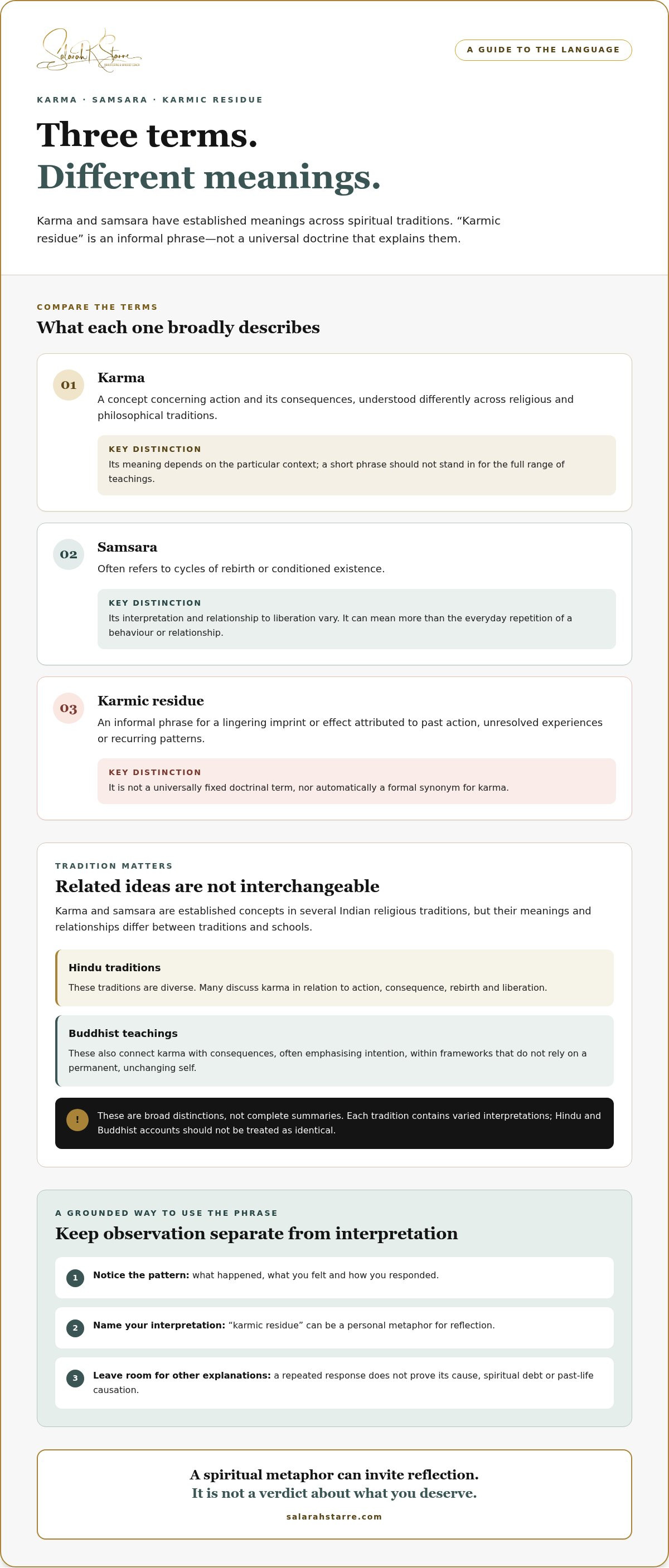
Karma and samsara are established concepts in several Indian religious traditions, but “karmic residue” is an informal phrase, not a single doctrine that neatly explains them. The ideas may be related in some interpretations, but they aren’t interchangeable. Keeping the distinctions clear helps avoid treating a personal metaphor as a summary of religious teaching.
| Term | Broad description | Important distinction |
|---|---|---|
| Karma | A concept concerning action and its consequences, understood differently across traditions. | Its meaning depends on the religious or philosophical context. |
| Samsara | Often refers to cycles of rebirth or conditioned existence. | Its interpretation and relationship to liberation vary. |
| Karmic residue | An informal phrase for a lingering imprint or effect attributed to past action. | It isn’t a universally fixed doctrinal term. |
Karmic residue is not a universally fixed doctrinal term. Using it as shorthand can make complex teachings sound more uniform than they are. The law of karma, for instance, is discussed in relation to volitional action and consequences, but that account shouldn’t be taken to represent every school or tradition.
How do Hindu and Buddhist understandings of karma differ?
Hindu traditions are diverse, and many discuss karma in relation to action, consequence, rebirth and liberation. Buddhist teachings also connect karma with consequences, often emphasising intention, but do so within frameworks that don’t rely on a permanent, unchanging self. These are broad distinctions, not complete summaries. Each tradition contains varied schools and interpretations, so avoid treating Hindu and Buddhist accounts as identical.
Where does samsara fit into the discussion?
Samsara is commonly used for the cycle of rebirth, though its precise meaning and significance differ between traditions. It can involve more than the everyday sense of repeating a relationship or behaviour. Connecting samsara directly to coaching language about recurring patterns risks shrinking a religious idea into a personal-development metaphor. Unless a specific tradition establishes a link, don’t assume “karmic residue” is a defined component of samsara.
For readers exploring the karmic residue meaning, the practical distinction is straightforward: traditional concepts belong to their own contexts, while personal reflection can use “residue” as a metaphor without claiming religious authority. If you want structured support to examine recurring responses and build self-trust, personalised coaching for hidden patterns provides a space for reflection.
Karmic residue or recurring pattern? Separate spiritual metaphor from diagnosis
A difficulty that keeps returning doesn’t prove karmic debt, punishment or a past-life cause. Repetition can feel charged with meaning, but it isn’t evidence that you deserve hardship or are spiritually blocked. Before settling on an explanation, separate what you can observe from what you believe it means.
Can recurring behaviour be explained without karmic blame?
Often, behaviour makes more sense when you look at context and learning. Someone who grew up around unpredictable conflict might, for instance, avoid disagreement as an adult. That response could once have helped them feel safer; it doesn’t mean they caused the pattern or are being punished for it. Other influences may also be involved, and no single explanation fits everyone.
These terms offer different ways of looking at a pattern, rather than interchangeable explanations:
- Spiritual metaphor: “Karmic residue” may be a personal lens for reflecting on what feels unresolved or repeated. It expresses meaning, not a verified cause.
- Learned habit: A response may have developed through experience and become familiar through repetition.
- Subconscious pattern: You may notice recurring reactions or expectations without immediately understanding what shapes them. This is a reflective description, not a diagnosis.
Compare “I keep agreeing when I want to say no” with “I’m destined to attract people who ignore my boundaries”. The first describes an observable response. The second adds a fixed story that can narrow your choices. Compassionate curiosity leaves room to investigate without labelling your life as karmically blocked.
How is a spiritual interpretation different from a diagnosis?
Karmic residue is not a clinical diagnosis. A recurring pattern, by itself, can’t establish that someone has experienced trauma or has a mental health condition. Trauma and mental health are complex, personal matters; spiritual or coaching language shouldn’t be used to assess or treat them. Reflection may help you notice questions to explore, but it isn’t clinical care.
If distress feels significant or persistent, consider speaking with a GP or a qualified mental health professional. You don’t need to prove a spiritual explanation before seeking support.
If you want to explore hidden patterns through a reflective, non-diagnostic lens, shadow work for self-sabotage offers another perspective. The aim isn’t to confirm a karmic cause. It’s to examine what you notice with honesty and care, then make room for a more intentional response.
How to reflect on karmic residue without blame or fatalism
Use the idea as an invitation to notice, not a verdict about your life. You don’t need to decide that a spiritual force is behind a repeating situation. Start with what you can observe: what happened, what you felt and what you did next. Brief, specific notes can reveal useful details without turning reflection into self-accusation.
What questions can help reveal a repeating pattern?
After a situation that feels familiar, try this short process. Keep your answers specific and open to more than one explanation.
- Describe the moment. What happened, and who or what was involved? Record observable details before interpreting them.
- Name your response. What emotions or physical sensations did you notice? What did you say, do or avoid?
- Look for context and exceptions. Does this happen in particular settings or relationships? When does it not happen? Exceptions can challenge a story that seems to explain everything.
- Consider what’s available now. Is there a boundary, conversation or different response you could choose next time? You’re identifying an option, not promising yourself a perfect outcome.
For example, you might notice that you feel tense before certain conversations and agree too quickly. Instead of concluding that this is karmic, record what the conversation involved, what you feared might happen and whether there are situations where you speak more freely. That gives you specific details to explore and may help you identify a response to practise.
How can reflection stay grounded and emotionally safe?
Keep journalling brief and focused on the present. You don’t need to force memories to surface or search for a hidden spiritual cause. If writing leaves you unsettled, stop, take a break and orient yourself to the present: notice your surroundings, move your body or choose a familiar activity. Reflection should leave room for choice, not pressure you to push through distress.
Grounded awareness can also mean noticing how your body responds to emotion, without treating any sensation as proof of a particular explanation. Read more about the nervous system and manifestation for another perspective on body awareness and emotional responses.
This exercise is for personal reflection, not therapy or a substitute for professional care. If the process feels overwhelming, or distress is persistent, pause and consider support from a qualified professional. If you want to explore recurring patterns with personalised coaching, one-to-one coaching offers space for reflection and building self-trust.
From karmic residue meaning to meaningful change: choose your next step
Understanding the phrase matters less than what it helps you examine. You don’t need to prove that karmic residue exists, identify a past-life cause or force a dramatic breakthrough. Start with one pattern you’ve noticed and ask: what do I want to understand, and what response feels more aligned with my values?
When might guided reflection be useful?
A pattern can be difficult to see clearly on your own, especially when familiar reactions affect self-trust or relationships. Guided reflection can help you look at what happens, what you feel and what choices might be available, without turning the process into a search for blame.
Shadow work is one optional approach. It invites you to explore feelings, assumptions or responses you may usually avoid, while awareness of subconscious patterns can help you examine familiar reactions. Neither proves a literal karmic mechanism. They’re reflective frameworks, not a promise that every pattern has one hidden cause.
If relationship dynamics are where you notice repetition, explore breaking toxic relationship patterns for further reflection on how those dynamics may be understood. Coaching with Salarah K Starre draws on shadow work and subconscious-pattern awareness to support reflection and self-trust. It isn’t clinical psychotherapy or crisis support.
What does moving forward look like?
Progress doesn’t have to mean “clearing” a spiritual residue or never responding in a familiar way again. It might mean recognising a trigger sooner, pausing before you agree or setting a boundary that reflects what matters to you. Small, intentional choices give you something practical to work with, without guaranteeing a particular outcome.
Choose one manageable next step. You could write down what you want to do differently, practise a sentence for an upcoming conversation or notice what helps you feel steadier before responding. Keep the step specific and realistic. If the process feels overwhelming, pause and seek appropriate support rather than pushing through.
The karmic residue meaning you settle on doesn’t have to define your future. Let the idea open a question, not close the case. If personalised guidance feels useful, one-to-one coaching can help you examine recurring patterns and strengthen self-trust.
Turn insight into a more intentional next step
The karmic residue meaning depends on spiritual context, and the phrase isn’t a universal doctrine or clinical diagnosis. A repeating difficulty doesn’t prove you’re being punished or that a past-life cause is at work. You can treat the idea as a metaphor, then examine the situations, emotions and responses you actually notice.
Reflection becomes useful when it creates room for choice, not shame. Notice what feels familiar, stay curious about possible explanations and identify one manageable action that aligns with your values. You don’t have to solve every pattern at once.
If you’d value support exploring subconscious patterns and strengthening self-trust, explore personalised one-to-one coaching with Salarah K Starre. Her work in mindset and manifestation coaching draws on nearly two decades of experience, alongside her work as a bestselling author and podcast host focused on personal transformation. Coaching can support reflection, without promising a particular outcome or replacing clinical care.
Your past doesn’t have to dictate your next response. Begin with curiosity, choose your next step with intention and let change take shape one decision at a time.
Frequently Asked Questions
What does karmic residue mean?
Karmic residue is a spiritual phrase people use for lingering impressions, unresolved experiences or patterns that seem to recur. The karmic residue meaning isn’t agreed across all traditions, and the phrase isn’t a clinical diagnosis. You can use it as an interpretive lens for reflection, but it can’t prove that an event has a supernatural cause or that you deserve hardship. Notice what you experience without turning the phrase into a verdict.
Can karmic residue affect your relationships?
Some people use the phrase to reflect on relationship dynamics that seem to repeat, but repetition doesn’t establish a karmic cause. Responses may be shaped by learned behaviour, personal history, present circumstances or several factors together. You can reflect on what you notice without blaming yourself or another person. If a relationship feels unsafe or causes ongoing distress, prioritise your safety and consider appropriate support from a qualified professional or trusted service.
How do you know if you have karmic residue?
There’s no reliable test or universal checklist that proves someone has karmic residue. If the idea resonates, use it as a prompt to notice recurring situations, feelings and choices, rather than as a judgement about your past or worth. Keep spiritual reflection separate from diagnosis. Be cautious of interpretations that intensify fear or shame, or suggest that you must tolerate harm to learn a lesson.
Is karmic residue a real spiritual concept in Hinduism or Buddhism?
The phrase appears in modern spiritual discussions, but it shouldn’t be assumed to be a standard term shared across Hindu and Buddhist traditions. Both include diverse teachings on karma and samsara, which need to be understood in their own contexts. A careful explanation distinguishes tradition-specific concepts from contemporary interpretations. Check claims against reliable scholarly or primary sources, and avoid presenting one school’s account as universal to either tradition.
How can I release karmic residue?
Can shadow work help with karmic residue?
Shadow work may offer a reflective way to explore feelings, assumptions or responses you’ve tended to overlook. It doesn’t prove karmic residue exists or remove a spiritual debt. Keep the process grounded: focus on what you notice, the boundaries you may need and the choices available to you now. Coaching can support personal reflection and self-trust, but it isn’t clinical mental health care or a substitute for professional support.


