

What if a racing heart can shape your thoughts just as strongly as anxious thoughts can change your body? If you’ve asked what is the mind body connection, you may already recognise the pattern: stress can affect breathing, muscle tension and sleep, while pain, fatigue or poor sleep can influence mood and concentration. It’s a two-way feedback loop, not proof that your thoughts caused every symptom.
That distinction matters. Physical sensations can feel confusing when emotions and stress are involved, but noticing a connection doesn’t make symptoms your fault or mean they’re “all in your head”. Mental and physical processes interact; that’s different from assuming one explains everything.
In this article, you’ll learn what the mind-body relationship can look like in everyday life and how to notice your own patterns without treating them as a diagnosis. We’ll look at stress and body awareness, then explore grounded ways to respond with curiosity rather than blame. The aim isn’t to force a single explanation. It’s to understand the signals while leaving room for other causes.
Key Takeaways
- Learn what is the mind body connection and why mental and physical processes can influence each other in both directions.
- Recognise how stress, pain, sleep and movement may affect your body, mood or concentration without assuming one explains everything.
- Understand that a mind-body link doesn’t mean symptoms are imagined or your fault.
- Try a simple pause: notice what you feel, consider the context and choose a supportive response without self-diagnosing.
- Explore recurring emotional responses through reflection or shadow work as a personal-growth lens, not a clinical diagnosis.
What Is the Mind-Body Connection? A Clear Definition
The mind-body connection is the two-way relationship between mental processes and the body’s systems: each can influence how the other feels and functions. Thoughts, emotions and attention don’t control every physical outcome, and a bodily sensation doesn’t point to one certain emotional cause.
A useful definition: the mind-body connection is the ongoing interaction between mental experience and bodily processes, shaped by the person and the situation. It describes a relationship, not a verdict about why a symptom has appeared.
What does the mind-body connection mean in everyday life?
Imagine feeling under pressure before a presentation. You might notice your shoulders tighten, your breathing change or your attention narrow. Those are observations about how you feel in that moment. On their own, they don’t prove exactly what caused the changes or mean everyone responds to pressure in the same way.
The influence can also flow from body to mind. Pain, illness, a restless night or a change in movement may affect someone’s mood, patience or concentration. That doesn’t mean the physical experience is “just emotional”. It means physical and mental experiences can interact, while other causes may also be involved.
Thoughts, emotions, attention and sensations can form a shifting loop. Noticing it can help you describe what’s happening, but observation is different from diagnosis. “My jaw feels tight when I’m concentrating” is an observation. “This proves I have an emotional block” is an assumption. Keep a note of what you notice, and avoid treating one moment as proof of a cause.
Is the mind separate from the body?
People have debated how mind and body relate for centuries. The mind-body problem describes this philosophical question, including the idea that mind and body might be separate. For practical purposes, it’s more useful to see thoughts, feelings, brain activity and bodily sensations as interrelated aspects of human experience, rather than forces where one always controls the other.
The brain is part of the body, and bodily information helps shape what we feel and notice. Interoception is the term for sensing signals from inside the body, such as a heartbeat or breathing. Those signals can contribute to how a moment feels, but they don’t tell the whole story. Context matters: the same sensation may have different explanations for different people, or for the same person at different times.
So, what is the mind body connection in plain terms? It’s a way to understand interaction without assigning blame or forcing one explanation. Stay curious about the pattern, and leave room for complexity.
How the Mind-Body Connection Works in Both Directions
The mind-body connection isn’t an abstract idea. It involves ongoing communication between the brain, nerves, hormones and other bodily systems. The effects can change with context: a situation that feels demanding to one person may not affect someone else in the same way.
Mental and physical states can shape one another, but neither offers a single explanation for every change in the other. The useful principle is to notice the interaction without turning it into a diagnosis.
How thoughts and emotions can affect bodily responses
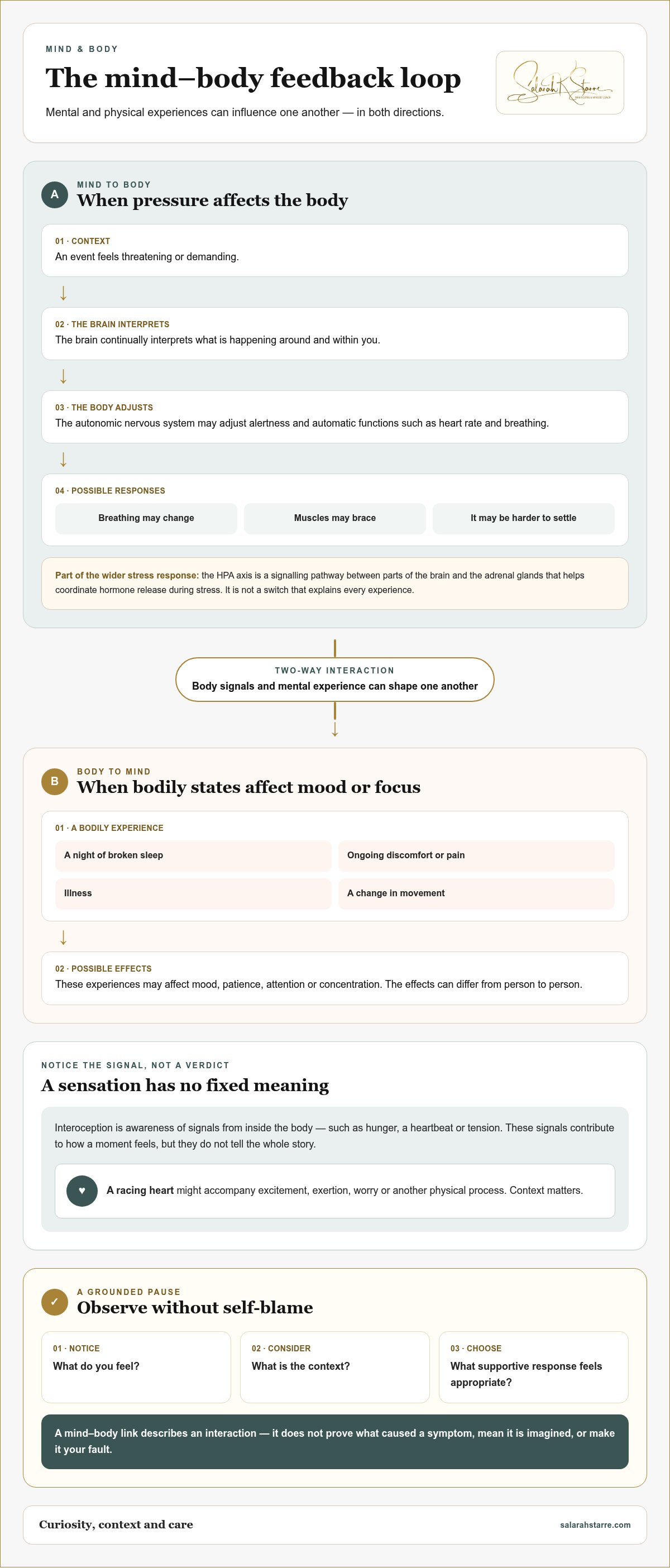
Your brain continually interprets what’s happening around you and within you. If an event feels threatening or demanding, the autonomic nervous system, which helps regulate automatic functions such as heart rate and breathing, may adjust the body’s level of alertness. You might breathe more quickly, feel your muscles brace or find it harder to settle. These responses can occur under stress, but stress doesn’t explain every physical symptom.
The body’s stress response also involves the hypothalamic-pituitary-adrenal (HPA) axis. In simple terms, this is a signalling pathway between parts of the brain and the adrenal glands that helps coordinate hormone release during stress. It’s one part of a wider response, not a switch that explains every experience. A reference on the HPA axis can help clarify this pathway.
How bodily states can influence thoughts and feelings
Influence also travels in the other direction. A night of broken sleep may leave you less focused; ongoing discomfort can make it harder to concentrate or feel patient. Illness and changes in movement can affect mood and attention, too. For example, structured exercise at facilities like gymngo.co.uk often highlights how staying active can lift mental fatigue and support clearer thinking. These are possible effects, not a rule that applies to everyone.
Interoception means awareness of signals from inside the body, such as hunger, a heartbeat or tension. Those signals contribute to how you experience a moment, but they don’t carry a fixed emotional meaning. A racing heart, for example, might accompany excitement, exertion, worry or another physical process. Context matters.
So, what is the mind body connection in action? It’s a feedback loop: brain and body exchange information, and the pattern depends on the circumstances. You can build personal-growth awareness by reflecting on how your own thoughts, feelings and physical states interact. Explore a reflective personal-growth approach with Salarah K Starre as one way to deepen that inquiry, without treating reflection as medical assessment.
Mind-Body Connection Myths: What It Does Not Prove
A mind-body link doesn’t mean symptoms are imagined, exaggerated or your fault. Pain, nausea, fatigue and a racing heart are real experiences, whether or not stress or emotion is also involved. Recognising an interaction can add context; it can’t, on its own, identify a cause.
Mind-body interaction can matter without explaining every symptom or condition. A physical experience may involve biological, psychological and social factors at once, and the balance can differ between people and situations. Stress may influence how someone feels, but noticing stress alongside a symptom doesn’t establish that stress caused it.
Does the mind-body connection mean symptoms are all in your head?
No. “All in your head” is a dismissive phrase, not a careful explanation. Stress can involve changes in bodily responses, and physical discomfort can affect mood or attention, but neither observation rules out other explanations. A symptom can be real and still have more than one contributing factor.
Be cautious about using self-help ideas to explain away symptoms that are persistent, severe or changing. Reflection may help you notice patterns, but it isn’t a way to diagnose yourself. If you’re concerned about a symptom, seek appropriate medical advice rather than assuming it is emotional or spiritual in origin.
What is the difference between evidence and interpretation?
Some general mechanisms are studied in physiology and medicine. For example, the body has stress-response systems that can affect functions such as alertness and breathing. That broad finding doesn’t prove that a particular symptom is stress-related, nor that a specific emotional event caused an illness. Individual assessment and other possible causes matter.
Personal-growth and spiritual frameworks may use language such as “energetic alignment” to describe how someone understands their inner life. That can be meaningful as a personal perspective, but it isn’t the same as an established medical explanation. Keep the distinction clear: an interpretation can invite reflection without proving what is happening in the body. A related overview of mind-body ideas can be read as a perspective, not a personal diagnosis.
So, what is the mind body connection when evidence and interpretation are kept distinct? It’s a way to recognise that mental and physical processes may interact, while resisting the leap from “these things occurred together” to “this one caused that one”. Stay curious, not certain, and don’t turn awareness into blame.
How to Notice Your Own Mind-Body Patterns Without Self-Blame
Awareness isn’t about searching for a hidden emotional cause. It’s about noticing what’s happening, separating observation from interpretation, and choosing a response that feels supportive. Keep it simple: you’re gathering information, not putting yourself on trial.
A simple check-in for thoughts, feelings and physical sensations
Try this brief sequence when you notice a change in how you feel:
- Pause. Take a moment to notice the present, without demanding that you feel different.
- Notice sensations. Name what you can observe, such as tight shoulders, a fluttering stomach or tiredness.
- Name the context. What was happening? What thoughts or emotions were present? Keep these as separate observations.
- Choose a supportive response. You might sit somewhere quieter, take a comfortable breath or try gentle movement if that feels right.
If it helps, make a short note with the situation, emotion and physical sensation. For example: “After a busy commute, I felt tense and noticed my jaw was clenched.” That records what you experienced; it doesn’t claim the commute was the only cause.
Look for patterns over time, not proof in a single moment. Similar events can coincide without one causing the other, and the same situation may affect you differently on another day. Keep reflection brief. If focusing on sensations or writing things down increases distress, stop and shift your attention to something grounding around you.
When self-reflection is not enough
Breathing, movement and reflection may support everyday awareness, but they don’t replace healthcare or establish what a symptom means. Seek medical advice for physical symptoms that are new, persistent, worsening or worrying. Don’t dismiss them as stress or assume you need to uncover an emotional explanation.
If there’s immediate danger, call 999 or go to A&E. For urgent health concerns in England, NHS 111 can help direct you to appropriate support. If you’re elsewhere in the UK, use the relevant NHS 111 service or local urgent-care guidance.
Curiosity can be powerful when it stays grounded. If you’d like support exploring personal patterns as part of your growth, explore one-to-one coaching. Coaching can support reflection, but it doesn’t diagnose or treat health conditions.
Using Mind-Body Awareness for Deeper Personal Growth
Understanding what is the mind body connection can be more than a way to make sense of a moment. It can help you notice how familiar situations, emotions and habits shape your responses over time. The aim isn’t to control every bodily state or decode each sensation. It’s to recognise what you’re experiencing, then reflect on what matters to you and how you want to respond.
How nervous system awareness can support self-understanding
Nervous system awareness, in this personal-growth context, means paying attention to shifts in your state, such as feeling more alert, withdrawn or settled. Notice them without treating them as proof of a particular cause. A tight chest, for instance, may be a cue to pause and check in, not evidence of a hidden emotional truth. Your body offers information; it doesn’t provide a complete explanation.
This kind of noticing can create space between an automatic reaction and your next choice. You might ask: What was happening? What did I feel? What response would support me now? For a related exploration of body awareness, see the nervous system and manifestation guide. Here, the focus is on self-understanding, not on treating bodily signals as instructions or guarantees.
How hidden patterns may shape repeated responses
Some reactions feel familiar before you’ve had time to think them through. Reflection can help you explore whether a habit, belief or unmet need might be part of that pattern. Shadow work is one personal-growth lens for examining aspects of yourself or your responses that you may usually avoid or overlook. It’s an invitation to ask thoughtful questions, not a clinical diagnosis or treatment. A repeated response doesn’t prove a specific past cause.
You could begin with a gentle prompt: “What might I be protecting, expecting or needing in this situation?” Let any answer remain a possibility, not a fact you have to force. For another perspective, read the shadow work guide to self-sabotage.
It’s useful to keep different kinds of explanation distinct. Physiology describes bodily processes; language such as energetic alignment belongs to a broader personal-growth or spiritual framework. One may help explain how the body responds, while the other may offer a way to reflect on meaning. Neither should be used to diagnose a health condition.
If you’d like a supported space to explore recurring responses and personal goals, one-to-one coaching, The Magnetic Recalibration or a deep healing programme may help you reflect on subconscious patterns and build self-trust. Choose reflection at your own pace, with curiosity rather than pressure.
Take the Next Step with Greater Awareness
So, what is the mind body connection? It’s a two-way interaction between mental and physical processes, not proof that thoughts cause every symptom. Paying attention to your own responses can reveal useful patterns, provided you stay curious, avoid self-blame and seek medical advice for concerning symptoms.
That awareness can also become a starting point for personal growth. Reflection may help you explore how habits, emotions and subconscious patterns influence the way you respond, without assuming one explanation fits every experience.
Salarah K Starre brings nearly two decades of experience in mindset and transformational work. A bestselling author and podcast host, she incorporates subconscious patterns, shadow work and nervous system awareness into her coaching and programmes as personal-development approaches, not medical treatment.
If you’re ready to explore your next steps, discover Salarah K Starre’s approach to personal transformation. Begin with curiosity, honour your own experience and let awareness guide you forward.
Frequently Asked Questions
What is the mind-body connection?
The mind-body connection describes how mental processes and bodily systems can influence one another. Stress may be accompanied by changes in breathing or muscle tension, while pain, fatigue or poor sleep may affect mood and concentration. These interactions vary between people and situations. The connection is a broad way to understand mind and body working together, not a diagnosis or proof that thoughts cause every physical symptom.
Is the mind-body connection scientifically proven?
Research supports many interactions between brain activity, emotions and bodily systems, including stress responses and awareness of internal sensations. But “the mind-body connection” covers a broad range of ideas, and not every claim made under that label has equal evidence. It’s useful to distinguish studied physiological processes from wider spiritual or personal-growth interpretations, and not to treat a general explanation as a diagnosis of an individual symptom.
Can stress cause physical symptoms?
Stress can be associated with physical responses, such as muscle tension, changes in breathing or stomach discomfort. These sensations are real, but stress is only one possible influence and cannot, by itself, explain or diagnose a symptom. If a physical change is new, persistent, severe or worrying, seek appropriate medical advice rather than assuming it’s simply emotional. Noticing a possible pattern can be useful without deciding its cause.
How does the nervous system connect the mind and body?
The nervous system carries information between the brain and the rest of the body, helping coordinate responses to internal signals and events around you. If a situation is perceived as threatening, for example, alertness or bodily readiness may change. Responses depend on context and individual factors. The nervous system is part of a complex network, so one sensation doesn’t have a single, guaranteed psychological meaning.
Can emotions affect physical health?
Emotions can accompany changes in the body, and ongoing stress may influence physiological responses and behaviour. The relationship also works in the other direction: physical health, sleep and environment can affect emotional wellbeing. Emotions don’t make you responsible for an illness, and interpreting feelings can’t replace appropriate assessment. Use awareness to notice possible patterns, not to assign blame or decide what’s causing a health concern.
What is interoception, and how does it relate to the mind-body connection?
Interoception is the process of sensing and interpreting signals from within the body, such as heartbeat, temperature or hunger. These signals can contribute to how a moment feels, but their meaning isn’t always obvious. A bodily sensation alone can’t reliably identify a medical condition or reveal a specific emotional cause. Interoception is one part of the broader interaction between mental experience and physical processes.
Can breathing or mindfulness improve the mind-body connection?
Gentle breathing or mindfulness can help some people pay attention to present-moment sensations and responses. These practices may support awareness or relaxation, but they don’t work the same way for everyone and aren’t guaranteed to help. Similarly, wellness spaces such as City Cave Carnegie provide sensory deprivation environments that many people turn to for calming the nervous system and encouraging deep physical relaxation. Keep breathing comfortable, avoid forcing a technique, and stop if it increases distress. These practices aren’t a substitute for suitable healthcare advice about physical or mental health concerns.


